Thursday, September 3, 2009

Chronological snobbery

I've been learning about the "emerging conversation" for a little while now, and I have to say every once in a while I just get the feeling like these guys are losing touch with reality.

You see, I go onto the Emergent Village web site because I'm a young 20-something in grad school with a particular bent toward intellectual and theological conversation. This is not normal for someone my age, or for anyone, really. But it's nice for guys like me to have an outlet.

And yet some are convinced that "Emergent" Christianity is going to be the next big thing. Just take a look at the video here. Also read what Phyllis Tickle writes in her post entitled, "The 18 Month Window":
In general, short-range predictions are fairly dangerous things. Like loose boards on an aging country porch, they tend to fly up and hit one in the face. I try to avoid them for that very reason. On the other hand, sometimes something is not only compellingly obvious in and of itself, but so too is the need for its telling. Whether I am accurate in my observations or not remains to be seen … very soon, in this case … but the possibility of error does not eliminate the obligation to speak the truth as one sees it, any more than it defuses the urgency.
This truth, as she sees it, which she feels is so urgent to express, is that churches are going to have to decide within the next 18 months whether or not they're going to be "Emergent" or not. Whatever that means.

I'm just really confused. Somehow this thing that almost no one I know in my non-Web-based life even knows or cares about is going to be the thing that transforms Christendom in the next... 18 months? ?? ? ? ? ?

I am just totally bewildered by it all. Hey, I just wanted to be part of the conversation, you know? I have questions, and I think lots of us have questions. Why is it that every movement that starts by having questions ends up thinking that they're so all-important?

Emergent types tend to have a lot of amazing theological points to talk about, and I'm really grateful for that. That's kept me thinking about things a lot this summer. Why, then, why would these folks go and set themselves up to be something that they're not? Just be a source for necessary conversation, and leave the pretension alone.

One commenter had a brilliant phrase to describe this pretension: "chronological snobbery." We all want to be at the most crucial moment in history. I guess there are both good and bad desires buried inside that.

On the one hand, we all have this desire to see the promised land we long for. On the other hand, we all want it to be now because we're thinking mostly about ourselves--our questions, our problems, and our brilliant solutions.

I'm sure this applies to the current political climate just as much as to religion.

I wonder what life could be like if I just lived every day as if no one will ever remember me. Maybe I could just do good for the sake of doing good, and not for the sake of being some super-important part of the narrative of the cosmos.

And who knows? Maybe someone would remember me, just not anyone super-important. And someone else would remember them, also not very important. And so on. None of us would be very important, but we'd all be part of something.

That something wouldn't take place at one crucial time in history, but it might just change the world. Or if it didn't, at least we each did something good.

There has to be meaning in that.

Monday, August 31, 2009

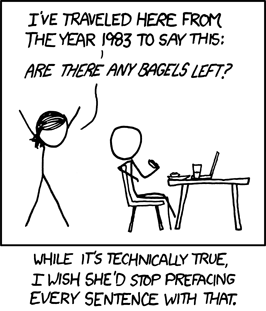
You're older than you've ever been...

XKCD has been on a roll lately.


Today's panel reminded me of a song by They Might Be Giants...

This particular performance was done in Charlottesville!

Sunday, August 30, 2009

Just as I am

Hear my words, you wise men,
and give ear to me, you who know;
for the ear tests words
as the palate tastes food.
Let us choose what is right;
let us determine among ourselves what is good.
Job 34:2-4

This morning the sermon I heard was a classic Presbyterian sermon on how we have nothing in ourselves to bring before God.

Actually, it was a very good exposition of Matthew 5:3, "Blessed are the poor in spirit." It was fully contextualized in the framework of Matthew's kingdom pronouncement, and some common misunderstandings of the verse were corrected.

Even so, this idea that we have nothing to bring before God seemed to be the main point. I don't necessarily have any problem with this idea on one level. I have certainly learned my own limitations as a human being. I don't pretend I've earned anything from God.

Christianity seems built on certain paradoxes surrounding this idea that we don't have anything in ourselves, and yet we are valuable beyond measure. In the case of evangelicalism, though, I tend to find a somewhat cruel paradox.

We sang the song "Just As I Am," which is a song built entirely on this idea of bringing nothing before God, wholly relying on His mercy. And then there's this curious verse in the middle:
Just as I am Thou wilt receive
Wilt welcome, pardon, cleanse, relieve
Because Thy promise I believe
O Lamb of God, I come...
"Because Thy promise I believe." That really sounds like bringing something to God. There's a paradox here. We are told that we bring nothing before God, and that we need to recognize this fact. But is not the recognition of this fact actually something we bring before God?

What about those who bring nothing--not even faith!--before God? Wouldn't these people be the ultimate beneficiaries of God's pure grace? Yet, paradoxically, Christians say one must have faith, or else God won't save.

Maybe it's just the scientific materialist in me, but I always think of belief as a physical property of a person. Like anything else a person has, it really is a function of chemical compounds interacting in very powerful and intricate ways. So when I hear that nothing is necessary but belief in Jesus, I think, what an obscure physical trait to expect of people.

But I don't think you have to think like me to see what I'm getting at. I started this post with a quote from Job that makes me think, you know, expecting a person to believe something really is a lot like expecting them to have a particular taste in food. It's not entirely up to them, is it?

Such a comparison will naturally lead people to cry, "relativism!" and the like. But really, taste in food isn't completely random or up to the individual. We grow up in a certain culture that tends to eat certain food. Chances are your tastes in food will be related to those trends.

But you can always try new food, and you can learn to like a lot of it. Your tastes can change the more you experience. Still, a lot depends on your own taste buds, which you had no part in determining.

Aren't truth claims pretty similar? Can anyone explain exactly what makes anything convincing? Scientists give "proofs" and Christians give "testimonies," and those are all great, but what if your taste buds just haven't shifted, so to speak?

I suppose conversion is usually described in terms of "taste buds" changing--I was blind but now I see, and the like. Calvinism is consistent, after all: even the faith that saves you is not from you, but a gift of God. "Nothing in my hands I bring."

But why in the world would that be limited to any group of people? If one person can be healed from his blindness, why not all people? Why not right now?

In the end, whatever reasons people give for believing something aren't going to satisfy everyone. I say this just as much for science or mathematics as for religion. (Why not? It's the same thing, really.)

The only catch is that some claims are more intense than others. Maybe science makes truth claims about our changing climate and what we should do about it. Okay, well, meanwhile religion is making truth claims about eternal salvation and damnation.

Some would say that if you don't believe a certain truth claim, you're damned for all eternity. What's fascinating is that in our society, many people take this claim and, instead of being scared by it into humble acceptance, actually use it to make a moral argument against believing the claim. This claim becomes morally self-defeating. Interesting.

To be honest, I think there's something healthy about that. To me it doesn't scream "relativism" at all. Rather, it suggests that deep down we all believe that truth and goodness belong together. If the truth isn't good, then what's the point?

Doubtless someone will say that the truth can't just be whatever you want it to be, but I disagree. If you learn to want life to be what it is, then life is what you want it to be. There's always this combination of discovery and self-transformation that has to take place.

So we're back to square one, aren't we? How do we have the faintest clue which is better: to learn to love the food in front of you, or to order up a new dish?

I never said I had any answers.

Friday, August 28, 2009

Mr. Potter's changed ways

I'm not afraid to admit when I might be wrong, and health care is one issue where I might be wrong.

This morning I read an op-ed about Wendell Potter, a former health insurance executive who is now testifying concerning the need for health care reform.

(I love that his name is Potter--it makes me think of the mean old man in It's a Wonderful Life.)

Stories like these about the health insurance industry should not go unnoticed:

Mr. Potter says he liked his colleagues and bosses in the insurance industry, and respected them. They are not evil. But he adds that they are removed from the consequences of their decisions, as he was, and are obsessed with sustaining the company’s stock price — which means paying fewer medical bills.

One way to do that is to deny requests for expensive procedures. A second is “rescission” — seizing upon a technicality to cancel the policy of someone who has been paying premiums and finally gets cancer or some other expensive disease. A Congressional investigation into rescission found that three insurers, including Blue Cross of California, used this technique to cancel more than 20,000 policies over five years, saving the companies $300 million in claims.

...

Mr. Potter notes that a third tactic is for insurers to raise premiums for a small business astronomically after an employee is found to have an illness that will be very expensive to treat. That forces the business to drop coverage for all its employees or go elsewhere.

All this is monstrous, and it negates the entire point of insurance, which is to spread risk.

The emphasis in the last paragraph is mine. For some reason that sentence triggered a suspicion in me that perhaps there are theoretical problems with the system as we have it.

Perfect competition in free markets depend on perfect information. Such a thing does not exist in the real world, so competition is never perfect, but the worse your information is, the worse your competition is.

In the case of health insurance, the information available is very bad for more reasons than I had realized. For one thing, insurance companies will look for any kind of loophole they can, and this creates huge uncertainties for a customer--you never know when you'll be dropped just when you actually need coverage.

I was already aware of this problem, and I do believe that it is the responsibility of government to do something about this. Laws are required to keep the market functioning, laws that make sure contracts between individuals are carried out faithfully.

But there's another problem, I realized, and it's a theoretical problem having to do with the nature of insurance. The problem is that insurance companies can defy some of the basic laws of competitive markets. Here's why I think so.

You don't need insurance now; you may or may not need it later, but you buy it just in case, to minimize risk. This means plenty of customers will probably go years without ever having a complaint about their insurance, because they never come into dire straits.

Now consider the 20,000 people in the story above who lost their insurance just when they needed it most. That's a lot of people who experienced a grave injustice--but relatively speaking, these cases don't happen that often to that many people.

That word relatively is critical. What it means is that insurance companies can save huge amounts of money by offering what is more or less an inferior product--except that they can count on a majority of their customers finding it acceptable a majority of the time.

So it's possible to see, in theory, why competition wouldn't solve this problem. Another company might come along and say to the customers who go screwed over, "Buy from us, and this will never happen to you." But there are two huge problems:
  • one, the damage has already been done, in the sense that customers have already paid lots of money into a plan that they now no longer have, and
  • two, because these unfortunate customers are relatively few (though not actually few--each of these lives matter) it's possible that it's not profitable for competing insurance companies to pick them up.
If you're a competing insurance company seeking to profit from another company's bad business, you have to win over a lot more customers than just the screwed-over customers, and that requires overcoming the problem of limited information.

It's probably just more efficient for all health insurance companies to adopt the same business practices as their competitors. But efficiency for health insurance companies is not what we really want; we want a system that's efficient for consumers.

I can't think of any great solutions. Having a public option seems like an inefficient allocation of resources, but what we have now is already enormously inefficient. I can't think of another feasible way to solve the problem.

My issues with the current proposed plan are much deeper than whether or not they violate market principles, so at this point I'm still not a fan. But who knows? Maybe some good will come out of this, after all.

Wednesday, August 26, 2009

Oh, the dichotomy...

Apparently the Myers-Briggs test is now all the rage on Facebook, reducing the once esteemed psychological survey to a time waster for people to post on their profile pages.

Okay, so naturally I just had to take it and post it on my wall. Hey, if you can't beat 'em, join 'em.

Anyway, some of the questions are just so frustrating, because they just separate things that should remain together. For instance, the classic example: "Mercy, or Justice?"

Oh, for crying out loud! We all want both, don't we? At least Jesus did. In a sense, don't you think it's unhealthy to ask someone to choose?

But there was another question that kind of bothered me, and it was, "Do you prefer practical solutions or creative ideas?" As a mathematician, I have to say, that's a complete toss-up.

I'd say creativity and practicality are impossible to separate in mathematics. A creative idea often is the most practical solution to a problem. A professor once said to me, "Five minutes of contemplation can save an hour of computation."

That sounds pretty practical, no? But it also means you have to let yourself be creative before you start plowing through pages of calculations.

Anyway, yeah, sure, the Myers-Briggs personality test is really useful. All I'm saying is that sometimes we put too fine a line where there shouldn't be one.

Tuesday, August 25, 2009

Of evolution and the created order

This op-ed I just read by Robert Wright reminded me that while I seek to have a faith in God that is compatible with modern science, there are certain compromises that leave me empty.
At first I had hopes that this article would bring something exciting to the table. What drew me in was this line:
Oddly, an underestimation of natural selection’s creative power clouds the vision not just of the intensely religious but also of the militantly atheistic.

But then I realized that all this "creative power" amounts to for Wright is that of Spinoza's clock-maker:
The first step toward this more modern theology is for them to bite the bullet and accept that God did his work remotely — that his role in the creative process ended when he unleashed the algorithm of natural selection...
Unfortunately, this theology is not at all new. It's just Deism, straight out of the Enlightenment. This might be an appealing religion for some people, but it's not Christianity--it's not a story about a God who comes into the world to redeem it and make all things new.

In the end, though, the punchline of the article was just another statement of hopeful modernism:
A more evolved religion could do what religion has often done in the past: use an awe-inspiring story to foster social cohesion — except this time on a global scale.
Something inside me trembles when I hear the words "social cohesion." Doesn't anybody read Brave New World and get freaked out? Human beings do not become what they're supposed to be simply by living "cohesively" with one another.

I just think a part of being human is seeking for something that doesn't make sense, that is so Other that it can only be called holy, or perhaps awesome, terrifying, bizarre, absurd, or mystical.

People will beat themselves, starve themselves, pray day and night to find it; they'll use drugs, or experiment sexually; they'll go to concerts to be blown away by music of all kinds, or they'll create art ranging from absurdly beautiful to absurdly depressing; they'll go to church to get an emotional high from music and preaching; they'll read any book they can get their hands on, searching for deeper ideas; sometimes they'll just sit alone in their room contemplating.

All of these hope desperately to find that there's something beyond the curtain of reality. I just can't stand any system of thought that makes this aspect of humanity out to be an unfortunate byproduct of our evolution. Harmony is good, but all great music has dissonance. To paraphrase Einstein, God does not play the same four chords with the universe.

Wright's article ends with this:
William James said that religious belief is “the belief that there is an unseen order, and that our supreme good lies in harmoniously adjusting ourselves thereto.”
I just don't agree. I am compelled by my religious faith to believe not merely in unseen order, but in unseen fury, the kind that can so easily be caricatured into this quaint little image of a God distributing people into heaven and hell.

The kind of fury I'm talking about is evident in that utter speechlessness that you experience on the edge of reason, when you finally realize that what you really want in life is far too big for you to handle. It's evident in Jesus of Nazareth, who in his wrath died on a cross for his people.

A lot of people don't seem to experience this, and so much the worse for them. They will probably be swept up in the tide of whatever system that comes around to ensure them harmony with the "unseen order" that today's intellectuals want to imagine for them.

As for me, I don't think Jesus asks us to simply harmonize with some invisible order. I think he asks us rather to tremble at the fury of the kingdom of heaven, a fury so incomprehensible that violence does not fully describe its power.

Maybe after all what I want is not so much a vision of God that harmonizes with science, so much as a vision of Him that renders all opinions on the matter irrelevant.

Tautological Statistics

I found this Gallup poll interesting:
Parents Rate Schools Much Higher Than Do Americans Overall

Parents Rate Schools Much Higher Than Do Americans Overall
Little change in recent years
by Frank Newport

PRINCETON, NJ -- Three in four American parents (76%) are satisfied with the education their children receive in school, compared to 45% of the general public who are satisfied with the state of schools nationwide. These findings from Gallup's annual Work and Education survey are almost identical to what Gallup found last year, and have not changed materially since 2003.

I just wanted to point out that it is mathematically guaranteed that more parents would be satisfied with their own children's education than with education as a whole, given the following fairly reasonable axiom:
Axiom. A parent who is dissatisfied with his own child's education is also dissatisfied with education as a whole.

Now it is not hard to prove the claim I just made:
Proof: Let S be the set of all parents satisfied with education as a whole, and let P be the set of all parents who are satisfied with their own children's education. By the contra positive of the above axiom, S is a subset of P. Therefore, it follows that the size of S is less than the size of P.
QED

In other words, often there's simply nothing remarkable about statistics. A little common sense (or deductive logic) will tell you what you wanted to know without doing any surveys.

On the other hand, what the survey really tells us is that nothing big government programs have done in the past several years has made any difference in results in our education system. That should have been the headline of the article.