I was hanging out with other math graduate students last night, having dinner and a beer before going to a Live Arts presentation featuring experimental computer-generated music.
Socializing with grad students is an eclectic combination of typical small-talk, pseudo-intellectual babble, and pure nerdiness. Amidst the pseudo-intellectual babble, religion is often a topic of interest.
One of my friends said something that I've heard enough times to trigger quite a number of thoughts on it: When faced with the question of whether there is any reason for living our lives, especially in any sort of moral way, it is "natural" to look to (or create) religion for answers.
I don't know what struggles this particular friend has with these questions, but I've noticed that in general this kind of statement is used to explain religion away. The implication can either be patronizing (as in, "Oh, well, it's fine that you believe that... it's perfectly natural") or condescending (as in, "How can you still believe that in this enlightened age?").
But the obvious question is, what else should one turn to? It sometimes seems like a blasphemous question in the academy, the church of secularism. I wondered aloud what would become of society if most of the world started to believe there really is no transcendent meaning to the world.
As if annoyed, my friends responded that the world has gotten on for a long time already, and it would surely continue on the way it is. This statement is highly presumptuous, and then again it is also rather depressing.
Presumptuous, because to say such a thing is to utterly fail to acknowledge the achievements of religious worldviews. For instance, to act as if the Christian way of thinking had nothing to do with the achievements of the Western world is, I dare say, shockingly stupid, though many people who act this way are not stupid.
Depressing, because it implies that not only is there no meaning, but there really has never been. The things we have accomplished as human beings have only come about because we wanted to do something with our little blips of existence in this meaningless universe. Under this philosophy, we humans would continue to do that even if we didn't believe in God or anything else, because we just can't help it.
In light of how depressing this idea is, I suppose religion is "natural." But I was musing on that word for a while, and I realized that there are really at least two senses in which we use it.
One use of the word "natural" is when we're saying something is easy, or obvious, as in, "It's only natural that he would think only of himself." It's the way we are when we're not trying very hard. Thus my drum line coach in high school used to yell at us, "Don't just do whatever feels natural! Do it right!"
On the other hand, we sometimes use "natural" in a more positive sense to mean that something feels right. When I started doing mathematics as a young child, it felt natural to me. For others, this could've been used in the first sense, meaning it came easily to me. But for me, it was more than that. I worked hard at math because it felt right.
You don't get good at anything just by taking it easy. You have to do more than what comes "naturally" to you. That's the first sense of the word. But surely when you find something you love to work hard at doing, it feels "natural" to you. You feel you are in your element.
In this way, I think at least a few of the world's religion could be considered quite "natural," in the second sense of the word. They make sense. Once you carefully consider their deepest and most powerful teachings, you can see how someone might believe such an idea.
Christianity, Judaism, Islam, Hinduism, and Buddhism (for example) all have ideas that really make sense of the world. In that sense it is "natural" to turn to one of them for answers to questions about the meaning of life. It makes sense.
Atheism, on the other hand, doesn't seem natural to me at all. It doesn't feel right. Is there really no transcendent meaning? What is the point, then?
But in the first sense, atheism is very natural, in the sense that it really is the most obvious answer. Is there a God? Well, I can't really see one, so I guess not. This is a very "natural" answer.
I imagine atheists would be extremely divided about this statement. I have read many opinions (from atheists) that say much the same thing that I am saying. Atheism is the obvious answer, and it's only this irrational desire for the second kind of "natural" that leads us to develop religion.
But I imagine other atheists would be deeply frustrated with my evaluation of their beliefs. Many atheists have had to really struggle to come to the conclusions about life they now hold. Given the culture in which they live, it is often a battle to leave the faith of one's youth and embrace a life of not knowing if there's really any point to it all.
I certainly don't want to diminish that struggle; I take it seriously. Yet I wonder if atheists take seriously enough the way in which religion has created a way for society to pass on the virtue of struggling for one's beliefs. "Seek, and ye shall find."
Christianity, in particular, does not assume that it is the default belief. (Many atheists, on the other hand, claim that atheism is the default belief.) Even where it is culturally dominant, Christianity admits and even insists that it is not the "natural" thing to believe.
This is why Christianity says faith is so important. True, "faith" can become a tool that the powerful use to brainwash the weak; but in its purest form "faith" is simply a statement of belief in something that is not obvious, yet is extremely important if it's true.
What if we lived in a society where struggle for one's beliefs was not considered a virtue? Sure, atheists are typically known for struggling to seek out knowledge now, in the culture in which we find ourselves, but what if it were different? What if no one felt the slightest urge to believe something that wasn't immediately apparent to all people?
Science would utterly collapse, just as much as any religion. Indeed, science is a religion, from a certain point of view. Although it easily passes as the true universal, uniting people from all cultures and all faiths, it really isn't any such thing.
Anyone who does math or science goes through a process of initiation, in which knowledge is revealed through many, many stages. Scientific knowledge is not natural in the first sense--it is not obvious--but it is natural in the second sense, in that once you see all the evidence, it begins to feel very natural, even if it's surprising.
To me, the truly atheist worldview has nothing of this second kind of naturalness that both scientific and religious knowledge have. Atheism just doesn't explain why. Worse, it almost seems to discourage asking such questions. All we can really know, it seems, is what.
Of course, my friends may continue to disbelieve in religion because religion lacks evidence, but I think that by this they mean only a certain kind of evidence, which does not include those indescribable connections a believer has with God.
For me, knowledge of God must begin with the heart, and all reason must subordinate itself to the connection found there. Surely this connection is not admitted as evidence by everyone, and perhaps with good reason--whose heart are we to believe, after all?
That is why I hesitate to insist upon how much I really know about God. I will say I know Him, but my mind is very limited in expressing this. Faith is a matter of the heart, and it is not always natural in the first sense. Yet it is natural in the sense of being beautiful, the way it is meant to be.
Showing posts with label meaning. Show all posts
Showing posts with label meaning. Show all posts
Saturday, November 14, 2009


Monday, July 27, 2009
The Spirit of Mathematics
 This is going to be one of those posts that interests only me.
I was having a conversation at lunch today with a fellow graduate student about how to deal with this tension we have as mathematicians.
The tension is between the idea that our mathematical ideas are inevitable, and the possibility that they are all inventions, mere reflections of our own way of thinking.
I've blogged about this kind of thing before. There are all kinds of weird thought experiments that you could do if to make you think that hey, maybe there's nothing special about our approach. A jellyfish in a pure continuum would never use numbers to do math, right?
But hold on, not so fast. There's still a strong argument to be made that if you never forced any sort of discrete patterns on your perception of reality, you'd simply never have any mathematics.
I was thinking, okay, what's an example of when we need to measure continuous things, rather than discrete things?
Here's an example to make you think twice about how numbers work. Let's say I throw three marbles into an empty bucket, and you throw four into the same bucket. Now how many marbles are there in the bucket? Well, three plus four is seven, of course. Sure enough, if we empty the bucket and count the marbles, there will be seven. We could run this experiment over and over and we'd always get seven. Three and four just are seven.
But now let's do the same thing with, say, shoveling sand. I'll shovel in three loads of sand, and you shovel in four loads of sand. Now let's have someone else empty the bucket with a shovel. How many loads will it take? Seven? Perhaps. But I could see how it might only take six, or maybe it'll take eight. If we repeat this experiment, we might get different answers.
Sand is more continuous than marbles. Marbles are discrete--you count them, 1, 2, 3, 4, 5, and so on. With sand you just sort of guess--oh, that's about a shovel full. So would math have evolved the same way if we had to first deal with continuous things, rather than discrete?
Let's say a mathematician was hired in ancient Egypt to measure the rise and fall of the Nile throughout the year. The water level is a continuous thing, though. How would he describe the change over time? Maybe he'd draw a curve, instead of a numeral. Wouldn't that be perfectly legitimate?
 There's some art here. The mathematician wants to make something to reproduce the flow of what he's seeing, to somehow relate to it in a natural way. In a way, he's being more poet than scientist. Most mathematicians want to be poets on some level.
But there is a practical question to be addressed. Chances are he's supposed to be tracking the water levels so that the people can know when it will flood. That's a yes/no kind of question. We have to draw a line somewhere.
Once you begin to think in this binary manner, you enter the world of the discrete. You begin to think using Aristotle's "law of the excluded middle": you can't be both A and not A. The river is either flooding or it isn't.
Moreover, it's not hard to see how this idea of distinction can progress beyond just two possible states. Maybe instead of merely drawing a curve to represent the water levels, the mathematician will decide it's useful to draw lines in banks of the river, so he can say at different times of year which lines the water level has surpassed. This provides a good estimate--a discrete way to measure a continuous thing.
And the truth is, that's all it takes to get to the integers. Once you have a way of drawing some line of distinction between yes and no, why, then you have 1 and 0. And if you have 1 and 0, then how many choices do you have? You have 2, of course. And if you have 0, 1, and 2, then how many numbers have you invented? Why the answer is 3... Could we keep going with this? Why, I think we could!
Oh, I understand perfectly well that not every culture would think to come up with the integers this way, but that's not the point. The point is how easy it really is to go from the bare concept of distinction into the vast realm of mathematics that has been built up for millennia.
It seems like the Platonists always have a point, you know? Mathematics really does feel, in a mysterious way, like it's merely discovered. It's somehow emanating all around us in the universe, and somehow we're eventually able to tap into its secrets.
 The development of surprising things like non-Euclidean geometries doesn't seem to me to make a huge dent in this claim. Yes, in some sense we are merely "inventing" systems of axioms that we then proceed to work with. But the powerful and unexpected thing about mathematics is how such a tiny, bare concept can lead to such an extraordinarily large body of knowledge.
For instance, if my little thought experiment is of any value, then it seems like the bare idea of distinction gives birth to arithmetic, which gives birth to number theory. It's kind of unreal if you know anything about all the powerful theorems that exist in this area.
Yet even here, there is this desire to be poetic. It is not enough simply to be able to manipulate the world around us using the power of arithmetic. Mathematicians desire elegance and symmetry. Solving particular computations are not as interesting as proving results about all the numbers that have spun out of this strangely simple thought experiment.
I suppose there must always be this mysterious blend of two forces: the scientific and the artistic. The scientific force is the force of distinction; it categorizes and quantifies. The artistic force is the force of expression; it responds intuitively.
If we had no ability to draw distinction, how could we really know anything? We might be free to respond to the world, but we would never understand it. We would never even think of ourselves as ourselves--we would have no line between ourselves and the world, or between different things in the world.
And yet if we have no ability to respond intuitively, how could we really know anything? We might be able to categorize and quantify, but we would never care to. How can we learn about the world unless we are first swept away by its beauty? Occasionally mysticism must trump rationalism.
 When I do mathematics, I actually do experience a bit of both. The scientific force is easy for everyone else in the world to see, but for any real mathematician, the artistic is there to see, as well. And if I could describe what I mean, well, then it wouldn't be what I mean. But you can always take a look for yourself.
It all comes back to Trinity. Three in One, One in Three. In Threeness, God has quantity, distinctness, the scientific force. In Oneness, God Is Who He Is, unquantifiable, beautiful, to which we but respond, overwhelmed, because we cannot describe.
Yeah.
Sunday, February 8, 2009
The objective of objectivity
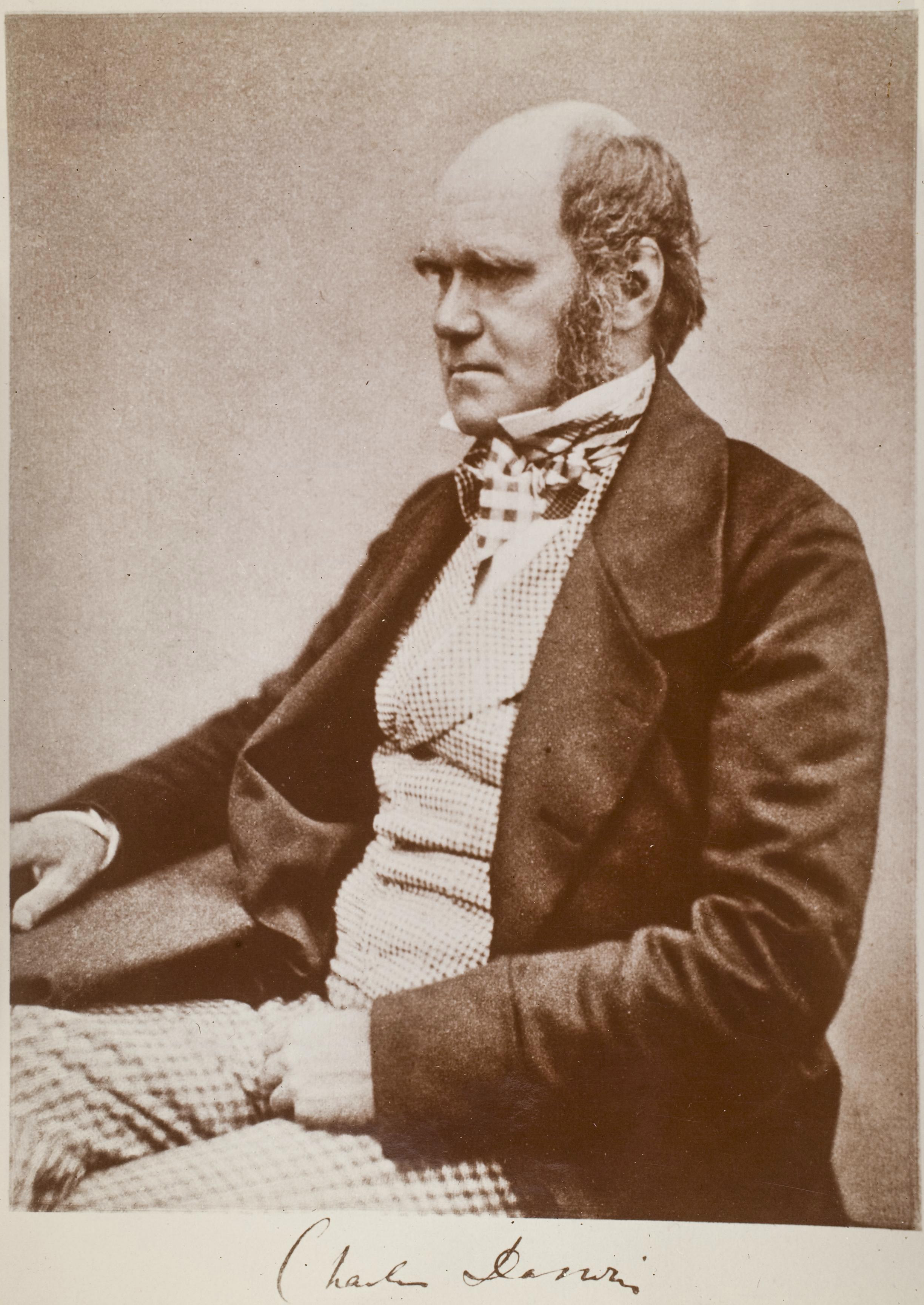 So I found an interesting new book in the New York Times "First Chapters" section, called Darwin's Sacred Cause. The basic thesis of the book is that Darwin's theory of evolution developed out of a complex process of very human thoughts about life, as opposed to simply sitting down to watch Finches one day and deciding animals evolved.
In particular, Darwin was a staunch abolitionist, which made the fact of common ancestry of all humans very important to him. Whereas his religious allies in the abolition movement used Adam, he used apes (to boil it down cartoonishly) establishing a common humanity between blacks and whites.
What this shows is that the notion of "purely objective science" is not very useful in the real world. There simply are no observers with no personal attachments to some kind of worldview. A completely detached, impartial judge of reality is a modernist myth, a hero that never existed.
Yet what we have, I believe, is something better. Scientists are and should be like Darwin--real human beings with real concerns about life other than purely mechanistic explanations of how things work. These explanations are key parts of how we see the world, but they are not the whole picture.
Incidentally, I also recently watched an episode of the Colbert Report featuring guest Jonah Lehrer, author of the new book How We Decide. The thesis of this book is that there are two parts of the brain involved in decision-making, which Lehrer calls the "rational" and the "emotional" parts. Good decision-making involves using both in healthy proportions.
 Let me quibble with the terminology here. I always think rational means "most in line with truth." Here it's not really being used that way, because, as Lehrer admits, those who think only using this part of the brain have incredible problems in the real world, such as being unable to make simple choices at a grocery store.
Indeed, his whole point is that to act in line with the truth, which I would call rationally, means to successfully combine the "emotional" or gut instincts with the more cognative, analytical side of thinking.
Even as a mathematician, I don't think it's possible to leave one side of your thinking at the door. Mathematics has everything to do with intuition, with mental "exploration" being the first real step in solving a problem. Hadamard would agree.
The prevailing modernist conception of objectivity needs to be a ltered. First, we can't step back from reality as observers and pretend we have no attachments to it. Second, we really wouldn't want to. Third, a very real possibility for objectivity still remains after giving up this version.
ltered. First, we can't step back from reality as observers and pretend we have no attachments to it. Second, we really wouldn't want to. Third, a very real possibility for objectivity still remains after giving up this version.Before explaining what the alternative is, let me point out where I think we go wrong in trying to define objectivity. We tend to think fair = impartial = detached. A fair judge is an impartial judge, which is a judge with no attachments to either party in a given case. That's the common sense of many centuries of tradition.
But we have to avoid thinking impartiality means zero attachment. In order to judge justly, a judge must care very deeply about something we all have in common, namely, our common value as human beings. A judge who doesn't think humans are worth anything has absolutely no reason to judge fairly, nor unfairly.
Thus a judge really ought to have a real attachment to both sides in a case. He ought to care equally for both sides, to see they get a fair trial. The goal is not detachment, but rather broader attachment.
I just think of all the debates in politics about issues like, say, poverty. We tend to imagine there are some who operate on emotion, saying, well, we just have to do something about it, and there are others who operate on cold hard reason, which tells them, no, we have to think about the costs.
I would argue that those who consider the costs are not emotionless (maybe in some cases they are, in which case they should not be trusted). Rather, those who consider the costs are mindful of all people equally--yes, they care for the poor, but they are equally concerned for others whose resources they would have to borrow/take in order to help the poor.
To show genuine concern for all people is to be truly rational when it comes to justice. And I would take that principle and apply it else where.
 where.
When we talk about objective science, we should not mean science done by robotic people with no attachments. Rather, we should mean people who are willing to stretch their attachments based on the principle that the understanding of physical reality is important.
Much as people would like to make scientific discovery entirely about finding the means to be more efficient with tasks we already want to do, most science is simply not about that. Technological applications are wonderful, but they are often propelled forward by discoveries that initially have no preconceived application. Science is done for the love of understanding.
I think love really is at the heart of everything, especially knowledge. We can't know something without loving it (conversely, we can't really love something unless we know it).
Where do we find any reason to love the physical world? Isn't it just full of mostly lifeless matter, most of which is useless to us and much of which is dangerous? A cynical pragmatist might say we study science simply to master such dangers, so we don't have to be afraid of the physical world.

But I think that we can find meaning in the physical world. Operating under the principle of divine creation, we see that there is more than just stuff to be described; there are meaningful things to be understood. In God science finds its integration point with other concerns of human existence, namely purpose, wisdom, and virtue.
If science can be done objectively, why not religion? I believe love will indeed take us to knowledge, not just of things but of the thing, the person, the God in whom all things hold together. The same objectivity principle applies--we must simply be committed to knowing the universal, rather than our own personal god.
It is only natural that love is a basis for understanding if a personal, knowable God is at the heart of all reality.
So why is any of this relevant? In our culture, being perceived as more objective than the next guy gives you more power. It makes sense that everyone, not only the scientific community but also in the media and in politics, would be scrambling for the title of "most objective."
All I'm saying is, here's a simple test of objectivity. Does this person love all people involved in a discussion? Is he willing to empathize with, and thus truly understand, each point of view? Is he willing to carefully and humbly offer up his own point of view as a possible corrective to faulty points of view?
Maybe this can shed light on some very heated discussions that take place in our culture. For love's sake, I hope it can.
Subscribe to:
Posts (Atom)