In following this account of the first three minutes [of the universe], the reader may feel that he can detect a note of scientific overconfidence. He might be right. However, I do not believe that scientific progress is always best advanced by keeping an altogether open mind. It is often necessary to forget one's doubts and to follow the consequences of one's assumptions wherever they may lead--the great thing is not to be free of theortical prejudices, but to have the right theoretical prejudices. And always, the test of any theoretical preconception is in where it leads. The standard model of the early universe has scored some successes, and it provides a coherent theoretical framework for future experimental programs. This does not mean that it is true, but it does mean that it deserves to be taken seriously.It certainly begs the question which prejudices are the right ones!
Showing posts with label science. Show all posts
Showing posts with label science. Show all posts
Sunday, June 5, 2016
Steven Weinberg on scientific progress
I'm a big fan of this passage from The First Three Minutes, Chapter V (emphasis added):


Thursday, May 14, 2015
A humble science
Mathematics is the lowest and humblest of all the sciences. It makes slow but steady progress, and it says little to nothing about the questions dearest to the hearts of human beings, but what it says is absolutely certain. What gives it such certainty? It is content to study objects which are wholly abstract, so that the relations between them are absolute, eternal, and necessary. The word abstract implies that they are drawn away from reality. In this way they are lifeless. Rather than exploring strange new worlds with their own vibrant existence, the mathematician is content to study lifeless forms which are absolutely transparent to the mind. Let the brave adventurers go off to study living creatures, the cosmos, and that most mysterious object of all, human pyschology. The mathematician will humbly work at understanding that which is already closer to home than anything can be--that is, close to the mind.
It would be a fatal mistake, then, to view mathematics as a lofty venture, towering over all the other sciences, for that is the opposite of the truth. Mathematics, like anyone who wishes to be great in God's kingdom, must be the servant of all. We happily live in a world which follows certain patterns, often not at all obvious, and the objects we encounter, though they have in some sense a life of their own, can be seen to follow abstract rules which can be studied at the level of theory. In this way the applications of mathematics are abundant, starting with the simplest of all objects (physics) and working our way up even to the most complex and spontaneous (biology, economics).
But it is a slippery slope from application to assimilation. The problem with much modern thought is the way it treats all objects as abstract, lifeless forms. What mathematics so useful and reliable is that it studies objects which have no independent existence and no context. To study living things--and particularly the human mind--in such a way would be (and often is) disastrous. Psychologists have noticed, for example, that searching for universal principles governing human thought by observing only Western, educated, industrialized, rich, democratic people is a flawed idea. Yet in observing that our methods do not lead to what we are searching for, rarely do we ask whether the search itself is misguided.
Why does modern thought push relentlessly toward that which is universal? I suspect the reason is as much moral as scientific. On the one hand, science seeks that which is universal because it gives us a deeper understanding of life as a whole, and that allows us to do the greatest amount of good. On the other hand, we would also find it unfair if our particular context really mattered. The universe should be, above all, fair, even if that implies it is meaningless. History must be random, because otherwise that would imply something special about the way things happen to be. We have concluded, after thoroughly deconstructing the moral pretentions of past generations, that there can be nothing special about our heritage, culture, or anything else passed down to us.
As an aside, I highly suspect this attitude explains why physicists have come up with the idea of a multiverse. If there really is one universe, with exactly one history, that means a practically infinite number of possibilities are shut off forever from all reality. That would mean all of reality is dependent on a particular context--it is no longer held captive by abstract concepts. Such a conclusion is intolerable in our intellectual climate.
The modern reaction against the Judeo-Christian tradition can be explained in these terms. If there is a God, its existence should be explicable in rational, abstract terms that do not depend on context--that is, mathematically. There is a long tradition of such proofs in Western tradition. But that is not what we find in the Bible. What we find there is a God who, though he is supposed to be the creator of all things, has attached himself to a particular people in the Middle East. "I Am Who I Am," God says, affirming his utterly transcendent identity, and then adds soon after, "the God of Abraham, Isaac, and Jacob." How can all of reality find its source in a God so particular? How could one petty group of people out in the middle of nowhere happened to have stumbled onto the source of life and hope for all humanity, and indeed all the universe?
As much as it offends our sensibilities, we ought to be able to understand this. Life is a serious of decisions and commitments, each of which cuts off others which were at one time possible. Once you say a word, it will be forever true that you said it. Once you are married, it will be forever true that you decided to marry. Once you go to your grave, whatever you have done with your life is all that you have done. There is no going back. Indeed, we might perhaps better understand this than our ancestors, since because of the Internet, nearly everything we say in public will be forever recorded somewhere in this vast ocean of data.
Is it really so impossible to believe that God himself would make such commitments, and that those commitments would be the basis of all reality? In fact I myself find it very hard. If at one time in human development it was natural to anthropomorphize God, today it seems difficult to think of God as anything other than an abstract concept.
Theology isn't the only thing at stake. It is not just the living God whom we try to kill with our abstract thinking. It is anything living. We moderns are increasingly detached from our own history, living in the dream that we can transcend history, which was random and arbitrary up to exactly our generation, and then build the future on abstract principles from here on. Naturally, we refuse to believe that this dream came from anywhere other than our own reason.
To be sure, looking at the abstract principles behind living realities is a good thing. It helps us to simplify problems and find solutions agreeable to everyone. It can even help us know better what we observe, so that we can appreciate it all the more. (I find this especially true of music, and I suspect it is true of art. For me, music theory makes great works come to life even more than they already do.)
The problem comes when we confuse abstract principles with true or ultimate reality. That is the path to self-destructive rationalism--it empties the world of all meaning, it jettisons history as a source of knowledge, and it risks degrading civilization itself, which is built on living traditions. No, reality is not a set of equations. It is a living, spontaneous, external universe which imposes its particularity on us. I say this not to denigrate my own field, but merely to put it in its rightful place as a loving servant of the real.
It would be a fatal mistake, then, to view mathematics as a lofty venture, towering over all the other sciences, for that is the opposite of the truth. Mathematics, like anyone who wishes to be great in God's kingdom, must be the servant of all. We happily live in a world which follows certain patterns, often not at all obvious, and the objects we encounter, though they have in some sense a life of their own, can be seen to follow abstract rules which can be studied at the level of theory. In this way the applications of mathematics are abundant, starting with the simplest of all objects (physics) and working our way up even to the most complex and spontaneous (biology, economics).
But it is a slippery slope from application to assimilation. The problem with much modern thought is the way it treats all objects as abstract, lifeless forms. What mathematics so useful and reliable is that it studies objects which have no independent existence and no context. To study living things--and particularly the human mind--in such a way would be (and often is) disastrous. Psychologists have noticed, for example, that searching for universal principles governing human thought by observing only Western, educated, industrialized, rich, democratic people is a flawed idea. Yet in observing that our methods do not lead to what we are searching for, rarely do we ask whether the search itself is misguided.
Why does modern thought push relentlessly toward that which is universal? I suspect the reason is as much moral as scientific. On the one hand, science seeks that which is universal because it gives us a deeper understanding of life as a whole, and that allows us to do the greatest amount of good. On the other hand, we would also find it unfair if our particular context really mattered. The universe should be, above all, fair, even if that implies it is meaningless. History must be random, because otherwise that would imply something special about the way things happen to be. We have concluded, after thoroughly deconstructing the moral pretentions of past generations, that there can be nothing special about our heritage, culture, or anything else passed down to us.
As an aside, I highly suspect this attitude explains why physicists have come up with the idea of a multiverse. If there really is one universe, with exactly one history, that means a practically infinite number of possibilities are shut off forever from all reality. That would mean all of reality is dependent on a particular context--it is no longer held captive by abstract concepts. Such a conclusion is intolerable in our intellectual climate.
The modern reaction against the Judeo-Christian tradition can be explained in these terms. If there is a God, its existence should be explicable in rational, abstract terms that do not depend on context--that is, mathematically. There is a long tradition of such proofs in Western tradition. But that is not what we find in the Bible. What we find there is a God who, though he is supposed to be the creator of all things, has attached himself to a particular people in the Middle East. "I Am Who I Am," God says, affirming his utterly transcendent identity, and then adds soon after, "the God of Abraham, Isaac, and Jacob." How can all of reality find its source in a God so particular? How could one petty group of people out in the middle of nowhere happened to have stumbled onto the source of life and hope for all humanity, and indeed all the universe?
As much as it offends our sensibilities, we ought to be able to understand this. Life is a serious of decisions and commitments, each of which cuts off others which were at one time possible. Once you say a word, it will be forever true that you said it. Once you are married, it will be forever true that you decided to marry. Once you go to your grave, whatever you have done with your life is all that you have done. There is no going back. Indeed, we might perhaps better understand this than our ancestors, since because of the Internet, nearly everything we say in public will be forever recorded somewhere in this vast ocean of data.
Is it really so impossible to believe that God himself would make such commitments, and that those commitments would be the basis of all reality? In fact I myself find it very hard. If at one time in human development it was natural to anthropomorphize God, today it seems difficult to think of God as anything other than an abstract concept.
Theology isn't the only thing at stake. It is not just the living God whom we try to kill with our abstract thinking. It is anything living. We moderns are increasingly detached from our own history, living in the dream that we can transcend history, which was random and arbitrary up to exactly our generation, and then build the future on abstract principles from here on. Naturally, we refuse to believe that this dream came from anywhere other than our own reason.
To be sure, looking at the abstract principles behind living realities is a good thing. It helps us to simplify problems and find solutions agreeable to everyone. It can even help us know better what we observe, so that we can appreciate it all the more. (I find this especially true of music, and I suspect it is true of art. For me, music theory makes great works come to life even more than they already do.)
The problem comes when we confuse abstract principles with true or ultimate reality. That is the path to self-destructive rationalism--it empties the world of all meaning, it jettisons history as a source of knowledge, and it risks degrading civilization itself, which is built on living traditions. No, reality is not a set of equations. It is a living, spontaneous, external universe which imposes its particularity on us. I say this not to denigrate my own field, but merely to put it in its rightful place as a loving servant of the real.
Friday, June 7, 2013
Historical and Theological Adam
Peter Leithart's argument on historical Adam confuses me. On the one hand, he subscribes to Pope John Paul II's distinction between "historical" and "theological" humanity. In order to understand Christian ethics, it is necessary to go back to the beginning:
Leithart gives theological arguments which suggest that if we give up on the historical reality of the creation of Adam, we will lose our theological and ethical foundation. This is problematic because it simply forbids us from asking any questions about the material reality of Adam. If we buy his argument, we accept the existence of Adam as recounted in the Bible because of the theological implications that come with it. Forget whether or not archaeology, biology, geology, or physics might have anything to say about the possible physical existence of such a human being, or the age of the earth, etc.
While I have never much appreciated the notion that theology and science are wholly separated spheres, the other extreme seems equally problematic. N. T. Wright's description of biblical cosmology has always stuck with me: it's the intersection of two worlds. Just as in C. S. Lewis's Narnia series there are two distinct worlds which intersect, so heaven and earth in the Bible appear to have such a relationship.
So what of historical Adam? Is it necessary that we accept this belief on theological grounds? Would it not be more appropriate to accept the existence of theological Adam?
The common objection from evangelical circles is that this is really a way to say Adam never existed in any real way. My response: this is a limited view of "real." If heaven is real, indeed if God is real, but is not perceptible by the methods of historical humanity--that is to say by the sciences and reason--I don't see why the same can't be true of Adam.
It's difficult to capture the distinction, here, but I'll try to do so with the Resurrection, the fundamental turning point for Christian theology. Christians historically believe that the Resurrection really happened--that is, Jesus physically, literally, really rose from the dead. But what we don't believe is that there is any scientific explanation for this. How could there be? Science insists on explaining things in terms of things we can control or observe repeatedly. We can't repeat the Resurrection. If it happened, it happened once and for all, and we hope it will happen to the rest of us some day. What can we say about it, then? Is there an explanation of the Resurrection? The most we can say is that the power to raise the dead came from heaven. This is inaccessible to us, but we believe it is there, and we believe we will have access to it again one day.
So with Adam, what analogy can one draw? Adam is inaccessible to the sciences. We can't see him with archaeology, we can't verify the historical records and find he is there. But we believe he was there, in the sense that we believe humanity was in a real sense created in the image of God. We don't have access to this. We believe that one day we will, but for now, all we have is the historical tools of historical humanity, which don't have access to theological Adam.
I am not suggesting the Bible is describing another world which has no relation to ours. But then I am suggesting that the Bible is not describing solely our world. If there really are two world which intersect (and sometimes collide?) then it should not be surprising of sometimes the Bible describes things which are simply inaccessible to any rational tools we have.
Whatever the appropriate response may be, I've found conservative evangelicals consistently failing in addressing this issue, because they always give me theological reasons to believe something historical, rather than theological reasons to believe something theological (or historical reasons to believe something historical). As someone who believes both science and theology are very important, I believe the distinction is worth making and then exploring.
Historical humanity is the humanity enslaved by sin, turned here and there by mixed motives, the humanity of domination and control, of objectification and shame. But the Bible begins with an account of a different form of human life, which John Paul labels the “theological,” according to which humanity is made in the image of God to be God’s covenant partner.On the other hand, having accepted this distinction between "historical" and "theological," Leithart goes on to assert that,
...And this theological form of humanity is still normative. Christians can’t stop at the boundary. We can’t concede that there is only “historical man” in all his evil and shame and abuse. We can’t really understand the career of historical man, John Paul says, without knowing that it is a deviation from the original state of man.
Unfortunately, Evangelicals appear eager to replicate the liberal error. Today, many, perhaps most, Evangelicals still believe that Adam was an actual man, but there is a growing body of opinion asserting the contrary.What does "actual" mean in this context? Does it mean ... historical?
Leithart gives theological arguments which suggest that if we give up on the historical reality of the creation of Adam, we will lose our theological and ethical foundation. This is problematic because it simply forbids us from asking any questions about the material reality of Adam. If we buy his argument, we accept the existence of Adam as recounted in the Bible because of the theological implications that come with it. Forget whether or not archaeology, biology, geology, or physics might have anything to say about the possible physical existence of such a human being, or the age of the earth, etc.
While I have never much appreciated the notion that theology and science are wholly separated spheres, the other extreme seems equally problematic. N. T. Wright's description of biblical cosmology has always stuck with me: it's the intersection of two worlds. Just as in C. S. Lewis's Narnia series there are two distinct worlds which intersect, so heaven and earth in the Bible appear to have such a relationship.
So what of historical Adam? Is it necessary that we accept this belief on theological grounds? Would it not be more appropriate to accept the existence of theological Adam?
The common objection from evangelical circles is that this is really a way to say Adam never existed in any real way. My response: this is a limited view of "real." If heaven is real, indeed if God is real, but is not perceptible by the methods of historical humanity--that is to say by the sciences and reason--I don't see why the same can't be true of Adam.
It's difficult to capture the distinction, here, but I'll try to do so with the Resurrection, the fundamental turning point for Christian theology. Christians historically believe that the Resurrection really happened--that is, Jesus physically, literally, really rose from the dead. But what we don't believe is that there is any scientific explanation for this. How could there be? Science insists on explaining things in terms of things we can control or observe repeatedly. We can't repeat the Resurrection. If it happened, it happened once and for all, and we hope it will happen to the rest of us some day. What can we say about it, then? Is there an explanation of the Resurrection? The most we can say is that the power to raise the dead came from heaven. This is inaccessible to us, but we believe it is there, and we believe we will have access to it again one day.
So with Adam, what analogy can one draw? Adam is inaccessible to the sciences. We can't see him with archaeology, we can't verify the historical records and find he is there. But we believe he was there, in the sense that we believe humanity was in a real sense created in the image of God. We don't have access to this. We believe that one day we will, but for now, all we have is the historical tools of historical humanity, which don't have access to theological Adam.
I am not suggesting the Bible is describing another world which has no relation to ours. But then I am suggesting that the Bible is not describing solely our world. If there really are two world which intersect (and sometimes collide?) then it should not be surprising of sometimes the Bible describes things which are simply inaccessible to any rational tools we have.
Whatever the appropriate response may be, I've found conservative evangelicals consistently failing in addressing this issue, because they always give me theological reasons to believe something historical, rather than theological reasons to believe something theological (or historical reasons to believe something historical). As someone who believes both science and theology are very important, I believe the distinction is worth making and then exploring.
Thursday, May 23, 2013
Another crisis for scientific objectivity?
The Heritage Foundation's recent report that immigration reform could cost the U.S. trillions of dollars resulted in a scandal for one Jason Richwine, who was forced to resign his position at the foundation due to the ensuing furor over the discovery of his 2009 dissertation. In his own words:
So what is actually in the dissertation? The dissertation shows that recent immigrants score lower than U.S.-born whites on many different types of IQ tests. Using statistical analysis, it suggests that the test-score differential is due primarily to a real cognitive gap rather than to culture or language bias. It analyzes how this cognitive gap could affect socioeconomic assimilation, and it concludes by exploring how IQ selection might be incorporated, as one factor among many, into immigration policy.Naturally, the word "racist" has been thrown around in response to this discovery, and the word "racist" tends to immediately discredit the views of one to whom it is applied with sufficient vigor. Richwine would therefore have you believe that this is a big cultural mistake. In particular, it portends a disastrous future in which scientific facts are ignored due to political correctness:
The furor will soon pass. Mercifully, the media are starting to forget about me. But a certain amount of long-term damage to political discourse has been done. Every researcher who writes on public policy over the next few years will have a fresh and vivid memory of how easy it is to get in trouble with the media’s thought police, and how easy it is to become an instant pariah. Researchers will feel even more compelled to suppress unpopular evidence and arguments that should be part of an open discussion. This is certainly not the way science should be conducted, and it’s not the way our politics should be either.This raises once again the troubling question of whether "objectivity" in science is illusory, or whether it's all just competing agendas. Consider this response:
Now, I don't think the subject or conclusion of Mr Richwine's dissertation is out of the bounds of reasonable discourse. Yet I think a suspicion of racism is perfectly reasonable. Grad students can choose from an infinite array of subjects. Why choose this one? Who are especially keen to discover a rational basis for public policy that discriminates along racial lines? Racists, of course. Anyone who chooses this subject, and comes down on the side vindicating racist assumptions, volunteers to bring suspicion upon himself, to expose his work to an extraordinary level of scrutiny.This almost seems as troubling as Richwine makes it out to be. Are we to shy away from controversial subjects because of the potential to offend?
(There is a part of that response, however, that makes me extraordinarily less sympathetic to Richwine, for a very, shall we say, "objective" reason. To wit:
Were Mr Richwine's dissertation a model of scientific rigour, he might easily enough survive this scrutiny. However, according to Daniel Drezner, a political scientist at Tufts, it's not exemplary work:No citations in four years? No published work resulting from it? It's frankly probably not worth defending.)
I've perused parts of Richwine's dissertation, and ... well ... hoo boy. Key terms are poorly defined, auxiliary assumptions abound, and the literature I'm familiar with that is cited as authoritative is, well, not good. It's therefore unsurprising that, until last week, Richwine's dissertation disappeared into the ether the moment after it was approved. According to Google Scholar, no one cited it in the four years since it appeared. Furthermore, Richwine apparently didn't convert any part of it into any kind of refereed or non-refereed publication.
Controversies like these give us cause to reflect on what we mean, or might mean, or might hope to mean, by objective reason. Whatever objectivity is, I am sure it is not a state of being completely free of value judgments. If that were the case, there could be no such thing as objective value judgments. Indeed, consider the very concept of "IQ" at issue here. Presumably, IQ is the measure of some kind of value, namely the effectiveness of some cognitive functions. There's no way to abstract that out of the realm of values into the realm of "pure facts," as if intelligence could be measured the way one measures the length of a table.
My favorite response to this has been from none other than the Cato Institute, which could in many cases be expected to take the Heritage Foundation's side. In this case the, author Brink Lindsey shows "why Richwine’s position is intellectually as well as morally unsound." Consider this point about the link between IQ and value judgments:
Comparisons of IQ scores across ethnic groups, cultures, countries, or time periods founder on this basic problem: The cognitive skills that IQ tests assess are not used or valued to the same extent in all times and places. Indeed, the widespread usefulness of these skills is emphatically not the norm in human history. After all, IQ tests put great stress on reading ability and vocabulary, yet writing was invented only about 6,000 years ago – rather late in the day given that anatomically modern humans have been around for over 100,000 years. And as recently as two hundred years ago, only about 15 percent of people could read or write at all.It is possible to quantify many things once you have developed categories as well as systems for measuring them. The fact that relationships between quantities (that is, mathematics) is a completely objective science, not requiring that any feelings be hurt, can easily be used as cover for things that are genuinely immoral.
Is there such a thing as an immoral idea? I think so. Indeed, that's really the whole point of morals. If we had no guide for ideas, we would in turn have no guide for actions.
So when people react to studies like Richwine's, are they reacting on a moral rather than on a scientific level? Yes, but the two can't really be all that separated. It is wholly appropriate for scientists to be kept in check by outside observers who understand the value content of their studies.
There are, of course, scientific truths that make us uncomfortable. There are facts we don't like facing. On a moral level, we should be willing to have our assumptions challenged. But it isn't so obvious how far we should let someone go with this. When is it appropriate to stop a scientist in his tracks and say, "Shut up you racist"?
I guess I'll just finish on a question, because I'm really not all that close to finding a satisfying answer. I will say that there are two possible answers that I find deeply unsatisfying. One is to say that every scientific inquiry is acceptable, that studies like Richwine's dissertation should be an acceptable part of the public discourse alongside everything else, and that we should always be forced to turn off our moral compasses so that we can listen to academics spit out statistics. The other is that we should choose not to study "dangerous" subjects which might or might not lead us into exactly Richwine's situation.
And a third possibility is also unsatisfying: that it doesn't matter what researchers say, because, after all, politics is a matter of the people's will, and we can decide whatever we wish regardless of the facts. That also seems a rather foolhardy notion.
If you ask me, our moral framework needs to be sufficiently robust that it can enter into the same arena as "objective science." We can't simply suspend all value judgments, and expect others to do the same, while seeking to abstract "purely factual information" from the world of research. But in what sense our moral framework should be "sufficiently robust," I'm not exactly sure.
These are things to keep pondering. In the meantime, I'm pretty sure IQ tests should not be part of American immigration policy.
Thursday, February 7, 2013
Literal creation?
A blog post by Peter Leithart got me thinking once more about creationism. Responding to a book entitled Darwin's Pious Idea, Leithart asks why some things can be taken literally while others can't:
To me Leithart's worry is a little strange, and indicative of a sort of interpretive panic on the part of evangelicals. Always the same question arises: if we can't take the creation story literally, then how can we take any historical account from the Bible, in particular the Resurrection, literally?
If I recall Luther's famous quote correctly, he insisted on both "Scripture and plain reason." I think plain reason tells us that when God spoke the universe into existence, it didn't literally make a sound. Before anything existed, there was no sound. Plain reason also tells us that plants can't live without the sun. And yet, plants come into being a day before the sun. Plain reason, finally, tells us that the narrator of Genesis does not intend the audience to think he was an eye witness to the event, nor that he personally knows any eye witnesses. The gospels, by contrast, read somewhat differently.
And modern scientific reasoning, while not so plain, really has reached a rather strong consensus on the age of the earth. I confess that it bugs me when Christians bring up "Darwinism" when the discussion seems to be about much more than Darwin. There's no point in discussing the evolution of life if you haven't come to grips with what modern geology and physics have told us about the age of the earth. It's clearly not "Darwinism" versus creationism. It's a much broader skepticism of modern science, based solely on the stubborn insistence that we read the Bible "literally."
"What makes the notion of “creation by speech” an un-literal interpretation and the notion of creation “in six days” literal? How does Cunningham know which is which? Perhaps evolutionary biology decides for him. Again, we have to guess, because he doesn’t say."It's a funny question, because I honestly never thought "creation by speech" was literal. When God spoke the universe into being, did it make a sound? Clearly there's something more to speech than the literal action of speaking. What does "literal" mean, anyway?
To me Leithart's worry is a little strange, and indicative of a sort of interpretive panic on the part of evangelicals. Always the same question arises: if we can't take the creation story literally, then how can we take any historical account from the Bible, in particular the Resurrection, literally?
If I recall Luther's famous quote correctly, he insisted on both "Scripture and plain reason." I think plain reason tells us that when God spoke the universe into existence, it didn't literally make a sound. Before anything existed, there was no sound. Plain reason also tells us that plants can't live without the sun. And yet, plants come into being a day before the sun. Plain reason, finally, tells us that the narrator of Genesis does not intend the audience to think he was an eye witness to the event, nor that he personally knows any eye witnesses. The gospels, by contrast, read somewhat differently.
And modern scientific reasoning, while not so plain, really has reached a rather strong consensus on the age of the earth. I confess that it bugs me when Christians bring up "Darwinism" when the discussion seems to be about much more than Darwin. There's no point in discussing the evolution of life if you haven't come to grips with what modern geology and physics have told us about the age of the earth. It's clearly not "Darwinism" versus creationism. It's a much broader skepticism of modern science, based solely on the stubborn insistence that we read the Bible "literally."
Sunday, February 3, 2013
A new challenge to materialism?
Two reviews of a new book by Thomas Nagel, entitled Mind and Cosmos, caused me to revisit one of the fundamental questions about the philosophy of science: can everything be "reduced" to matter? Though I haven't read the book myself, I take it the reason Nagel's book is so provocative is that he is both an atheist and a skeptic of the standard materialist worldview that makes atheism most plausible. Arguing for teleology in a world without God seems to be reaching for the impossible, which is why one critic says Nagel is "Awaiting a New Darwin" to fill in the gaps. This critic concludes, in what I find to be a rather even-handed statement:
Why are we at such an impasse when it comes to questions of reductionism, materialism, and teleology? One side goes on about "what science can do," while the other side insists there's more than just science. I suspect Nagel has found the place where it all converges into a tangled mess: the mind. It is here, more than anywhere else, where modern scientific materialism will inevitably clash with other worldviews.
Modern science seems to owe much of its existence to a philosophy move toward mind/matter dualism. Cartesian dualism is more than just a metaphysical statement about the mind and the body; it's a methodological decision, placing a priori questions in a different realm than empirical ones. Such a move allows empiricists to proceed with an unquestioning confidence in their enterprise. We know, a priori, that the world behaves according to logical rules. All that remains for us to conquer the world is to perform enough experiments until we discover all its secrets.
This story plays out pretty well until this relentless application of the scientific method starts to tear down the source of its boldness: the mind. If the mind is itself mere matter, subject to the same rules as anything else, and in particular the rules of evolution by natural selection, then no longer does the scientific method possess an eternal mandate from the realm of a priori truths. The method itself is an experiment, one in which we have confidence because it just seems to work (for now). But now we are trapped in a vicious circle (this is the famous problem of induction).
I understand the need to face this problem, and I find it intolerable the way some try to shrug it off for merely the sake of keeping science free from metaphysical questions. Indeed, the very notion that science (or what we now call "science" in the modern age) can be separated from any other discipline is in some ways a throwback to the worldview which most scientists now reject. Empirical questions are only independent from other questions if there really are two (or more) separate spheres of existence--for instance, mind and matter.
What I don't understand is teleology. The idea of "intrinsic bias" seems to already be present in the very notion of physical laws. In physics we posit many "intrisic biases," such as the tendency of particles in a closed system to settle in low entropy states, for matter to follow the influence of gravitational and electromagnetic fields, etc.
When we start talking about more complex things like the evolution of living organisms, it seems to me there is a double temptation. On the one hand, we marvel at the complexity and precision which present themselves in even the most basic organisms, and we are tempted to say it can't be the product of "merely random" changes, thereby rejecting Darwinian biology. On the other hand, we are tempted to interpret Darwinian biology as saying the array of organisms we see now is completely arbitrary. I would say this latter interpretation is highly misleading. The organisms which now exist have one extremely important feature in common: they survived the process of natural selection. It would not be entirely unfair to say that nature is "biased" toward producing, in certain environments, the kinds of creatures we do in fact see.
Naturally, I look at these issues from my own perspective, which is shaped by my study of dynamical systems from a mathematical point of view. From a mathematical perspective, the essence of a well-behaved dynamical system is that it tends toward some sort of "nice" behavior in the long run, even though it is governed not by a guiding hand but by a law which is applied mindlessly at each instant in time. Calculations demonstrate the intrinsic relationship between this law mindlessly applied on the long run behavior which is bound to result. On the one hand, this cannot be called "teleology." On the other hand, it cannot be called "chance." Indeed, it is a form of determinism unaided by any sort of mind.
On the other hand, how can we be so convinced that the universe evolves according to such laws? Without the guidance of a priori and immutable truths, why put our faith in the use of scientific laws to explain the world?
The reason theism seems an unattractive option to so many modern intellectuals is that they believe they understand it. By the same token, the reason so many theists make it so unattractive is that they, too, believe they understand it. There seems to be some sort of paralysis of the human mind, such that whenever theologians say something to show God higher, we interpret it as placing man lower. For instance, Plantinga says, "According to theism, we human beings are also at best very junior partners in the world of mind." I find my natural response is, wrongly, to assume this means that the amazing achievements and liberty of the human mind are not so grand after all, because we are really all little ants in God's ant farm. What a grotesque image, I say, as I search for philosophical reasons to reject it. I am not the sort who would find comfort in being an ant in an ant farm, as safe as that would be.
When I come to my senses, I realize theism should not be interpreted this way. God, I say, is not an explanation of anything. Explanations allow us to understand and manipulate the world. Belief in God does precisely the opposite: it affirms the unknowable and uncontrollable.
As such, I confess I don't find theism much help in explaining why the universe obeys certain laws, or whether or not Darwinism is true. It seems to me that teleology, in the sense of studying God's purposes for the world, cannot so much be a matter of study as a matter of patience. We honestly have no idea--certainly not a priori--where we are headed, but I am convinced we are headed somewhere.
Suppose that, unlike Descartes sitting in an armchair pondering a priori truths, we are more like children eating what is presented to us by a nurturing mother. At first we have absolutely no proof that such food is good for us, or that it is even edible. We merely have an instinct to eat, and we have no one else to trust. The proof comes later, when we are all grown up precisely because we trusted in something to begin with. Later we may find there are better things to eat by comparing to what we have already eaten.
As far as I can see, this is the true story of scientific discovery. We start with many things taken for granted. There is no way to even begin an inquiry into anything of scientific importance without being fed by someone else more experienced and learned. Once we are all grown up, we become more and more free and independent, capable of adding to the wealth of human knowledge by using what is known to face the unknown.
And it seems this is the story of all knowledge and even of living things. It is the story of evolution. I see very well why natural selection can seem like a cruel process with no discernible purpose. On the other hand, it is very much the story of growth, the story of inheritance being passed down and tested while new possibilities emerge from these trials. My intuition says that many of these philosophical arguments may just come down to how we interpret this story.
In this story there is no division between empirical and metaphysical. Mind is itself an inheritance, not an a priori metaphysical postulate. Perhaps there is something, higher and more wonderful and mysterious than mind, which permeates the universe, but I am rather sure we do not have that. What we do have is the opportunity to understand as much as we can, knowing there is never an end to what we can know.
The reason we accept materialism as a framework for modern science seems to be that it is a simple idea with far-reaching explanatory power. By assuming all things can be broken down into small, physical pieces with observably properties, we have been able to revolutionize the world. I think one can be forgiven if he sounds a bit overly excited about this. It truly is astounding how much has been accomplished by modern science. Modern science is itself the product of evolution, having been "selected" because of its unprecedented ability to yield new discoveries. If in the future we see changes emerge, so much the better. But in any case, I see the "reduction" to matter as a way to transmit a body of scientific knowledge in an effective way. It is the function of materialism as a philosophical inheritance that interests me, more than its final intrinsic truth.
All of this debate over materialism is part of that process of evolution, and I suppose the strongest challenges will survive. There probably will always be weaknesses in the materialist account of things, but I believe it futile to search for a replacement in immutable, a priori truths. (Ironically, it was perhaps just these immutable truths that gave us materialism in the first place, with all of its simplicity and orderliness.) All we can do is search for what is on the boundary of our current knowledge, and hope for growth.
"The question, then, is not whether teleology is formally compatible with the practice of science. The question is whether the practice of science leads to taking teleology seriously. Nagel may find this question unfair. He is, he says, engaging in a “philosophical task,” not the “internal pursuit of science.” But it seems clear that he is doing more than this. He’s emphasizing purported “empirical reasons” for finding neo-Darwinism “almost certainly false” and he’s suggesting the existence of new scientific laws. These represent moves, however halting, into science proper. But science, finally, isn’t about defining the space of all formally possible explanations of nature. It’s about inference to the most likely hypothesis. And on these grounds there’s simply no comparison between neo-Darwinism (for which there is overwhelming evidence) and natural teleology (for which there is none). While one might complain that it’s unfair to stack up the empirical successes of neo-Darwinism with those of a new theory, this, again, gets the history wrong. Teleology is the traditional view; neo-Darwinism is the new kid on the block."Alvin Plantinga, not surprisingly, is in favor of the teleology proposed by Nagel but is waiting on Nagel to convert to theism:
"Nagel’s rejection of theism does not seem to be fundamentally philosophical. My guess is this antipathy to theism is rather widely shared. Theism severely limits human autonomy. According to theism, we human beings are also at best very junior partners in the world of mind. ... This discomfort with theism is to some extent understandable, even to a theist. Still, if Nagel followed his own methodological prescriptions and requirements for sound philosophy, if he followed his own arguments wherever they lead, if he ignored his emotional antipathy to belief in God, then (or so I think) he would wind up a theist. But wherever he winds up, he has already performed an important service with his withering critical examination of some of the most common and oppressive dogmas of our age."I find both critics make good points, but both also make the same predictable move of getting down to what it's really all about, which amazingly enough is a restatement of one popular dogma or another. In the first case we get a restatement of modern scientific orthodoxy: science proceeds by testing hypotheses empirically, ruling out those that don't work, and accepting those that continue to be verified by experiments. In the second place we get a call to conversion: if we're looking for something to make sense out of this universe, we ought to find it in God.
Why are we at such an impasse when it comes to questions of reductionism, materialism, and teleology? One side goes on about "what science can do," while the other side insists there's more than just science. I suspect Nagel has found the place where it all converges into a tangled mess: the mind. It is here, more than anywhere else, where modern scientific materialism will inevitably clash with other worldviews.
Modern science seems to owe much of its existence to a philosophy move toward mind/matter dualism. Cartesian dualism is more than just a metaphysical statement about the mind and the body; it's a methodological decision, placing a priori questions in a different realm than empirical ones. Such a move allows empiricists to proceed with an unquestioning confidence in their enterprise. We know, a priori, that the world behaves according to logical rules. All that remains for us to conquer the world is to perform enough experiments until we discover all its secrets.
This story plays out pretty well until this relentless application of the scientific method starts to tear down the source of its boldness: the mind. If the mind is itself mere matter, subject to the same rules as anything else, and in particular the rules of evolution by natural selection, then no longer does the scientific method possess an eternal mandate from the realm of a priori truths. The method itself is an experiment, one in which we have confidence because it just seems to work (for now). But now we are trapped in a vicious circle (this is the famous problem of induction).
I understand the need to face this problem, and I find it intolerable the way some try to shrug it off for merely the sake of keeping science free from metaphysical questions. Indeed, the very notion that science (or what we now call "science" in the modern age) can be separated from any other discipline is in some ways a throwback to the worldview which most scientists now reject. Empirical questions are only independent from other questions if there really are two (or more) separate spheres of existence--for instance, mind and matter.
What I don't understand is teleology. The idea of "intrinsic bias" seems to already be present in the very notion of physical laws. In physics we posit many "intrisic biases," such as the tendency of particles in a closed system to settle in low entropy states, for matter to follow the influence of gravitational and electromagnetic fields, etc.
When we start talking about more complex things like the evolution of living organisms, it seems to me there is a double temptation. On the one hand, we marvel at the complexity and precision which present themselves in even the most basic organisms, and we are tempted to say it can't be the product of "merely random" changes, thereby rejecting Darwinian biology. On the other hand, we are tempted to interpret Darwinian biology as saying the array of organisms we see now is completely arbitrary. I would say this latter interpretation is highly misleading. The organisms which now exist have one extremely important feature in common: they survived the process of natural selection. It would not be entirely unfair to say that nature is "biased" toward producing, in certain environments, the kinds of creatures we do in fact see.
Naturally, I look at these issues from my own perspective, which is shaped by my study of dynamical systems from a mathematical point of view. From a mathematical perspective, the essence of a well-behaved dynamical system is that it tends toward some sort of "nice" behavior in the long run, even though it is governed not by a guiding hand but by a law which is applied mindlessly at each instant in time. Calculations demonstrate the intrinsic relationship between this law mindlessly applied on the long run behavior which is bound to result. On the one hand, this cannot be called "teleology." On the other hand, it cannot be called "chance." Indeed, it is a form of determinism unaided by any sort of mind.
On the other hand, how can we be so convinced that the universe evolves according to such laws? Without the guidance of a priori and immutable truths, why put our faith in the use of scientific laws to explain the world?
The reason theism seems an unattractive option to so many modern intellectuals is that they believe they understand it. By the same token, the reason so many theists make it so unattractive is that they, too, believe they understand it. There seems to be some sort of paralysis of the human mind, such that whenever theologians say something to show God higher, we interpret it as placing man lower. For instance, Plantinga says, "According to theism, we human beings are also at best very junior partners in the world of mind." I find my natural response is, wrongly, to assume this means that the amazing achievements and liberty of the human mind are not so grand after all, because we are really all little ants in God's ant farm. What a grotesque image, I say, as I search for philosophical reasons to reject it. I am not the sort who would find comfort in being an ant in an ant farm, as safe as that would be.
When I come to my senses, I realize theism should not be interpreted this way. God, I say, is not an explanation of anything. Explanations allow us to understand and manipulate the world. Belief in God does precisely the opposite: it affirms the unknowable and uncontrollable.
As such, I confess I don't find theism much help in explaining why the universe obeys certain laws, or whether or not Darwinism is true. It seems to me that teleology, in the sense of studying God's purposes for the world, cannot so much be a matter of study as a matter of patience. We honestly have no idea--certainly not a priori--where we are headed, but I am convinced we are headed somewhere.
Suppose that, unlike Descartes sitting in an armchair pondering a priori truths, we are more like children eating what is presented to us by a nurturing mother. At first we have absolutely no proof that such food is good for us, or that it is even edible. We merely have an instinct to eat, and we have no one else to trust. The proof comes later, when we are all grown up precisely because we trusted in something to begin with. Later we may find there are better things to eat by comparing to what we have already eaten.
As far as I can see, this is the true story of scientific discovery. We start with many things taken for granted. There is no way to even begin an inquiry into anything of scientific importance without being fed by someone else more experienced and learned. Once we are all grown up, we become more and more free and independent, capable of adding to the wealth of human knowledge by using what is known to face the unknown.
And it seems this is the story of all knowledge and even of living things. It is the story of evolution. I see very well why natural selection can seem like a cruel process with no discernible purpose. On the other hand, it is very much the story of growth, the story of inheritance being passed down and tested while new possibilities emerge from these trials. My intuition says that many of these philosophical arguments may just come down to how we interpret this story.
In this story there is no division between empirical and metaphysical. Mind is itself an inheritance, not an a priori metaphysical postulate. Perhaps there is something, higher and more wonderful and mysterious than mind, which permeates the universe, but I am rather sure we do not have that. What we do have is the opportunity to understand as much as we can, knowing there is never an end to what we can know.
The reason we accept materialism as a framework for modern science seems to be that it is a simple idea with far-reaching explanatory power. By assuming all things can be broken down into small, physical pieces with observably properties, we have been able to revolutionize the world. I think one can be forgiven if he sounds a bit overly excited about this. It truly is astounding how much has been accomplished by modern science. Modern science is itself the product of evolution, having been "selected" because of its unprecedented ability to yield new discoveries. If in the future we see changes emerge, so much the better. But in any case, I see the "reduction" to matter as a way to transmit a body of scientific knowledge in an effective way. It is the function of materialism as a philosophical inheritance that interests me, more than its final intrinsic truth.
All of this debate over materialism is part of that process of evolution, and I suppose the strongest challenges will survive. There probably will always be weaknesses in the materialist account of things, but I believe it futile to search for a replacement in immutable, a priori truths. (Ironically, it was perhaps just these immutable truths that gave us materialism in the first place, with all of its simplicity and orderliness.) All we can do is search for what is on the boundary of our current knowledge, and hope for growth.
Monday, June 25, 2012
Einstein on the quest for harmony in nature
Quoting from Subtle is the Lord, Chapter 2a, here's Einstein addressing Planck on the latter's sixtieth birthday (emphasis mine):
The longing to behold ... preestablished harmony is the source of the inexhaustible persistence and patience with which we see Planck devoting himself to the most general problems of our science without letting himself be deflected by goals which are more profitable and easier to achieve. I have often heard that colleagues would like to attribute this attitude to exceptional will-power and discipline; I believe entirely wrongly so. The emotional state which enables such achievements is similar to that of the religious person or the person in love; the daily pursuit does not originate from a design or program but from a direct need.You can't teach that in schools. (Or can you?)
Saturday, October 29, 2011
The mathematics of causality
The other day some of my fellow grad students got an e-mail forwarded from our professor. The e-mail was from a student in electrical engineering who wanted help with a system of nonlinear differential equations. In particular, the student wanted "the solution." Keep in mind that most differential equations don't work that way. When you take a class in differential equations, you always start with those basic examples that you can solve explicitly. Once you get out into the "real world," you quickly realize how futile it is to dream of finding an exact, closed-form solution. Our professor had to respond to this student by explaining something about the general theory of differential equations, to which the student replied with apparent dissatisfaction. She was only interested in "the answer." Of course, our professor is not planning on wasting any more time with this e-mail.
The incident highlights an important fact: very few people actually understand what I do. (Most days I don't even understand what I do, which is why we call it "research.") To me this is rather unfortunate, because I actually think what I do has a tremendous philosophical contribution to make to the sciences. Too often the contribution of mathematics is seen in purely utilitarian terms: we can model a "real-world" process in mathematical terms, thereby understanding it in rigorous quantitative terms. I think there's a lot more to it than that.
The incident highlights an important fact: very few people actually understand what I do. (Most days I don't even understand what I do, which is why we call it "research.") To me this is rather unfortunate, because I actually think what I do has a tremendous philosophical contribution to make to the sciences. Too often the contribution of mathematics is seen in purely utilitarian terms: we can model a "real-world" process in mathematical terms, thereby understanding it in rigorous quantitative terms. I think there's a lot more to it than that.
Tuesday, October 4, 2011
Not so magical
Today I went with a friend to see Richard Dawkins speak at our very own University of Virginia. I was thoroughly underwhelmed. Perhaps it would have been better if I had gone into it knowing that it was simply a promotion for his new book, The Magic of Reality, which is essentially a children's atheist bible. Now if I just insert a few words into the title, like so:
Dawkins opened his talk by apologizing that he might sound patronizing, since the book was originally aimed at children of age 12, but he hoped that the book would be valuable to people of all ages. Whenever you hear that expression, "Fun for all ages," don't believe it--the grown-ups will be bored to tears, I assure you. From his high-school level exposition of evolutionary biology to his stumbling explanation of how a prism really splits white light into colors (he wasn't quite successful today with his I-Pad apps), Dawkins was always somewhere in between putting me to sleep and offending me. Does one have to be an atheist to understand rainbows? It's amazing to me how he can consistently disparage any and all religious beliefs as antiquated myths and simultaneously reference scientists like Newton and Copernicus as intellectual giants, without ever dealing with the simple fact that such men had faith.
But that isn't the thing that really bugged me about this talk. Dawkins apparently had some desire to display genuine reverence for truth and to show just how beautiful the natural world really is. How, then, did he come up so short? This I can only explain by pointing out the tension between the desire to find beauty in the universe and the belief that only skepticism is an acceptable lens through which to view it. The word awe simply never came up. Speaking for myself, I heard not a trace of passion in his voice as Dawkins explain that our planet is but a tiny speck of dust compared to our sun, which is itself insignificant compared with the galaxy which enfolds it, which is itself but one out of hundreds of billions in the universe. If you can speak of such things without trembling, you simply have no sense of place in the universe.
The last chapter of Dawkins' book, on miracles, really says everything about the kind of philosophy into which he would like to indoctrinate young minds. He believes in strict rationalism, an approach to learning which refuses to accept anything which has not first been proved. It might be worth pointing out that the proposition that we ought to be rationalists cannot be proved, except by appealing to assumptions which themselves have not been proved. But aside from being logically self-defeating, this philosophy is not as consistent as it would appear with the reality of scientific progress. Were we to throw out the notion of trust entirely, we could not build on the work of others to form a scientific consensus. Trust in some sort of community is a necessary part of all intellectual development, including scientific. Dawkins knows this. That is why he works hard to build community among those who are like-minded. It just doesn't seem to occur to him that this desire for community might have implications for the philosophy he espouses.
This is not going to be a "refute atheism" post. I realize there are plenty of reasons to be skeptical of all religions, and I encourage a healthy amount of skepticism in everyone. All I would warn against is making skepticism into an end in itself, and putting one's faith solely in mankind's ability to explain and control reality. Such faith tends to cannibalize itself; it destroys the very magic it once so longed to find.
Taking the Magic Out of of Realitywell then, yes, I think that about sums up the lecture today.
Dawkins opened his talk by apologizing that he might sound patronizing, since the book was originally aimed at children of age 12, but he hoped that the book would be valuable to people of all ages. Whenever you hear that expression, "Fun for all ages," don't believe it--the grown-ups will be bored to tears, I assure you. From his high-school level exposition of evolutionary biology to his stumbling explanation of how a prism really splits white light into colors (he wasn't quite successful today with his I-Pad apps), Dawkins was always somewhere in between putting me to sleep and offending me. Does one have to be an atheist to understand rainbows? It's amazing to me how he can consistently disparage any and all religious beliefs as antiquated myths and simultaneously reference scientists like Newton and Copernicus as intellectual giants, without ever dealing with the simple fact that such men had faith.
But that isn't the thing that really bugged me about this talk. Dawkins apparently had some desire to display genuine reverence for truth and to show just how beautiful the natural world really is. How, then, did he come up so short? This I can only explain by pointing out the tension between the desire to find beauty in the universe and the belief that only skepticism is an acceptable lens through which to view it. The word awe simply never came up. Speaking for myself, I heard not a trace of passion in his voice as Dawkins explain that our planet is but a tiny speck of dust compared to our sun, which is itself insignificant compared with the galaxy which enfolds it, which is itself but one out of hundreds of billions in the universe. If you can speak of such things without trembling, you simply have no sense of place in the universe.
The last chapter of Dawkins' book, on miracles, really says everything about the kind of philosophy into which he would like to indoctrinate young minds. He believes in strict rationalism, an approach to learning which refuses to accept anything which has not first been proved. It might be worth pointing out that the proposition that we ought to be rationalists cannot be proved, except by appealing to assumptions which themselves have not been proved. But aside from being logically self-defeating, this philosophy is not as consistent as it would appear with the reality of scientific progress. Were we to throw out the notion of trust entirely, we could not build on the work of others to form a scientific consensus. Trust in some sort of community is a necessary part of all intellectual development, including scientific. Dawkins knows this. That is why he works hard to build community among those who are like-minded. It just doesn't seem to occur to him that this desire for community might have implications for the philosophy he espouses.
This is not going to be a "refute atheism" post. I realize there are plenty of reasons to be skeptical of all religions, and I encourage a healthy amount of skepticism in everyone. All I would warn against is making skepticism into an end in itself, and putting one's faith solely in mankind's ability to explain and control reality. Such faith tends to cannibalize itself; it destroys the very magic it once so longed to find.
Tuesday, September 6, 2011
Hayek on scientism
From "The Pretense of Knowledge," Nobel Prize lecture given in 1974 (emphasis added):
What I mainly wanted to bring out by the topical illustration is that certainly in my field, but I believe also generally in the sciences of man, what looks superficially like the most scientific procedure is often the most unscientific, and, beyond this, that in these fields there are definite limits to what we can expect science to achieve. This means that to entrust to science - or to deliberate control according to scientific principles - more than scientific method can achieve may have deplorable effects. The progress of the natural sciences in modern times has of course so much exceeded all expectations that any suggestion that there may be some limits to it is bound to arouse suspicion. Especially all those will resist such an insight who have hoped that our increasing power of prediction and control, generally regarded as the characteristic result of scientific advance, applied to the processes of society, would soon enable us to mould society entirely to our liking. It is indeed true that, in contrast to the exhilaration which the discoveries of the physical sciences tend to produce, the insights which we gain from the study of society more often have a dampening effect on our aspirations; and it is perhaps not surprising that the more impetuous younger members of our profession are not always prepared to accept this. Yet the confidence in the unlimited power of science is only too often based on a false belief that the scientific method consists in the application of a ready-made technique, or in imitating the form rather than the substance of scientific procedure, as if one needed only to follow some cooking recipes to solve all social problems. It sometimes almost seems as if the techniques of science were more easily learnt than the thinking that shows us what the problems are and how to approach them.
Wednesday, August 10, 2011
Charles Darwin on "Chance"
Although the theory of evolution is now progressed far beyond Darwin's original work On the Origin of Species, I thought it would be interesting to read through it, for historical perspective, and to round out my education (I never did learn very much biology). I'm not finished, but a couple of things have caught my eye that I wanted to write down.
Many people take issue with Darwinism based on the general idea that it promotes chance over design, thus making the universe out to be chaotic and purposeless. But that's not how Darwin himself wrote about it. Chapter V is framed by the following statements:
Darwin's assumption is a very modern one: there must be some underlying principles which are both comprehensible to humans and universally applicable to what humans perceive in nature as distinct objects. Creationism, by contrast, asserts that the existence of the several species is fundamentally inexplicable: God spoke, and the species came into being, and that's as far as we can go. I consider both of these ways of thinking to be in tension throughout the history of Judeo-Christian thought. On the one hand, God's inexplicable intervention into history is central to the message of Scripture, particularly on Mount Sinai and at the resurrection of Christ. On the other hand, God's faithfulness, sovereignty, and wisdom are also essential parts of his character, and creation is thus characterized as fundamentally driven by principles which are comprehensible to human beings.
Can we therefore say that Darwin's idea is thoroughly unbiblical? True, it goes beyond the creation account in Genesis, as some would say attempting to see the "story behind the story." But if one were to completely forbid this kind of attempt from Christian thought, would we not have to give up all talk of the Triune existence of God, seeing that we do not ever see this explicitly spelled out in Scripture? Indeed, most Christians see the Trinity in the first few lines of Genesis: the Spirit is present in the "wind," and the Son is present as the Word of God speaking all things into existence (cf. John 1). Is this not also an example of seeing the "story behind the story"?
One final point: discovering the underlying principle does by no means remove all mystery from the universe. Even in light of modern genetics, there is no way we will ever be able to predict the long-run outcomes of evolution, as it is driven by countless tiny variations of which we will never be fully aware; much less can we possibly conceive of their future use. Because the process is so far beyond our control, we may thus call it a matter of "chance," but only if we are so inclined for reasons other than the facts themselves.
Many people take issue with Darwinism based on the general idea that it promotes chance over design, thus making the universe out to be chaotic and purposeless. But that's not how Darwin himself wrote about it. Chapter V is framed by the following statements:
I have hitherto sometimes spoken as if the variations--so common and multiform with organic beings under domestication, and in a lesser degree with those under nature--were due to chance. This, of course, is a wholly incorrect expression, but it serves to acknowledge plainly our ignorance of the cause of each particular variation.In other words, we only perceive natural selection as due to "chance" because it occurs in systems of so many constituent parts that we cannot possibly know how they all relate to one another. Or better, "chance" is simply an expression of our ignorance, not nature's chaos.
...
Our ignorance of the laws of variations is profound. Not in one case out of a hundred can we pretend to assign any reason why this or that part has varied. But whenever we have the means of instituting a comparison, the same laws appear to have acted in producing the lesser differences between varieties of the same species, and the greater differences between species of the same genus.
Darwin's assumption is a very modern one: there must be some underlying principles which are both comprehensible to humans and universally applicable to what humans perceive in nature as distinct objects. Creationism, by contrast, asserts that the existence of the several species is fundamentally inexplicable: God spoke, and the species came into being, and that's as far as we can go. I consider both of these ways of thinking to be in tension throughout the history of Judeo-Christian thought. On the one hand, God's inexplicable intervention into history is central to the message of Scripture, particularly on Mount Sinai and at the resurrection of Christ. On the other hand, God's faithfulness, sovereignty, and wisdom are also essential parts of his character, and creation is thus characterized as fundamentally driven by principles which are comprehensible to human beings.
Can we therefore say that Darwin's idea is thoroughly unbiblical? True, it goes beyond the creation account in Genesis, as some would say attempting to see the "story behind the story." But if one were to completely forbid this kind of attempt from Christian thought, would we not have to give up all talk of the Triune existence of God, seeing that we do not ever see this explicitly spelled out in Scripture? Indeed, most Christians see the Trinity in the first few lines of Genesis: the Spirit is present in the "wind," and the Son is present as the Word of God speaking all things into existence (cf. John 1). Is this not also an example of seeing the "story behind the story"?
One final point: discovering the underlying principle does by no means remove all mystery from the universe. Even in light of modern genetics, there is no way we will ever be able to predict the long-run outcomes of evolution, as it is driven by countless tiny variations of which we will never be fully aware; much less can we possibly conceive of their future use. Because the process is so far beyond our control, we may thus call it a matter of "chance," but only if we are so inclined for reasons other than the facts themselves.
Tuesday, August 9, 2011
Maybe I should go into politics?
A NYT article suggests some scientists are tired of being left out of the public arena:
One thing he didn't notice about the article was this amusing paragraph:
When asked to name a scientist, Americans are stumped. In one recent survey, the top choice, at 47 percent, was Einstein, who has been dead since 1955, and the next, at 23 percent, was “I don’t know.” In another survey, only 4 percent of respondents could name a living scientist.Hat tip goes to Tyler Cowen, who hopes to see a cultural shift toward higher respect for scientists.
While these may not have been statistically rigorous exercises, they do point to something real: In American public life, researchers are largely absent. Trained to stick to the purity of the laboratory, they tend to avoid the sometimes irrational hurly-burly of politics.
One thing he didn't notice about the article was this amusing paragraph:
Daniel S. Greenberg, author of the 2001 book “Science, Money and Politics” (University of Chicago Press), said in an interview that he thought the odds of success [at making scientists more involved in politics] were “pretty poor,” in part because of the widespread belief that such activity is inappropriate for serious researchers or taints their objectivity. He pointed to the presidential election of 1964, when scientists organized opposition to Barry Goldwater, the Republican candidate. Goldwater was defeated, but, Mr. Greenberg said, the effort left many researchers feeling “we have sullied science.”I didn't know about this organized opposition to Barry Goldwater before. It makes sense, of course. It's just a little bit ironic, since one of the most prestigious scholarships for undergraduate science students is named after him:
The Barry M. Goldwater Scholarship and Excellence in Education Program was established by Congress in 1986 to honor Senator Barry M. Goldwater, who served his country for 56 years as a soldier and statesman, including 30 years of service in the U.S. Senate.Oh, what a world we live in.
Wednesday, July 20, 2011
The Magic of Reality
That's the title of an upcoming book by Richard Dawkins. Here's the product description from Amazon.com:
The Magic of RealityAnyone who doesn't understand modern atheism as a religion is just kidding himself.
Science is our most precise and powerful tool for making sense of the world. Before we developed the scientific method, we created rich mythologies to explain the unknown. The pressing questions that primitive men and women asked are the same ones we ask as children. Who was the first person? What is the sun? The myths that address these questions are beautiful, but in every case their beauty is exceeded by the scientific truth.
With characteristic clarity and verve, Dawkins uses each chapter to answer one of these big questions. Looking first at some of the myths that arose to answer the question, he then, with the help of McKean’s marvelous full-color illustrations, dazzles us with the facts. He looks at the building blocks of matter, the first humans, the sun—explaining the life and death of stars; why there’s a night and a day—ranging from our solar system to the inner workings of our planet; what a rainbow really is—going from the rainbow in your backyard to the age of the universe; and finally, he poses a question that still baffles scientists: When did everything begin? This is a frame-by-frame look at the infinite beauty behind everyday phenomenon.
Global warming: an older debate than I thought
Check out this article on the Smithsonian Magazine. Here's an excerpt:
How old is the idea that the earth has been warming?
(No pun intended.)
As the tumultuous century was drawing to a close, the conservative Yale grad challenged the sitting vice president’s ideas about global warming. The vice president, a cerebral Southerner, was planning his own run for the presidency, and the fiery Connecticut native was eager to denounce the opposition party.That's right, dear old Mr. Jefferson believed in global warming, and Noah Webster refuted his ideas. In fact, his detailed studied basically settled the question for at least a century and a half.
The date was 1799, not 1999—and the opposing voices in America’s first great debate about the link between human activity and rising temperature readings were not Al Gore and George W. Bush, but Thomas Jefferson and Noah Webster.
(Read more: http://www.smithsonianmag.com/history-archaeology/Americas-First-Great-Global-Warming-Debate.html#ixzz1SfjCsQu4)
How old is the idea that the earth has been warming?
For more than two millennia, people had lamented that deforestation had resulted in rising temperatures. A slew of prominent writers, from the great ancient naturalists Theophrastus and Pliny the Elder to such Enlightenment heavyweights as the Comte de Buffon and David Hume, had alluded to Europe’s warming trend.The take-home message isn't that global warming isn't happening, or that human activity has nothing to do with it. But it is good to be reminded that there's really nothing new under the sun.
(No pun intended.)
Thursday, July 14, 2011
The Unselfish Gene?
Today as I was reading an article by Yochai Benkler on the Harvard Business Review entitled, "The Unselfish Gene" (by way of The Browser) I began to get depressed. Not because, as the article forcefully argues, it turns out our selfishness is not the key to understanding all human behavior. This should be rather uplifting, I suppose. Rather, it was because I found it contained so many pernicious errors in reasoning that I began to wonder how our cultural elite can be so blind.
To begin with, let's summarize the major premise. For years now we've been operating under the assumption that humans are fundamentally driven by the selfish desire to advance one's own interests, the so-called "rational actor theory." Thus we have to determine which personal incentives to use in order to drive people toward good behavior. But now, thanks to modern science, we can successfully say that in general, people actually like to cooperate with one another!
My first critique, which is almost my most overarching critique, can be stated as follows: how can we possibly think we needed modern science to figure this out?
To begin with, let's summarize the major premise. For years now we've been operating under the assumption that humans are fundamentally driven by the selfish desire to advance one's own interests, the so-called "rational actor theory." Thus we have to determine which personal incentives to use in order to drive people toward good behavior. But now, thanks to modern science, we can successfully say that in general, people actually like to cooperate with one another!
My first critique, which is almost my most overarching critique, can be stated as follows: how can we possibly think we needed modern science to figure this out?
Wednesday, July 13, 2011
Reverse economies of scale
HT goes to Alex Tabarrok, since I found this video on his post. But I admit I heard of this several months ago from a friend.
This technology really fits the phrase "marginal revolution."
Sunday, June 26, 2011
From mathematics to theology
[T]heology is, for all its modesty, in an exemplary way a free science. This means it is a science which joyfully respects the mystery of the freedom of its object and which, in turn, is again and again freed by its object from any dependence on subordinate presuppositions.In modern usage, science is the study of a particular object or range of objects. Physics takes as its objects the most basic or "fundamental" objects of the empirical world, e.g. particles, energy, forces. Biology takes as its objects all living things, though it is not at all times clear what this means. Economics may take as its object particular markets, e.g. the housing market or the automobile industry, or it may take that grand object which Hayek liked to call the "catallaxy." In all cases, the amount of knowledge we can obtain about something is often inversely proportional to the level of complexity with which we are dealing. This is how it is usually described: physics studies the most simple objects, chemistry studies one level of complexity higher (i.e. compounds of the most basic materials), biology studies another level, psychology and neuroscience perhaps another level higher, environmental science and ecology another level still, and finally the social sciences: sociology, economics, and political science.
--Karl Barth, Evangelical Theology: An Introduction
If we can classify mathematics as a science, it precedes even physics on this staircase of complexity. As John von Neumann said, "If people do not believe that mathematics is simple, it is only because they do not realize how complicated life is." Mathematicians study the very simplest objects of all: those which can be defined precisely and axiomatically, and which therefore can be understood with absolute certainty.
Tuesday, June 7, 2011
Tyler Cowen's TEDx talk
I found this really fascinating. Also, I confess I enjoyed the end. "We need a greater reverence for science." I just wish I knew a way to actually make that happen.
Friday, April 1, 2011
Florensky on space-time
Toward the end of his life in a Soviet prison camp, Florensky had one last burst of creative insight:
"On 3 April [1936], Florensky directed a letter through Kirill [his son] to his teacher, Academician Vernadsky, in which he overcomes his anger at 'human stupidity' and tries to reformulate the cornerstone of his philosophy: the reality of time and space. Thought of by rationalists as an abstract way of organising our perceptions and by the sensualists as subjective delusion, for Florensky space and time are the key to understanding and
These hypotheses, Florensky tells his son and through him his son's teacher, still out there and able to study and publish in the world of science, may be proved wrong tomorrow but will surely be proved right the day after and he needs to record them. So the free mind, struggling in the weary body amid the white mice, winter flies and billowing steam, still fought to communicate, to leave some trace..." (Pyman, p. 178)
If the Soviets had allowed Florensky to live, and if before his death he had been allowed to continue his own research, they might very well have had the philosophical counterpart to Einstein's general relativity.
"On 3 April [1936], Florensky directed a letter through Kirill [his son] to his teacher, Academician Vernadsky, in which he overcomes his anger at 'human stupidity' and tries to reformulate the cornerstone of his philosophy: the reality of time and space. Thought of by rationalists as an abstract way of organising our perceptions and by the sensualists as subjective delusion, for Florensky space and time are the key to understanding and
the most weighty proof of the reality of space-time is the fact of the existence of asymmetry in nature and of irreversibility in the temporal ... Asymmetry in time is irreversibility. To be is to be in time, to be in time is to be irreversible, that is 'historical'.We cannot, as the cinema can, turn time around and have the splash before the dive. ... 'Physical space-time cannot be thought of other than as potentially immense in compass yet endowed with distinct content. And that leads to the assertion of the curvature of space-time'. Different sections of the curve have different surfaces: a rough surface wears more slowly, a jutting corner weathers faster. We cannot conceive of the border between the inner and outer body as flat. Thus time itself can be measured differently in different spatial conditions.
These hypotheses, Florensky tells his son and through him his son's teacher, still out there and able to study and publish in the world of science, may be proved wrong tomorrow but will surely be proved right the day after and he needs to record them. So the free mind, struggling in the weary body amid the white mice, winter flies and billowing steam, still fought to communicate, to leave some trace..." (Pyman, p. 178)
If the Soviets had allowed Florensky to live, and if before his death he had been allowed to continue his own research, they might very well have had the philosophical counterpart to Einstein's general relativity.
Thursday, February 24, 2011
Cantor's Miraculous Function
Secular historians often define a miracle (implicitly or explicitly) as the least likely thing to happen. Thus the historian must never use a supernatural explanation for any event. This implies that any secular conception of history must assume an historical continuum: it must be possible to measure the likelihood of a particular event by comparing it to other events we are used to.
What if there were a simple mathematical illustration showing how those events which have negligible probability, i.e. those events which are by definition the least likely to happen, can have a dramatic effect? In fact, there is, and it has been well-known for quite a long time. It's called the Cantor function and it looks a little something like this: What's so special about the Cantor function? Here are a few of it's properties. First, it increases continuously from 0 to 1 as x ranges from 0 to 1. Second, it has a derivative defined almost everywhere with respect to the uniform probability distribution (or Lebesgue measure) on the unit interval. Third, this derivative which is defined almost everywhere is zero.
To put it in laymen's terms, pick a random point x in the interval from 0 to 1. The probability is 100% that the Cantor function will be staying perfectly still at that point, i.e. the instantaneous rate of change of the function at the point is zero. And yet! The function increases continuously--that is, without any jumps--from 0 up to 1. (In fact, multiplying by any constant changes none of these properties; the Cantor function could increase as high we like!) This absolutely mystifying property has earned the Cantor function the title "devil's staircase"
by some. I think a more fitting title is this: the Cantor function is a miracle.
Why do I say miracle? Because the event which enables the Cantor function to increase is, in the language of probability, an event which almost never happens. The set on which the Cantor function's derivative is undefined is called the Cantor set. This set meets the historian's criterion of being an event which, by definition, is the least likely event to happen, ever. Yet it is precisely this set which connects this "devil's staircase" from top to bottom. Hence I call this ascension from 0 to 1 a miracle. The historian's explanation will not explain the Cantor function. If one looks at the event most likely to happen, one sees that the Cantor function is not moving. Yet the function moves. Not only does it move--it bridges the entire gap from start to finish, never missing any point between.
The universe is full of such miracles. The continuum is teeming with undetected and undetectable events, whose impact cannot be readily assessed by scientific measurement. Part of the joy of mathematics is discovering such events and bringing them to light! Can there be a more spiritual endeavor?
What if there were a simple mathematical illustration showing how those events which have negligible probability, i.e. those events which are by definition the least likely to happen, can have a dramatic effect? In fact, there is, and it has been well-known for quite a long time. It's called the Cantor function and it looks a little something like this:
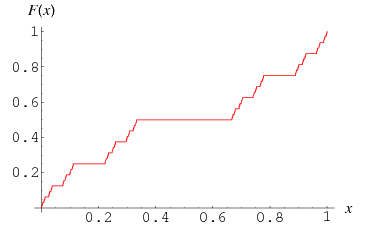
To put it in laymen's terms, pick a random point x in the interval from 0 to 1. The probability is 100% that the Cantor function will be staying perfectly still at that point, i.e. the instantaneous rate of change of the function at the point is zero. And yet! The function increases continuously--that is, without any jumps--from 0 up to 1. (In fact, multiplying by any constant changes none of these properties; the Cantor function could increase as high we like!) This absolutely mystifying property has earned the Cantor function the title "devil's staircase"
by some. I think a more fitting title is this: the Cantor function is a miracle.
Why do I say miracle? Because the event which enables the Cantor function to increase is, in the language of probability, an event which almost never happens. The set on which the Cantor function's derivative is undefined is called the Cantor set. This set meets the historian's criterion of being an event which, by definition, is the least likely event to happen, ever. Yet it is precisely this set which connects this "devil's staircase" from top to bottom. Hence I call this ascension from 0 to 1 a miracle. The historian's explanation will not explain the Cantor function. If one looks at the event most likely to happen, one sees that the Cantor function is not moving. Yet the function moves. Not only does it move--it bridges the entire gap from start to finish, never missing any point between.
The universe is full of such miracles. The continuum is teeming with undetected and undetectable events, whose impact cannot be readily assessed by scientific measurement. Part of the joy of mathematics is discovering such events and bringing them to light! Can there be a more spiritual endeavor?
Subscribe to:
Posts (Atom)