Thursday, September 17, 2009

Name Worshiping

I recently picked up a book I'm really excited about called Naming Infinity. The subtitle sums up why I am so excited: "A True Story of Religious Mysticism and Mathematical Creativity."

Seriously, does it get any more fascinating than that?

I just read the first chapter, which sets the stage in early 20th century Russia, at the intersection of a religious dispute in Eastern Orthodoxy and a mathematical controversy in Europe.

At issue in the Russian Orthodox Church was a group of monks called "Name Worshipers," who supported the practice of the Jesus Prayer--a prayer to be repeated until the worshiper achieves a sort of "mental fusion with God."

The Russian Orthodox Church deemed the practice a heresy, but it turned out to be an inspiration to Russian mathematicians working on important advances in set theory. This interaction between mathematics and religion is intriguing to me.

The first chapter of this book was a really compelling read. It opened with talking about the religious persecution of the "Name Worshipers"--Russian Orthodox monks living in a monastery in Greece--who were violently forced out of their monastery. This was before the revolution, and I suppose the State still felt obligated to do the bidding of the Russian Orthodox Church.

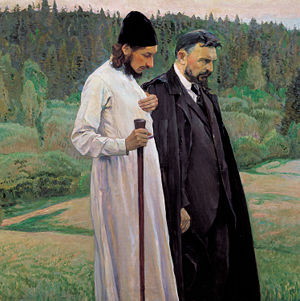
After the revolution in 1917, however, Name Worshiping caught on as an underground movement that captured the attention of intellectuals, including such great mathematicians as Dmitri Egorov, and a student of his, Pavel Florensky.

The chapter ends with a transition into talking about the mathematical controversies of the day regarding mathematical set theory. To see how Name Worshiping could possibly inspired mathematical insights, we read,
Florensky saw a relationship between the naming of "God" and the naming of sets in set theory: both God and sets were made real by their naming. In fact, the "set of all sets" might be God Himself.
As out there as this might seem, it's fascinating to me personally because I'm familiar with how central set theory is to modern analysis (which is what I do)--and I'm also fascinated with religious exploration.

I'll try blogging through this book, just because I'm so taken with the story. I also think it could have a lot to say about modern controversies over religion, science, and rational thought.

One thing that's interesting is how these Russian mathematicians rejected Western "positivism," but nevertheless broke with the more traditional approaches to religion to develop new insights.

Perhaps this indicates that we have too few categories here in America when it comes to religion. "Religious" and "skeptic" are hardly adequate. There is such a vast continuum of thought out there.

Monday, September 14, 2009

Prayer for all people

Heavenly Father, God Almighty, Maker of Heaven and Earth, of all that is, seen and unseen,

a God merciful and gracious,
slow to anger, and abounding in steadfast love and faithfulness,
keeping steadfast love for the thousandth generation,
forgiving iniquity and transgression and sin,
yet by no means clearing the guilty,
but visiting the iniquity of the parents upon the children and the children's children,
to the third and the fourth generation,


have mercy on us all.

Out of the depths I cry to you, O Lord. Lord, hear my voice!
Let your ears be attentive to the voice of my supplications!
If you, O Lord, should mark iniquities, Lord, who could stand?
But there is forgiveness with you, so that you may be revered.


Lord, what can I say for the cowardly, the faithless, the polluted, the murderers, the fornicators, the sorcerers, the idolaters, and all liars, when you say their place will be in the lake that burns with fire and sulfur?
Those who have nothing--will you take even what little they have away? Will you throw them into outer darkness, where there will be weeping and gnashing of teeth?
Will you forever fix a chasm between the righteous and the unrighteous, so that the righteous may not bring relief to those being tortured by flames?

How can this be?
For you, O God, did not send your Son into the world to condemn the world, but that the world through Him might be saved.
I know that your light has come into the world, and that people have loved darkness rather than light, because our deeds are evil.

For there is no one who is righteous, not even one;
There is no one who has understanding,
There is no one who seeks God.
All have turned aside, together we have become worthless;
There is no one who shows kindness, there is not even one.
Our throats are opened graves;
We use our tongues to deceive.
The venom of vipers is under our lips.
Our mouths are full of cursing and bitterness.
Our feet are swift to shed blood.
Ruin and misery are in our paths,
And the way of peace we have not known.
There is no fear of God before our eyes.


I know we grieve your heart, O God; you look on us and say, "I am sorry that I have made them."
You say to your servant, "How long will this people despise me? And how long will they refuse to believe in me, in spite of all the signs that I have done among them?"

Have mercy, O God, according to your steadfast love.
According to your abundant mercy, blot out our transgressions.
Wash us thoroughly from our iniquity, and cleanse us from our sin.

Create in us clean hearts, O God,
And put a new and right spirit within us.
Do not cast us away from your presence,
And do not take your Holy Spirit from us.


For then all creation will hear of it; for in your power you created human beings in your image, and all the creation knows that for us and for our salvation you have come among us, taking the form of a human being. If you destroy the disobedient, then all creation will cry out, "It is because the Lord was not able to save the people He created that He has thrown them into the hell of fire."

It is not that I love wickedness, O God.

Do I not hate those who hate you, O Lord?
And do I not loathe those who rise up against you?
I hate them with perfect hatred;
I count them my enemies.
Search me, O God, and know my heart;
Test me and know my thoughts.


It is not because I love wickedness that I pray for all people.

Yet because the wicked are my enemies, I love them, and I pray for them, because that is what your children do, O God.

Therefore forgive all people, for we do not know what we are doing.

I know you do not want any to perish. Have mercy on us all.

No one has ever seen you, O God; in Christ you have made yourself known, but Christ has ascended into heaven.
Be patient with us, O God, and do not condemn, since no one has ever seen you. Manifest yourself in us; let love be perfected in your people, so that the world may know you.
Do not leave us to continue in our errors. Instruct sinners in the way we should go.
In your love make us into something new, for if anyone is in Christ, there is a new creation!

O Lord, I confess that I do not know how to pray as I ought, and I know that I will not be heard for my many words.
Yet I do pray all these things in love, in the name of Christ, trusting in His promise to do anything His followers ask in His name.
Forgive all people, O God, on the day of your judgment, so that there may truly be no more mourning, crying, or pain, when you send your holy city down from heaven.
Let sin, death, mourning and pain all be defeated by your infinite Love, O God.

For the greatest of these is Love.

Wednesday, September 9, 2009

Secular ProLife

Students for Life of America is trying to reach a maximal audience by branching out toward the secular side of the abortion issue. A recent e-mail from them linked to the web site SecularProLife.org, which has as its subtitle, "Pro-life for a reason."

I have to say, that subtitle made me smile.

As their description on facebook says,
SecularProLife.org exists to promote secular pro-life arguments and fight the media portrayal of pro-lifers as "religious extremists." The scientific facts support our cause- let's use them!

We are not anti-religion. We welcome people of all faiths, atheists, agnostics, etc. We don't get involved with things like the pledge of allegiance, gay marriage, or In God We Trust on coins. SecularProLife.org is dedicated solely to issues of life and death.
Although this group is just getting off the ground, I'm encouraged by their mere existence. In order to defend innocent human life, it is necessary to break down the walls of rhetoric that the pro-"choice" movement has made over the years.

Specifically, the separation of church and state should not be given as a reason to defend abortion. The pro-life position on abortion is non-sectarian. It is not based on any specific doctrine of any religious denomination. It is based on good scientific evidence and one basic moral principle: that all human beings deserve the chance to live.

In honor of SecularProLife.org, I decided to write my top reasons why I don't use the Bible to defend the unborn. I'm sure this list will scandalize some Christians, but I feel like this stuff needs to be said--if for no other reason than that innocent children should not have to die because we can't agree on a single religion.

Top 5 reasons I don't use the Bible to defend the unborn
  1. Non-Christians don't care about the Bible. This sounds really straightforward, but sometimes it feels like conservative politicians forget this.
  2. Christians don't care about it, either. That's right, I said it. The fact is, about half the country doesn't agree with the pro-life position on abortion. About 80% of the country is Christian. That means there have to be plenty of Christians out there who are pro-choice; what are you going to do about it? Quoting scripture probably isn't doing the trick. Maybe they're from a more liberal mainline denomination that doesn't interpret scripture like you do. Or maybe one of the other reasons below has something to do with it.
  3. The Bible doesn't even mention abortion. There is no commandment given by God in the Bible that prohibits, specifically, killing a child in the womb. Of course, "Thou shalt not kill," but everyone already agrees with that. Defining the word "kill" can be tricky, though, and unfortunately the Bible doesn't give us straightforward guidance on the issue. (Phrases often quoted such as "Before I formed you in the womb, I knew you," when read in context, are not at all about the life of the unborn.)
  4. The Bible may even find abortion acceptable. There are some interpretations of Exodus 21:22 that find no legal rights given to the unborn (see the NRSV). Whether this is true or not is not mine to say, but I have wondered many times about this verse.
  5. The scientific facts are more compelling than the Bible. Consider one of the most often quoted passages of scripture used in pro-life circles:
    For you formed my inward parts;
    you knitted me together in my mother’s womb. (Psalm 139:13)
    This actually gives an image of life in the womb that is misleading and could suggest that unborn children are nothing more than bits and pieces being "knitted together." Other than for fear of defying God's sovereignty, why not "abort" such a creature? If growth in the womb is really a process of parts being put together, then maybe it's not too late to "abort" such a process.

    The scientific image, on the other hand, is one of continual growth. From the moment of conception, a human being in the womb is doing what humans do--growing, consuming nutrients, and struggling to survive. All the various parts of the human body naturally differentiate (very quickly!) from stem cells. From the time you're about 8 weeks old in the womb, you already have major vital organs--a heart, a brain, something like lungs--and even more, you have fingers, toes, and eyes that are not much more than little buds. All of these parts will grow--they won't be "put together." You are a complete organism from day 1.
There is one other reason why maybe using the Bible to defend the unborn isn't always such a good idea: the abortion issue is not primarily an intellectual one. It involves all of our emotions and fears. Even when scripture is appropriate, it must be used with extreme care. The unborn child is not the only human life at stake.

So there you have it. I will say that there is a right way to use the Bible in defense of the unborn: to inspire hope, to motivate change, and to provide a foundation for compassionate ministry to women in need of better options than abortion.

With that, I think there's one scripture passage that reminds me that I need to speak out on this issue, whether or not I use the Bible to do it:
If you faint in the day of adversity,
your strength being small;
if you hold back from rescuing
those taken away to death,
those who go staggering to the slaughter;
if you say, "Look, we did not know this"--
does not he who weighs the heart perceive it?
Does not he who keeps watch over your soul know it?
And will he not repay all according to their deeds? (Proverbs 24:10-12)

Tuesday, September 8, 2009

A Milton Friedman Disneyland

The Boston Globe reports on a smart, idealistic plan for relieving poverty in the third world--with a remarkably right-wing feel.

Paul Romer, an economist from Stanford, has decided to leave his tenured professorship to defend an idea he calls "charter cities." Basically, it means Western nations would buy (or maybe rent, to be more accurate) cities from third-world countries, put in our own form of government, and see if we can't spur economic growth that way.

"Unemployed workers and frustrated entrepreneurs from the host country would flock there for the opportunities; international firms would be drawn by the combination of First World stability and cheap labor. And from these nodes, money and expertise, laws and norms would spread throughout the rest of the country and, potentially, the developing world. Ultimately, their work done, the cities would revert to local control."

It's classic free market economics. Quality tends to propagate through the mechanism of competition. As you see potential customers flocking to a different city, chances are you will make an effort to improve your business, to give people a reason to stick around.

Of course you know what detractors will say. Those inclined to view everything in terms of power struggle will cry, "Colonialism! Imperialism!" Admittedly, there is a sort of "pragmatic paternalism" (from the article) about this whole plan. But I find it refreshing to hear a bit of free market idealism these days.
“I hope he’s right, I’m rooting for him,” says Elliott Sclar, a professor of urban planning and international affairs at Columbia University. “But history is littered with visions like this.” Romer’s charter cities, he argues, are “almost a kind of Milton Friedman Disneyland.”
And who says Milton Friedman's dreams can't come true? I think that if we really want to something about the enormous gap between rich and poor, it wouldn't hurt to try something logical.
Central to Romer’s proposal, no matter what the exact structure, is the belief that the developed world has lessons to teach poorer countries about how to deter violence, spur trade, incorporate new technologies, and train a workforce, and that we shouldn’t let political correctness blind us to that fact.
I'm sure this sounds really arrogant to someone who wants it to sound arrogant. But it's not; it's just a simple fact, as factual as me saying that I know way more math than all of my freshman calculus students. It doesn't make me a more valuable person, but it does mean they're better off coming to my class than not coming.

To me this plan contains a perfect concoction of pragmatic idealism, something I find lacking in today's political arena. I believe every person of every origin has the potential to display his own creativity in whatever form that may take, and contribute to a global, interconnected economy. And I think we can allow people to do that if we implement the right policies.
Aid programs today, [Romer] argues, think too small - they aim simply at keeping people in poor countries alive, or at making their farms more productive or their schools marginally less bad. They don’t dare to try to actually vault them into prosperity and growth, and they ignore many of the ambitions of the inhabitants, especially the young ones

“These kids don’t want to use a foot treadle generator to produce their own light to read books, they want to write apps for the iPhone,” says Romer. “And they’ll never be able to do that if they can’t go live in a major modern city.”

“Small isn’t beautiful,” he says. “Small is condescending.”

I agree. And I have to say, I'm inspired.

Follow-up to yesterday's post

I just got finished reading the mother of all de-conversion narratives, that of Nate Phelps, son of the infamous Fred Phelps of Westboro Baptist Church. I don't know if it's really possible to say anything in response to it.

Read it.

Monday, September 7, 2009

De-conversion stories

Isn't it interesting how humans have this need to tell stories about ourselves?

It's certainly true in our culture, which I suppose is shaped largely by a Christian tradition that places a strong emphasis on personal testimony. In the midst of such a culture, I have found a new kind of "testimony": de-conversion stories.

What you notice when you read the comments on these personal narratives is how others can so easily relate to these stories. Just like personal Christian testimonies, these stories bind together a sort of community, not in a very exclusive way by any means, but in a personal and vaguely spiritual way.

Stories like this one have all the classic elements, all the perfect reasons why Christianity was found wanting. I find myself entranced as I read this man's story. It is no less compelling than stories of converts to Christianity.

A man grows up in the church, totally committed to his faith. At a relatively young age, he harbors some doubts about the goodness of God:
What about people who are born into other religions? Would God punish them eternally in Hell for being born in a country where the social landscape was dominated by a different (read: false) religion?
And then there are the doubts relating to issues of science and faith:
Regarding creation, I had always leaned towards theistic evolution, which was only inches away from pure evolution. At what point were humans given the “breath of life” and acquired souls? How did that evolve? Or were we plopped fully formed into an already evolving environment?
The doubts become personal as experiences with an autistic son raise questions about the goodness of God:
My wife gave birth to a beautiful baby boy.... But at around one and a half years we began to notice that things weren’t necessarily as they should be.... A year later, it was confirmed and diagnosed as autism.

...I prayed for a miracle for my son, who was getting worse. ... I spent hours in prayer. I fasted. ... God never performed the miracle we prayed for and our families prayed for and their churches prayed for.
Perhaps the most cruel dimension was the lack of support from the Christian community:

I was working at a church at the time and was beginning to ask more questions about the source of their theology which brought up questions regarding theology at large. ... [T]he more I read, the more I became convinced that the Catholic church had existed long before it had become the “Roman” Catholic church... I set about to quit my job as assistant pastor and worship leader to be confirmed into the Catholic Church. ...

[T]his didn’t go over to well with my employers.... I was immediately dismissed and completely cut off socially. ... [M]y friends dismissed me, even to the point that I was labeled as a demoniac sent to sow dissension among the faithful. Still, I remained a faithful follower of Jesus, convinced that I was doing the right thing.

Finally, after making it through all the muck and the mess, the de-conversion (which turns out to be a sort of conversion, after all) is complete:
I don’t need a ‘first cause’ to believe in so that I can feel significant. I don’t need a creator to give me a divine purpose. I believe I have an earthly purpose and that it is mine to choose. I no longer need the promise of escaping this life to heaven. I believe that we have the opportunity to make our world a better place and that is far more beneficial than chasing after ‘eternal rewards’ in an afterlife while our fellow humans suffer.
Reading this ending makes me smile. It is no less a creed than anything Christianity has to offer. It is a fine creed, filled with purpose and meaning for human existence. I could give an honest critique of it, but I won't now. Maybe I'll save it for a later post.

I am not setting up a punch-line. This story really is compelling, and it's one that Christians should be familiar with in this world. Just read the whole thing for yourself--how can you not go along with him on his amazing journey?

I'm just trying to reflect on why it is we tell stories about ourselves. Life is full of desires held in tension; I think these stories reflect that tension.

On the one hand, we seek the universal, something that can be accepted by all. On the other hand, we seek the Truth, something that can be clung to with all our might no matter what anyone says.

When we tell stories about ourselves, we invite others into them. Whether it's a Christian giving his story of being born again before his church or an atheist telling his de-conversion story on a web site, I think it's natural to hope to experience a degree of universality. When others say, yes, that is my experience, too, we are full of hope.

But we all know how empty that hope can be, when a community supports you in believing something that turns out to be horribly wrong. There has to be some Truth that is undemocratically ordained as absolutely authoritative, doesn't there?

And yet the pain caused by those convinced they have this Authoritative Truth can be even worse than the pain caused by those who cling to a common experience.

I don't suppose it's possible to avoid the pain. Do we really have a choice other than to reach out with all our might to both of these desires, though they pull our souls in opposite directions? Can we really avoid being crucified by the desire for what is true to be universal, and what is universal to be true?

I don't know that I can avoid it, anyway. "Blessed are those who mourn," as my pastor preached yesterday. How can I help but mourn? What is true is not universal, and what is universal is not true, yet these seem made for each other.

"Blessed are those who mourn, for they will be comforted." I don't have any idea what that comfort will look like, but I suppose the anticipation is what keeps me waking up each morning.

Friday, September 4, 2009

Another evolution story

Brian McLaren keeps bringing up these different Christian interpretations of evolution. While I appreciate his efforts to bring in varying points of view, I've been pretty disappointed with what I've seen.

The interpretation I read tonight was written by Joan Chittister, a Benedictine nun, which perhaps informed a lot of her reading of past and present views of God. Here is part of what she writes about the old view of God:

The God of creation, the religious world determined, was all-knowing, all-powerful, all-present and all-holy. The problem lay in the fact that a God of these proportions failed, it seemed, to exercise such power when it came to the creation this very God had created.

This God did not save the world from evil, did not exercise blatant power in behalf of the good, did not save the righteous from the unrighteous, did not act in behalf of the oppressed. This was a God whose merit theology, whose rule-driven scorekeeping, trumped care, compassion and love.

It's interesting to view these statements from the point of view of a Protestant, coming from a tradition that rebelled against precisely this view of God.

It makes me think of John Calvin, whose commitment to God's sovereignty was unshakable, and is probably perceived by many as part of this "old" way of viewing God. Yet nothing could be further from the truth.

Calvin's commitment to God's sovereignty meant that God was acting on behalf of the oppressed, that prayer could change the world, and that God could save the righteous. For Calvin, it was the very sovereignty that Chittister seems to dislike that made these things possible.

Also the undying commitment of Protestants to justification by faith alone prevents any notion of God keeping a score-card. Indeed, such a view of God is exactly what Protestants were trying to reform.

What's so fascinating is that Chittister reacts to a horrifying conception of God by asserting free will at every turn, and diminishing God's sovereignty to do so:
A self-creating universe becomes co-creator with the humble God who shares power and waits for the best from us and provides for what we need to make it happen. We become participants in the process of life and the development of the world that is not so much planned as it is enabled. As nature grows, experiments, unfolds, selects and adapts, so then must we. Growth, not perfection, becomes the purpose of life. Ongoing creation, not predestined fate, becomes the purpose of life.
There's some tension here between Chittister's desire to see the role of the self more highly and to see our final eschatological purpose wrapped up in God. For instance, she writes towards the end of her article:
We learn from the fossils of the ages that development is most often a slow and uncertain process, a precarious and breakneck experience that demands both time and trust in the future that is God, and in the God of the future.
Somehow this desire for God to be the reliable end of life's journey doesn't change, even when you and God are partners, as opposed to the more traditional roles.

Chittister concludes that "Evolution gives us a God big enough to believe in." I'm not sure her story does, though.

I find myself actually much more inclined to go back to the Reformers, and find hope not in the partnership between God and self, but rather in the all-encompassing sovereignty of God.

There are some huge mistakes I think people make when thinking about God's sovereignty. I think the number one mistake is viewing it in primarily in terms of personal salvation. God has foreordained each soul for heaven or hell, end of story. That is an ugly picture, I think.

Instead I think the sovereignty of God, if it covers anything, should cover everything. One should not miss how this is a vital source of hope. It means that this world matters--God is involved in everything. It means God's power is here and now just as much as in eternity.

At the same time, of course, it is a frustrating view of God, but there's a certain kind of frustration that I find essential to spiritual health.

I am constantly fascinated by how the Old Testament deals with God's sovereignty. You get all kinds of passages more or less blaming God for bad things, even Israel's disobedience (cf. Isaiah 63:17).

Hebrew theology didn't allow for any dualistic explanations of the world--God was behind everything. But it did allow for full expression of disappointment with God, and a desire for God to change things. I think there's great wisdom in that.

The thing I think is most damaging in all of these discussions is how individualistic we are in our thinking. Modern thinking gives us two choices: either God is in charge, or the autonomous self is in charge.

How sad it is that we find it somehow original to think of this meager third option, that God and the self are working together.

What we really ought to learn from evolution, among many other things, is that we are part of something much bigger. It is not just between God and me. There is God, and there is all of creation!

I find it tragically ironic that in her post featuring beautiful pictures of outer space, Sister Chattister failed to meditate on the sheer vastness of the universe, and our smallness in it. Whereas Chattister wants to "imagine a greater sense of self," I feel compelled by scientific knowledge to imagine a much smaller sense of self, and a greater sense of my surroundings.

And yet, in a way, if I can imagine just how small I am compared to the world, I can become much bigger, in the sense that I will be part of something much bigger--something God made me to be by making all things according to His wisdom.

Well, one thing is clear: there is no one spiritual interpretation of scientific theories. This debate could certainly be enlightened by having more varying perspectives heard.