Showing posts with label mysticism. Show all posts

Saturday, November 5, 2016

Consciousness and reality

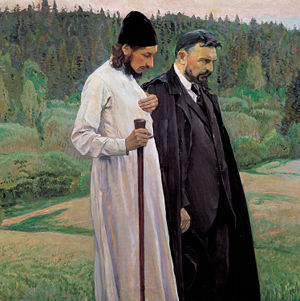
Descartes' "cogito" is not a syllogism but a profound mystical experience of one's reality. (Pavel Florensky)
It is all the rage these days for scientists to become interested in the question of consciousness. We want to explain this phenomenon, because it seems like the last bastion of metaphysics where physics cannot touch. No scientific materialist can resist such a challenge.

But consciousness is not simply a "phenomenon." It is the background of all phenomena. To assert that something exists is the same as saying, "I am conscious that it exists." If there is no consciousness, there is essentially no existence. We can imagine a closed system in which no conscious being exists. But such a reality is merely hypothetical. It would not--could not--have any meaningful existence outside of our own thought experiment, which is itself the product of consciousness!

Reflecting in this manner, one is slightly tempted by solipsism. Perhaps all of reality is actually the product of my consciousness. Yet this is only a very slight temptation, because it feels immediately absurd. In reality, I have so little control over my surroundings, so little understanding even of myself. If I am at all self-aware, I have the constant sensation of being a very small part of a vast universe which goes on existing whether I do or not.

So if the existence of the universe depends on consciousness, it certainly does not seem to depend on my consciousness.

Both of these reflections have such a strong intuitive appeal that I can't help but accept them both. I conclude that my own consciousness is in fact one small result of a much greater consciousness, to which all things in existence are attached.

The materialist will argue that all of my experiences are the result of processes which occur physically in the brain, and therefore there is no reason to posit any notion of immaterial consciousness. But this is only to explain consciousness as an external phenomenon, one which we can observe, test, and then circumscribe in physical theory. That is not at all what consciousness is. We cannot reduce consciousness down to anything else because it is the most fundamental fact of all, as Descartes sensed vividly when he said, "I think, therefore I am." The most fundamental fact is, "I am." But that fact is precisely consciousness, which is why for Florensky this is not a syllogism but rather a mystical experience, that is, a powerful awareness that we normally suppress.

This is why the name of God translates to, "I am." There is nothing more fundamental than that something exists. But that fact would no longer be a fact if it were not known. Hence the universe comes into being through the words, "I am."

Obviously our own awareness of the universe is very limited, and it is only made possible by our extraordinarily complex material composition (in particular, the brain). But as much as we might understand the human brain, we will never remotely penetrate the question of why there exists something rather than nothing, and in the same way we will never be able to theoretically circumscribe consciousness. Indeed, consciousness is that which circumscribes all our theories.

Instead, we ought to try to understand the whole universe as an outworking of this assertion, "I am." Although our own consciousness is receptive, seeking to understand that which precedes it, God's consciousness is an active one, calling things into existence. The physical complexity of our brains is a requirement for us because we need so many complex functions to be able to respond to the world as it exists. God, on the other hand, needs no complex parts, because His consciousness is all-encompassing.

We encounter here the mystery of human existence. If we retreat into our own minds, we encounter consciousness, and it is as if we ourselves were God. But if we look outward for even a moment, we realize that we are mere creatures, and it is only because of the absurdly rich genetic inheritance that we have received that we have even a drop of consciousness in us. We cannot decide whether we are creatures or creators.

Scientific materialism leaves no room for this mystery. It makes us into mere creatures because it wants to assert that we are creators. It is the ultimate irony. We are alone in the universe; apart from sufficiently complex organisms, there is no such thing as consciousness; the universe is empty, no one is listening, no one is watching. We therefore must make our own reality, except that reality is already imposed on us; we are mere creatures, desperately attempting to be creators on the basis of our intellectual capacities. But since we are not created but the product of mere time and chance, we are not even creatures but rather objects. There is no mystery of existence; rather, it is a tragedy, or a farce.

I realize that it is with a very aggressive tone that I make these assertions, but that is not because I am so certain of my own position. Quite the opposite. I admit it's plausible, when we look at the world from a human point of view, that we are an accidental blip of consciousness in an otherwise dead universe. For me, it is more the heart than the head which rails against such conclusions. And although the heart is quite easily intimidated by the head, I think one sees more clearly through it than through any power of reason.

Thursday, October 29, 2009

Martyrdom of a Mathematician

I finished reading Naming Infinity a while ago, but I never did get a chance to wrap up my blogging on the book. The end really is quite tragic, and all the more so because it's a true story.

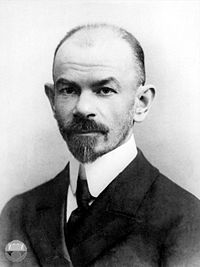
There is so much to say about all that Dmitri Egorov, Nikolai Luzin, and Pavel Florensky did for mathematics and science, and how their faith influenced their work. But since I have to choose what to focus on in a little blog post, I will choose to talk about how they were treated on account of their faith.

Pavel Florensky and Dmitri Egorov both died for their faith. It's a complicated story, and they both went down distinctly different paths, but in the end they both had the same problem--they were openly Christian under a militantly atheist regime.

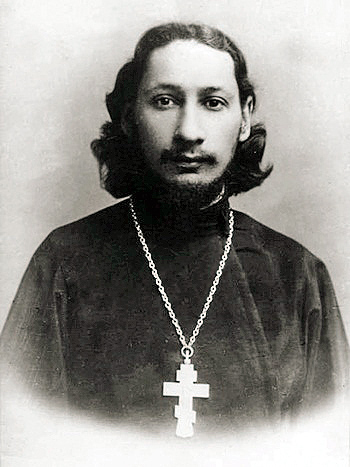
Pavel Florensky was a Russian Orthodox priest, but he was also a scientist and inventor, and he is part of this story because he was very close friends with both Egorov and Nikolai Luzin, the other member of this "Russian trio."

I suppose it didn't help him that he insisted on wearing his white priest's cassock while delivering his scientific papers. You can kind of guess how the Soviet police eventually got to him--they "proved" that he was the leader of a counter-revolutionary organization, which of course he had never heard of. They shipped him off to a prison camp where he continued scientific research, but I guess they didn't even want him doing science as a prisoner.

In 1937, Florensky was sentenced to be shot. He was executed on December of that year. Recent evidence suggests the details of this death were not pleasant:
According to this information, in December 1937 Florensky was brought from the Solovetsk Islands to Leningrad, where for a while he was in a prison cell in the "Big House," the headquarters of the Leningrad secret police.... Then, according to this new evidence, Florensky was forced to undress, his hands and feet were bound, and he was taken along with several hundred other people in a convoy of trucks to the Rzhevsky Artillery Range, near the town of Toksovo, about 20 miles south of Leningrad. There, we are told, they were all shot.
What causes certain regimes to have such an irrational hatred of religion (or any dissenting view) so as to treat someone in this way?

Egorov didn't fare much better. What's crazy is that he simply insisted that his religious views were a private affair, and that all views should be tolerated in the university. Nevertheless, when he was arrested in 1930 the charge included "mixing mathematics and religion." Can you imagine living in a country where that's a crime?

While in prison Egorov prayed daily, including practicing the "Jesus Prayer," despite persecution from the guards. He eventually died there in prison due to digestive failure (which had already been a problem before being sent to prison, where his health only deteriorated). His last words are reported to have been, "Save me, O God, by Thy name!" from Psalm 54--which according to the authors of this book were "appropriate to his Name Worshipping creed."

Nikolai Luzin was not martyred for his faith, but he came pretty close. In the tragic "Luzin affair," he was basically put on trial for his faith--the crime was being tied to anything considered anti-Soviet, including the old monarcy and Christianity. Kind of ironic, considering Luzin at one time had been a sympathizer with the revolutionaries.

It's really depressing to see a lot of those big names of mathematics listed among the people who attacked Luzin, such as Alexandrov, Khinchin, Sobolev, Kolmogorov, Liusternik, and Pontriagin. Most of these are names I've heard at one time or another in my analysis classes.

But that's part of why I write this. Who knows what will ultimately draw us to such evil? It may be that a compelling ideology will grip our hearts so tightly that we lose all sanity. It appears as if a whole country was led into insanity by such an ideology. I don't think any amount of intelligence or wisdom can prevent it. Evil cuts through all of our hearts.

In the end Luzin was spared, thanks to the intervention of a famous physicist of the time, Peter Kapitsa. It's still not entirely clear why Stalin spared Luzin in this instance. He got rid of plenty of other people who were just as valuable as scientists. Perhaps we'll never really know.

What a change it is to think about mathematicians as people who suffered for their beliefs! All you typically hear is about how these child geniuses grew up to prove amazing theorems; but rarely is it ever mentioned that mathematicians have been people who struggled through real trials.

And it puts things into perspective. My friends in grad school were talking about this, and one of us said, "Next time we start to complain about departmental politics, I guess we should keep this in mind." We are so blessed to live in a country where freedom is a given.

But finally, this story really is an inspiration to me, in that it makes me contemplate how to integrate my faith completely with my occupation. It's interesting to read the author's of this book struggle with this idea:
"In concluding that mysticism helped Russian mathematicians in the development of descriptive set theory, we have had to overcome our own natural predispositions. Both of us are secular in our outlooks--far from being Name Worshippers ourselves. We did not start out writing this book in order to come down on the side of religion in the infamous science-religion debates that have occupied so large a place in recent public discussions."
As Jesus Christ put it, Wisdom is vindicated by her deeds. There really is no need to endlessly debate over religion and science. The faithful simply ought to pursue knowledge with all their heart, and they will bear fruit.

That's my goal in life--a unified pursuit of knowledge. Incidentally, that's why I've been loving Florensky's Pillar and Ground of the Truth. Maybe I'll start blogging about that soon.

Monday, October 12, 2009

Mystical Mathematicians

The essence of mathematics lies in its freedom.
Georg Cantor
I continue on in my reading of Naming Infinity, that book about religious mysticism and mathematical creativity.

Chapters 4 and 5 introduce some of the most fascinating mathematicians I've ever read about. Two of them are familiar names from my graduate level Real Analysis class during my first year: Dmitri Egorov and Nikolai Luzin.

Egorov seems more of a distant character than Luzin. He's described as "a very reserved and modest man, so much so that it would be easy to believe that he lived only for mathematics." But if one looks at his actions, one finds a man driven by strong principles and devout religious faith. This becomes a bit more of an issue later, after the Communist take-over in Russia.

Luzin is Egorov's student, a bright, idealistic intellectual who sympathizes with political radicals of his day--at least as a younger man. What really fascinates me is Luzin's story of conversion from atheism to Christianity. It's a story of real crisis, both intellectually and emotionally.
"From 1905 to 1908 Luzin underwent a psychological crisis so severe that several times he contemplated suicide. One precipitating event was the unsuccessful revolution of 1905, an event that was sobering for many left-wing members of the intellegentsia.... Luzin was shaken not only by the shedding of blood but also by personally witnessing poverty and suffering.

...

Earlier, he had embraced science, materialism, and secularism as the answer to Russia's problems. Now he doubted that these were any answers at all."
Thankfully, Luzin is deeply acquainted with Pavel Florensky, the third member of this "Russian trio." Florensky studies mathematics with Luzin in Moscow and then later becomes an Orthodox priest. The two of them remain very good friends, and later during the time of Luzin's personal crisis, this friendship becomes extremely important, as the two correspond concerning Luzin's troubled thoughts. Luzin writes to Florensky,
"You found me a mere child at the University, knowing nothing. I don't know how it happened, but I cannot be satisfied any more with the analytic functions and Taylor series.... To see the misery of people, to see the torment of life....--this is an unbearable sight....I cannot live by science alone.... I have nothing, no worldview, and no education.

...

"If I do not find a path to seek the truth...I will not go on living."
Florensky himself is a convert to Christianity, having converted from atheism at the age of 17. Despite having been raised in a secular environment, he believes that one of the sources of Russia's problems is that so many of its brightest minds (like Luzin) are attracted to atheism.

Florensky therefore provides Luzin with a "path to seek the truth" from his own religious insight. Luzin reads Florensky's thesis "On Religious Truth" (a version of which I happen to have at the moment, thanks to a kind uncle who seems to have every book in the world).

This reading combined with a continued friendship with Florensky leads to a full conversion. In 1908 Luzin writes to Florensky, "I felt as if I had leaned on a pillar...I owe my interest in life to you."

Luzin and Florensky press forward from here into a study of mathematics shaped by a shared interest in Christian mysticism. Florensky becomes an avid supporter of the "Name Worshiping" movement which goes back to chapter 1. Luzin surely knows about this development, even if he never becomes an active participant in the movement.

When it comes to mathematics, Luzin and Egorov are the real experts, it seems, but when it comes to fusing religious, philosophical, scientific, and mathematical thought together, Florensky is the real genius. Some quotes from the book illustrate:
"Florensky was convinced that intellectually the nineteenth century, just ending, had been a disaster, and he wanted to identify and discredit what he saw as the 'governing principle' of its calamitous effects. He saw that principle in the concept of 'continuity,' the belief that one could not make the transition from one point to another without passing through all the intermediate points.

...

Florensky faulted his own field, mathematics, for creating this unfortunate monolith. Because of the strength of differential calculus, with its many practical applications, he maintained that mathematicians and philosophers tended to ignore those problems that could not be analyzed in this way--the essentially discontinuous phenomena. Only continuous functions were differentiable, so only those kinds of functions attracted attention... Differentiable functions were 'deterministic,' and emphasis on them led to what Florensky saw as an unhealthy determinism throughout political and philosophical thought in general, most clearly in Marxism.

...

Florensky was convinced that mathematics was a product of the free creativity of human beings and that it had a religious significance. Humans could exercise free will and put mathematics and philosophy in perspective.... Mathematicians could create beings--sets--just by naming them.... The naming of sets was a mathematical act, just as, according to the Name Worshipers, the naming of God was a religious one....
I can't tell you how motivating it is to read about Florensky's religious and mathematical thought, and his influence on Egorov and Luzin. Today's mathematicians often seem inclined to divorce philosophical concerns from mathematics, but that is a sad state of affairs, one from which these early 20th century Russians can liberate us.

I am also deeply moved by the personal struggles of these mathematicians, and how they had to respond to the crisis of their time. I, with them, am persuaded that the best response to the crises of our time is deeper religious thought, not more secular thought.

As much as I am a fan of interacting with secularism in a healthy and open-minded manner, I think that ultimately secular thought lacks the resources we humans need to move forward. Not that religion doesn't often hold us back; but I think the best cure for stale religion is fresh religious thought. Man, does one ever find that in Florensky.

Still more to come... This book has been really good so far!

Monday, September 28, 2009

Infinity and Insanity

I've just finished reading chapters 2 and 3 of Naming Infinity, a book about mathematics, religious mysticism, and the problem of infinity.

Part of the main thesis of the book is that mathematical advances in the early 20th century were profoundly shaped by cultural and philosophical background. Overall, the book tries to compare the very different approaches of the French and the Russians, contrasting the very rationalist with the very mystical.

Chapter 2, however, starts with the Germans. In a way, I suppose the German mathematicians in this chapter (and the next) come across as in between France and Russia, both in geography and in philosophical approach. The whole mess about set theory starts with the work of Georg Cantor, who proves that there are multiple types of infinity.

Entering into Chapter 3, we read that Cantor eventually suffers from mental illness in connection with his studies of infinity. He keeps trying to prove something called the continuum hypothesis, which, as it turns out, is not really provable within the axioms of set theory. Poor guy is chasing a phantom.

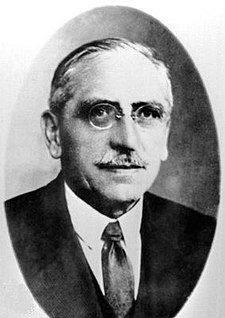
People respond to Cantor's set theory with mixed reactions. One German that is willing to go to bat for him is David Hilbert, who is busy trying to advance an axiomatic approach to mathematics. Also he has a terrific hat in the picture I found on Wikipedia.

This axiomatic approach is culturally much different from the French approach, which stresses the need for a connection between physical reality and mathematics. In 1900 Hilbert proposes that the continuum hypothesis is one of the most important problems in mathematics--a pure mathematical problem, needing no grounding in physics or other sciences.

It is in this mathematical climate that we meet the three star French mathematicians of the book: Emile Borel, Rene Baire, and Henri Lebesgue. All three are very different people, except they do seem to share in common that they were not born into privilege--their mathematical talents caused them to rise to prominence in France.

The French have a cultural commitment to rationalism, inherited from Descartes, as well as positivism, a product of late 19th century philosophy. Under this philosophy, "once science liberates itself from all metaphysical influences and enters the 'positive stage,' its goal is no longer a metaphysical quest for truth or a rational theory purporting to represent reality. Instead, science is composed of laws (correlations of observable facts) that can be used by the scientists without regard to the nature of reality."

Contrast this with Cantor, whose struggles with infinity are deeply metaphysical and even religious. This is a foretaste of how the Russians will deal with the issues of set theory. But in the meantime, this "French trio" sets out with their own brilliance, eventually hitting a wall of mystery and frustration.

Despite the fact that Borel, Baire, and Lebesgue all make deep discoveries that move the study of infinity forward, eventually they all reject some basic notions of infinite set theory.

Ernst Zermelo (another mischievous German) comes up with this notion of the "axiom of choice," which all three of the French trio reject.

Kind of bizarre for me to read, really, because the very first day of Real Analysis in grad school was using the axiom of choice to generate a set that isn't Lebesgue measurable. History is full of irony.

In any case, Borel goes all hard-core and starts saying that the only entities that really exist in mathematics are those that can be constructed in finite steps. He abandons his older pursuits and focuses on more "useful" mathematics. Lebesgue can't quite divorce himself from the study of the continuum, but he's rather stuck without certain philosophical tools.

Baire becomes another victim of mental illness in this story of infinity. His already unstable mind isn't helped by the fact that he can't seem to find any way forward through the "intellectual abyss" created by the problem of the infinite.

Meanwhile, lurking around the corner seems to be a glimmer of progress in these Name-Worshiping Russian mathematicians who are about to be introduced in Chapter 4. Their secret seems to lie in being open to precisely what the French are closed off to: allowing metaphysics to mix with mathematics.

This has been a good read so far. It's keeping me awake at night, to be sure. It also makes me hope I don't go crazy. Why is there such a strong connection between mathematics and insanity, anyway?

One thing I'm seeing in these first few chapters is that perhaps there really is a need in all of us to embrace mystery, and accept what we cannot understand. Maybe it really can drive a mind insane to try to iron out all the details of a rational system that may simply have boundaries that we can never see.

Mathematics and mystery... at first they don't seem to go hand in hand, but the more I think about it, the more I think they do.

Anyway, I'm excited to continue on through this book!

Thursday, September 17, 2009

Name Worshiping

I recently picked up a book I'm really excited about called Naming Infinity. The subtitle sums up why I am so excited: "A True Story of Religious Mysticism and Mathematical Creativity."

Seriously, does it get any more fascinating than that?

I just read the first chapter, which sets the stage in early 20th century Russia, at the intersection of a religious dispute in Eastern Orthodoxy and a mathematical controversy in Europe.

At issue in the Russian Orthodox Church was a group of monks called "Name Worshipers," who supported the practice of the Jesus Prayer--a prayer to be repeated until the worshiper achieves a sort of "mental fusion with God."

The Russian Orthodox Church deemed the practice a heresy, but it turned out to be an inspiration to Russian mathematicians working on important advances in set theory. This interaction between mathematics and religion is intriguing to me.

The first chapter of this book was a really compelling read. It opened with talking about the religious persecution of the "Name Worshipers"--Russian Orthodox monks living in a monastery in Greece--who were violently forced out of their monastery. This was before the revolution, and I suppose the State still felt obligated to do the bidding of the Russian Orthodox Church.

After the revolution in 1917, however, Name Worshiping caught on as an underground movement that captured the attention of intellectuals, including such great mathematicians as Dmitri Egorov, and a student of his, Pavel Florensky.

The chapter ends with a transition into talking about the mathematical controversies of the day regarding mathematical set theory. To see how Name Worshiping could possibly inspired mathematical insights, we read,
Florensky saw a relationship between the naming of "God" and the naming of sets in set theory: both God and sets were made real by their naming. In fact, the "set of all sets" might be God Himself.
As out there as this might seem, it's fascinating to me personally because I'm familiar with how central set theory is to modern analysis (which is what I do)--and I'm also fascinated with religious exploration.

I'll try blogging through this book, just because I'm so taken with the story. I also think it could have a lot to say about modern controversies over religion, science, and rational thought.

One thing that's interesting is how these Russian mathematicians rejected Western "positivism," but nevertheless broke with the more traditional approaches to religion to develop new insights.

Perhaps this indicates that we have too few categories here in America when it comes to religion. "Religious" and "skeptic" are hardly adequate. There is such a vast continuum of thought out there.

Sunday, February 1, 2009

Silence

This morning in Sunday School at Trinity Presbyterian, we were talking about how God speaks today. One way, the teacher said, quoting A. W. Tozer, was in the silence. Away from the distractions of the world, alone with your own thoughts, allowing the persistent presence of God to permeate your mind, there is much to discover about life.

It's funny how often life is about going back and forth. These days there is so much information for us to consume. A quick Google search and you can find out almost any little thing you want to know. There is great advantage in that. The world is meant to be explored, and at no time in history has that been easier than now.

But sometimes all the noise drowns out that persistent presence known as Yahweh. I remember one time being taught to breathe the name of God. Indeed, the name Yahweh flows in and out very easily, and sounds like a whisper, piercing through the storms of noise around us.

I've noticed that for some reason American Christians tend to prefer the practical to the mystical, and if the mystical is desired it is most often in the context of loud storms of emotion. I like discovering elements of the mystical in my own faith.

It is a serene, cool, crisp winter day here in Charlottesville. Perfect for... watching the Super Bowl, no doubt. And getting work done for tomorrow. And for surfing the Internet, and talking to friends and family on the phone...

But if I can just stop for a second, I notice that it's really quiet in my room right now. The world looks very still through my window. It's late afternoon, and the sun is shining at a low angle on my desk, highlighting the edges of a beautiful framed quote that an old friend gave me.

And I can hear my own breathing.

God, the world is so beautiful.

I feel like a stranger. I don't come to the silence often enough. Just like I don't get back to my old home town enough, that small town with nothing to do but see old friends. I guess that's why I fumble so much on the question "Where are you from?" I've never made my roots strong enough anywhere to have a reasonable answer.

Just the same, I wonder if I know who I am, since I find it so hard to describe the silence of being alone.

Maybe the one who does know will tell me.