Showing posts with label history. Show all posts

Sunday, July 6, 2014

Impressions from a first reading of de Tocqueville's Democracy in America, vol 1

I just finished reading the first tome of Alexis de Tocqueville's De la démocratie en Amérique. It is, of course, a classic work, and it would be worth very little to add yet another summary or review to the cybersphere. On the other hand, I thought it would be worthwhile to write down the strongest impressions it made on my own thinking. There's nothing quite like learning about your own country from a point of view that comes from both a different era and a different continent. Here I will write a point by point list of the ideas that stuck with me most strongly.


  • The United States can be rightfully called a Christian nation. This has not so much to do with the Constitution or the Founding Fathers, and everything to do with the original colonists, their culture, their beliefs, and their mission. Religion was everywhere in early America, much like today, though it is in a slow decline. It was not just a matter of personal belief, but it shaped laws and cultural norms. In particular, the education of children was highly shaped by Christian belief.
  • Despite the mix of cultures, the USA is still very much an Anglo-Saxon nation. Its political and legal traditions have the same roots as those of England. Democracy in America was not an 18th century invention. It was a 17th century evolution. That is, the colonists put into practice what they already knew, and whatever innovation they came up with was learned from experience in their new circumstances.
  • There was, from the very beginning, a pretty significant divide between the North and South. In some ways, the Civil War seems kind of inevitable in retrospect. This doesn't seem to be the result of profound cultural differences, but rather circumstances which caused political interests to be rather divided. I think we all know which was the biggest difference.
  • Concerning slavery: it was already well-recognized at that time (the 1830's) that slavery hindered economic improvement. I found it particularly fascinating that Tocqueville would argue quite explicitly that the North ended slavery for economic reasons.
  • Racism was just a given, North and South. In fact--and I admit this was a real discovery for me--Tocqueville argues it was in many ways worse in the North, precisely because there was no slavery (strange as that seems). Indeed, without the institution of slavery keeping blacks and whites legally separated, white people separated themselves from black people all the more carefully. And of course this racism wasn't against blacks only, but also against the indegenous people of America. The difference is that black people lived among whites, whereas the indigenous people were outsiders.
    Tocqueville said that if slavery ever ended in the South, there would be a huge struggle between the black and white races. It seems he was right.
  • Freedom was not considered to be a state of nature. People had to learn how to be free. Certain morals were required for a free society. In short, freedom was the result of civilization.
    In some ways this feeds into my previous point, because if you don't consider a certain race civilized enough, then they can't really be free, either.
  • Americans enjoyed remarkable equality of possessions and status, even though they didn't explicitly seek it.
  • Americans believed in freedom: all people where free to choose in whatever concerned only themselves, and likewise for each city, county, and state (in relation to other cities, counties, and states). This is a point on which Tocqueville insists over and over again, calling it the principle on which the entire American society was based.
  • The union was, in Tocqueville's opinion, fairly loose: in one place he said the federal government seemed to be losing control over the states. Things have certainly changed since 1835.
  • Actually, an interesting example of the previous point had to do with American interactions with the indigenous peoples. The individual states were actually worse than the federal government, though both acted in bad faith. In theory, the federal government should have been responsible for interactions with foreign peoples, but individual states got rather impatient when it came to chasing tribes off of lands they wanted.
  • Tocqueville was pretty certain America was going to become a global superpower. I don't have the historical knowledge to say whether he was unique in this, but I found his predictions kind of impressive. For instance, in one place he says that 100 years from his writing, the US would have at least 100 million people. His first volume was published in 1835. The US population broke 100 million in 1915, and in 1935 it was around 127 million. Not bad.
  • The American president was a relatively powerless figure in Tocqueville's opinion. On the other hand, he said this had nothing to do with the Constitution, and everything to do with circumstances. At the time the US had relatively few military opponents. Any country surrounded by enemies will inevitably have to set up a strong executive.
    I think the experience of the US over the past century or so confirms, in a disturbing way, exactly what Tocqueville said.
Some of these points deserve more developed reflection, and I'm sure I'm forgetting a lot of other things that jumped out at me, but that's a start.

Monday, June 13, 2011

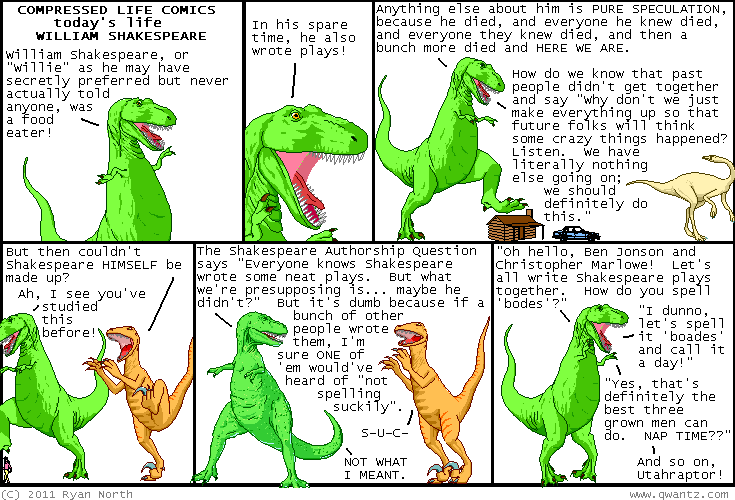
Let's spell it "boades" and call it a day


The thing you have to appreciate about Dinosaur Comics is the ability to put history into proper perspective.

http://www.qwantz.com/comics/comic2-1991.png

Thursday, February 24, 2011

Cantor's Miraculous Function

Secular historians often define a miracle (implicitly or explicitly) as the least likely thing to happen. Thus the historian must never use a supernatural explanation for any event. This implies that any secular conception of history must assume an historical continuum: it must be possible to measure the likelihood of a particular event by comparing it to other events we are used to.

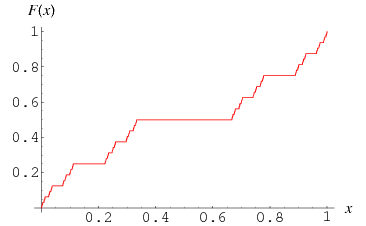
What if there were a simple mathematical illustration showing how those events which have negligible probability, i.e. those events which are by definition the least likely to happen, can have a dramatic effect? In fact, there is, and it has been well-known for quite a long time. It's called the Cantor function and it looks a little something like this:
What's so special about the Cantor function? Here are a few of it's properties. First, it increases continuously from 0 to 1 as x ranges from 0 to 1. Second, it has a derivative defined almost everywhere with respect to the uniform probability distribution (or Lebesgue measure) on the unit interval. Third, this derivative which is defined almost everywhere is zero.

To put it in laymen's terms, pick a random point x in the interval from 0 to 1. The probability is 100% that the Cantor function will be staying perfectly still at that point, i.e. the instantaneous rate of change of the function at the point is zero. And yet! The function increases continuously--that is, without any jumps--from 0 up to 1. (In fact, multiplying by any constant changes none of these properties; the Cantor function could increase as high we like!) This absolutely mystifying property has earned the Cantor function the title "devil's staircase"
by some. I think a more fitting title is this: the Cantor function is a miracle.

Why do I say miracle? Because the event which enables the Cantor function to increase is, in the language of probability, an event which almost never happens. The set on which the Cantor function's derivative is undefined is called the Cantor set. This set meets the historian's criterion of being an event which, by definition, is the least likely event to happen, ever. Yet it is precisely this set which connects this "devil's staircase" from top to bottom. Hence I call this ascension from 0 to 1 a miracle. The historian's explanation will not explain the Cantor function. If one looks at the event most likely to happen, one sees that the Cantor function is not moving. Yet the function moves. Not only does it move--it bridges the entire gap from start to finish, never missing any point between.

The universe is full of such miracles. The continuum is teeming with undetected and undetectable events, whose impact cannot be readily assessed by scientific measurement. Part of the joy of mathematics is discovering such events and bringing them to light! Can there be a more spiritual endeavor?

Wednesday, July 22, 2009

Our Story

I was listening to this fascinating podcast featuring Stanley Hauerwas over on Emergent Village (it's an older podcast, I'm just catching up). The topic of the speech given by Hauerwas was actually the theology of death... Kind of a dark subject, but it launches him into some amazing points.

The thought I had about it doesn't have anything to do with death, actually. What interested me was this thing Hauerwas kept saying about what he called the "modernist story:"

"The modernist story is that we should have no story but the story we chose when we had no story."

It sounds like a bit of a tongue-twister, but if you can decipher it, it's making an interesting point. This story is what modernists think of as "freedom." It's the ability to make up your own identity.

Hauerwas said the belief in this type of freedom has shaped our attitudes toward death. What occurred to me is that it affects our attitude toward the Bible.

If we think about how modernism has affected Christianity, it would appear that we can see it in the narratives we tell about ourselves--the "testimonies" we give as Christians. How a person came to Christ is essential in many churches. Without a credible testimony, you might not be admitted into membership.

Essentially, each individual Christian tends to feel that his story should be a fresh, originally rendering of Amazing Grace: I was lost, but now I'm found. This story becomes the story which defines a Christian's identity.

The reason I think this is a very modernist narrative is that it starts with the individual, and it is designed to give identity to the individual. This shapes how we read scripture: we are relentless in our pursuit of applications of scripture to our personal everyday lives.

We've taken the idea that scripture is God's word to us as individuals quite seriously in evangelical culture. A pastor might use no more than a single verse for his sermon text on Sunday, but you better believe he wants you reading through all the scriptures in your own quiet time.

And there are many churches where it is not uncommon to hear people saying they received "a word from the Lord" as they were reading scripture. A certain passage might "really speak to me" in whatever circumstance I'm dealing with. All of this is interpreted as God's providential ability to connect scripture with our everyday lives.

All of this is well and good, but I think it loses something very big. Scripture is fundamentally not my story, but our story; not only that, but it is a story that started thousands of years ago. My story is not the story that gives me my identity. The story that gives me identity is a story that existed long before I ever did.

Sometimes when I read scripture, I see absolutely no application to my everyday life. And I'm totally okay with that. The point of the text is not necessarily to teach me what to do, but rather who I am. I think it's application enough to be reminded that I was not here first, that life, the universe, and Christianity do not revolve around me and my story.

I can imagine most evangelicals sympathizing with this point, but still... I've noticed that the standard evangelical tendency is to make everything practical. By which we really mean, focused on individual lives.

What if pastors, instead of preaching from scripture in order to get some practical point across, used scripture to remind their congregations that Christianity is way bigger than their day to day lives?

I really like N. T. Wright's essay on How Can The Bible Be Authoritative? He argues that we interpret scripture by becoming the fifth act in the five-act play set up by scripture (Creation, Fall, Israel, Jesus, Church). This makes intuitive sense to me. It's basically saying our biblical interpretation would be more sound if we had the bigger picture in mind.

So yes, we can have the Bible give us wisdom on how to act in today's world, but it won't focus on our individual lives. It will focus on the big picture, on how to be part of the Church all over the world.

To the modernist, this is not freedom, but for the Christian, it is. Freedom for the Christian is not some abstract concept. It is a reality that is grounded in the history of flesh and blood human beings--one human being in particular, who died on a cross and rose from the dead.

It's too bad Christians often don't appreciate our history more.

Wednesday, December 24, 2008

Christmas

Tonight is Christmas Eve, and my cousins and I just watched The Muppet Christmas Carol again, simply because we have done it for at least ten years in a row. I love that movie. It is a delightful rendition of Dickens's famous story, and really, who can resist the muppets?

Seeing that movie one more time got me thinking about traditions. So much of what we do comes from the familiarity of it. My mom's side of the family always goes to Pittsburgh for Christmas. From the time my brother and I and our three cousins were children, we always made a big event of Christmas, with all the gift-giving excitement you would expect in a typical American consumerist family. Why get rid of a good thing?

I'm happy to be here in Pittsburgh again this year, but I can't help notice how different things are. My brother, just like last Christmas, is on the other side of the Atlantic doing Christian missions. (Fortunately, he'll be with us tomorrow thanks to the wonders of Skype.) My cousin Loren is engaged to be married next year. Ethan and Eric are now thoroughly into their military careers, and I'm in graduate school. The "kids" are not kids anymore.

This is also the sixth Christmas I have celebrated without my father. Although I am glad to know that he rests in the arms of his father in heaven, I can't help but feel a little sorry for myself for having been without him all these years. I am astonished at how much more I have thought about him this Christmas season than I did in any of my four years of college. Perhaps that is because Christmas has given me the chance to reflect on these past few years more than the summer after my graduation. Perhaps I needed to look back at where I came from, so that I can assess where I've really gone since then, particularly in my college years.

I could go on about that, but I won't. Not here, anyway. I guess I was just thinking about how we tend to fall in love with the familiar patterns of life. All cultures develop some sort of calendar to keep track of time, both for practical and sentimental reasons. We need to know what's coming--what the weather will be like, for example--but we also need to set aside time to think about important events, themes, values, etc. which are represented by our various holidays.

What results from this scheme is a very cyclic view of the world. Every Christmas, we see something very familiar, and there is comfort in that. The New Year will come around just like it did last year, and we can look forward either cynically or optimistically to a lot more of what we've already seen. There is surely something good in this cycle. After all, it is part of nature for things to come in cycles.

But Christmas really isn't about cycles at all. If there's one thing the birth of Christ tells us, it's that history is going somewhere. Just as my cousins and I are not kids anymore, history also has grown up. Every year we are approaching the fulfillment of all God's promises; otherwise Christmas--the incarnation of God--is meaningless.

Human beings really have no excuse anymore for the way we continue to tolerate immorality and injustice. We have a perfect model in the man whose birth we celebrate this time of year. When I think about the atrocities of the world, whether it be the genocide in Darfur, or the terrorism of Al Qaeda, or perhaps the secret atrocities that we in the West commit daily, though we prefer not to think of them as such--I think, how can this be, seeing that God himself was born to us more than 2,000 years ago?

Yet the whole story of the world, according to Christianity, is one in which human beings cause both the downfall and the renewal of God's perfect world. "For the creation waits with eager longing for the revealing of the sons of God." (Romans 8:19) Indeed, you can already see signs of life in the dead race of man. There is love, there is joy, and there is peace this time of year, in many places all over the world, where people gather together to celebrate the God of all goodness and beauty and wonder.

God is doing something among us, and that is why we see our lives moving forward. For me, it means that these years ahead of me in are not just about building a career for the purpose of gaining enough of an income in my adult life to be comfortable. My future is all about God's future, which means ushering in an era in which people really do act like Christ. It means standing up against atrocities, showing people the most excellent way, and hopefully living ever more consistently with the message I endorse with words. I cannot just sit idly by while the world suffers, especially when God really has been so good to me.

God is moving history forward. In a world of cycles, it is easy to believe that what has happened cannot be undone, and that every year we know what to expect. But the challenge of Christmas is to believe that in fact the dead can rise again. Not only do we celebrate people being changed from Scrooges into saints, but we also look forward to a literal resurrection, in which people like my father will once again live on the earth, never to die again. No matter what it is in this world that makes our hearts sigh and yearn for things to be different, we know because of Christmas--because God is now with us--that things can be different, and they will be different.

I suppose that's the whole reason I started this blog. I know that even though history tends to repeat itself, nevertheless everything we choose to do with the time we are given matters. Every word we say, every stand we take, and every person we reach is a building block in God's project of history. If I didn't see it this way, I think I'd go insane. It's nice to take comfort in what's familiar, but a life that only goes around in circles really is meaningless. I guess I have just enough faith to believe that God is using these silly little blog posts as part of His mission to change the world.

Having said all of that, I really do think one of the best ways to change the world is to celebrate. There's nothing like a celebration to show the world that love and joy really will prevail. There's nothing like a celebration to show people that the King really is here to make things right. After all, we ought to be living in light of our hope for the future given to us by Jesus Christ, so how can we help but celebrate? The world needs to see what a real party looks like!

So to all of you out there in cyberspace...

Merry Christmas.