To me the Bible is the greatest book never written. Its contents were collected and edited over centuries until finally becoming the self-contained cornerstone of Judeo-Christian tradition that it is today. Like any great institution, the Bible was grown, not designed.
As a result of its history, the Bible carries around it now a sort of magical fence which, Catholic-Protestant debates notwithstanding, prevents any serious changes to be made to its contents. There is a marvelous double effect of the Bible on the community of Christian believers: on the one hand, conservative Bible believers are forced to confront a wealth of confusing, frustrating, and downright bizarre stories and passages which, by their own standard, cannot be erased; and on the other hand, liberals are forced to confront the reality that faith is not the result of pure reason, that rationalistic belief can only be something other than Christianity, and that it is in ancient tradition rather than current that the mind continues to receive its greatest stimulation and challenge.
It's a delicious irony. Conservatives, who hate evolution because they love the idea of God the designer of all things, are in reality relying on an evolved tradition, while liberals, who love evolution because they love the process of reason which discovered evolutionary theory, have in reality found the very principle which destroys their own rationalism.
If you really want to be a rationalist, the logical belief is not that the creation story was too short (thousands of years vs. billions of years) but rather too long, as Origen pointed out. Everyone knows God the great architect really created everything at once. Those seven days are all just metaphors.
Indeed, it's hard to accept that God might just like watching things grow. Evolution requires both patience and spontaneity; that is, one must go into it knowing it will take a very long time but not at all knowing the final outcome. And the really strange thing is that the conservative hates this because he is too impatient, while the liberal hates it because he isn't spontaneous--when it should really be the other way around.
Showing posts with label reason. Show all posts
Showing posts with label reason. Show all posts
Monday, May 4, 2015


Sunday, June 12, 2011
Logic, empathy, and public reasoning on abortion
Kelsey Hazzard has a great blog going over at Secular Pro-life, and I'm not sure how I missed it this long. I caught a glimpse of this post refuting the message of this picture: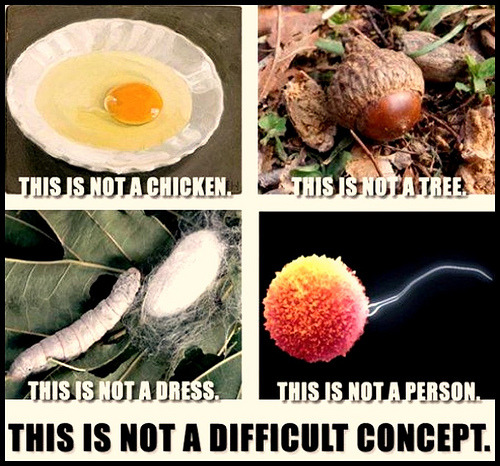 The pro-life response to this picture is sound, but how do you combat pictures in general? As we are but young idealists, we are oh so tempted to believe that logic will win the day. In reality, logic seems to determine but a small portion of human behavior.
Tuesday, June 7, 2011
OK, so I just have to post another one...
This guy is great.
This would be a great video for discussion among Christian intellectuals. Can stories be dangerous? Should we be suspicious of stories? Are we comfortable with being "agnostic"? Are we OK with messes? All these questions seems to get right at the heart of the relationship between faith and reason.
It's good to pay attention to economists.
Saturday, March 5, 2011
Language and Reason
Pyman discusses Florensky's attempt at "an answer to the eighteenth-century dispute between Church and Enlightenment as to whether language is God's gift to man or the creation of the peoples who speak it and the individuals who us it. Florensky's take of this dispute is conciliatory:
In other words, no matter how in tune we are with eternal truth, we still have no firm or final way to express this. "Out of the mouths of babes and infants..."
it is precisely in this contradiction, and in its extreme acuity, that language as eternal, steadfast, unchanging Reason, as pre-human Logos, is in fact conceivable as something at the same time infinitely close to the soul of each one of us, affectionately supple to the heart, personal in its every moment, its every movement and expressive of utmost individuality."I see what Florensky's getting at here, but my suspicion here is that the Church and the Enlightenment were both wrong, and that even a conciliatory view of their positions is insufficient. I'm more convinced by a view of language as a cultural artifact, a "product of human action but not human design." I am a skeptic when it comes to language being so closely tied to "eternal, steadfast, unchanging Reason." There is a reason why words are so hard to define, why Socratic dialogs never reach firm conclusions. Language is grown; it does not transcend the created order, but is a product of the physical passage of time.
In other words, no matter how in tune we are with eternal truth, we still have no firm or final way to express this. "Out of the mouths of babes and infants..."
Tuesday, November 2, 2010
Voting Paradox
Key quote from this video: "While it's entirely rational not to vote...maybe that's not how people decide whether or not to vote."
Monday, October 25, 2010
Concerning philosophy and one year olds
rationalism -noun
1. the principle or habit of accepting reason as the supreme authority in matters of opinion, belief, or conduct.
The life of a graduate student, in my experience, is typically spent around peers, around professors, or in solitude. Marriage is common enough in graduate school, but I would venture to guess that the majority of us aren't married. Parents make up a much smaller percentage of graduate students. In this environment it is taken as a truism that having children hinders progress in our studies. (I have heard stunning exceptions to this. One student in religious studies once told me that his advisor recommends having children as a graduate student--then suddenly you will be unable to waste time.)
Well, you'll get no argument from me on the practical implications of having children--they take a lot of work. What I'm interested in is the effect of simply not being around children, of being immersed in a world of professionals. Of course we could go on all day about how this affects our priorities, what it does to our personal development, and so on. But I'm really interested in the intellectual side of it. How does being absent from children all the time affect the way we think, about ourselves and about our beliefs?
Subscribe to:
Posts (Atom)