At the request of my uncle, who helps run the Splintered Light Bookstore, I'm reading through a book entitled, Mathematics through the Eyes of Faith, which is part of "through the eyes of faith" series. I intend to write a review fairly soon, once I finish, but at the moment I just had a general comment to make about the "through eyes of faith" series. The concept of such a series seems both familiar and strange to me. Many Christians I interact with regularly are of the kind to ask the "big questions" about how faith and life connect, about how to view everything in light of the gospel, about how to bring all things under the authority of Jesus Christ. From a Christian point of view, this seems like the right mission, even if it is an enormous undertaking. Thus, in particular, many Christians are wondering how the various academic disciplines relate to the faith; hence, this series.
On the other hand, something feels a little strange about the kinds of ideas which result from this grand endeavor. Some will argue (not the book I'm reading) the rather extreme position that mathematics makes no sense outside of a Christian worldview. That would be a powerful apologetic if it made any sense to anyone other than those making the argument. Others take the more moderate approach of just trying to draw vague but highly stimulating connections between a particular discipline and Christian faith. For instance, what does Cantor's theory of infinity say about God? Does belief in a personal infinite being open up avenues of inquiry to us which may not have otherwise existed? (Such might be suggested by the very interesting book, Naming Infinity.)
But whatever ideas you might generate by looking "through the eyes of faith," the simple fact is that all disciplines, from mathematics to history to philosophy, continue onward without adhering permanently to one guiding framework. Paradigms come and go. The notion that we need to be constantly aware of how all knowledge fits into a bigger picture can be quite stifling, or at best irritating. No, I'm really not thinking about God every time I recall a result from functional analysis in order to prove a theorem about a system of partial differential equations. Asking me to explain how this new truth I've discovered relates to the gospel is, from my point of view, silly. Frankly, I don't expect mathematics to look noticeably different "through the eyes of faith" than through any other set of eyes.
I think a case can be made for a little fragmentation in our lives. This is precisely what many Christians seem to think is wrong with the secular world: we live in many different parts of reality without being integrated into a whole. But I'm not convinced this is so much of a problem. In fact, it might be worth being more intentional about this. For instance, I highly recommend that everyone make a point of fragmenting political issues from one another. Gay marriage, abortion, prayer in schools, immigration, medicare, and terrorism are all completely unrelated issues. By saying "completely unrelated" I may have made the above statement false, but if you let yourself believe that it is true for a least a little while, you might end up thinking about each issue more rationally, without allowing your views to be predetermined by the one big picture that now informs all of your beliefs. The more we are in the habit of seeing everything through a single lens, the harder it becomes to resolve our differences without entering into conflict.
We may not be willing to say that some beliefs and ideas are unrelated to faith, but perhaps we can at least say that we do not know what the relationship is. Maybe we can never know. In our vain life, sometimes we must simply be content to solve the problems which are solvable, and to leave to God the things that are mysterious. A holistic worldview is perhaps but a chasing after wind.
Showing posts with label epistemology. Show all posts
Showing posts with label epistemology. Show all posts
Wednesday, August 31, 2011


Wednesday, July 20, 2011
Metaphor and Truth
That's the title of Chapter 8 in Philosophy in the Flesh by Lakoff and Johnson. In this chapter they seek to dismantle the traditional theory of metaphor, which they outline as follows:
When I was studying Paul Churchland's work in college, I found phrases like "folk psychology" being used, just as "folk theory" is used here, as if to indicate that the average "folk" really have such a quaint Aristotelian view of the world. If only we would catch up with the recent discoveries of modern science.
Philosophers ever live under the illusion that any idea which is validated by modern science must therefore be modern. In reality, none of the above points make "intuitive sense" to me or, I suspect, any common person who fully understood what was being said. Of course we all use metaphors, all the time. Lakoff and Johnson have done a fine job in their book of showing just how numerous the examples are which illustrate how many of our concepts are built out of controlling metaphors, such as "life is journey" or "love is a car ride" or "knowing is seeing" or "knowing is grasping." But the fact that these simple, ordinary examples are readily available suggests that it never really did require the amazing advances of modern science to realize how blind the philosophers always were to the vanity of their theories of cognition.
"This theory," they claim, "is deeply rooted in the Western philosophical tradition and makes intuitive sense to many people, because it fits an extremely common folk theory about language and truth."
- Metaphor is a matter of words, not thought. Metaphor occurs when a word is applied not to what it normally designates, but to something else.
- Metaphorical language is not part of ordinary conventional language. Instead, it is novel and typically arises in poetry, rhetorical attempts at persuasion, and scientific discovery.
- Metaphorical language is deviant. In metaphor, words are not used in their proper senses.
- Conventional metaphorical expressions in ordinary everyday language are "dead metaphors," that is, expressions that once were metaphorical, but have become frozen into literal expressions.
- Metaphors express similarities. That is, there are preexisting similarities between what words normally designate and what they designate when they are used metaphorically.
When I was studying Paul Churchland's work in college, I found phrases like "folk psychology" being used, just as "folk theory" is used here, as if to indicate that the average "folk" really have such a quaint Aristotelian view of the world. If only we would catch up with the recent discoveries of modern science.
Philosophers ever live under the illusion that any idea which is validated by modern science must therefore be modern. In reality, none of the above points make "intuitive sense" to me or, I suspect, any common person who fully understood what was being said. Of course we all use metaphors, all the time. Lakoff and Johnson have done a fine job in their book of showing just how numerous the examples are which illustrate how many of our concepts are built out of controlling metaphors, such as "life is journey" or "love is a car ride" or "knowing is seeing" or "knowing is grasping." But the fact that these simple, ordinary examples are readily available suggests that it never really did require the amazing advances of modern science to realize how blind the philosophers always were to the vanity of their theories of cognition.
Saturday, June 25, 2011
Another Invisible Hand...
Lakoff and Johnson's Philosophy in the Flesh opens with a couple of chapters pummeling the traditional philosophical notion that pure conscious reflection is the way to discovering truth, particularly epistemological truth. In Chapter 2, on "The Cognitive Unconscious," they write (with some emphasis added),
Conscious thought is the tip of an enormous iceberg. It is the rule of thumb among cognitive scientists that unconscious thought is 95 percent of all thought--and that may be a serious underestimate. Moreover, the 95 percent below the surface of conscious awareness shapes and structures all conscious thought. If the cognitive unconscious were not there doing this shaping, there could be no conscious thought.The more we learn about the world, the more we realize how little we consciously control--even in ourselves.
...
Our unconscious conceptual system functions like a "hidden hand" that shapes how we conceptualize all aspects of our experience. This hidden hand gives form to the metaphysics that is built into our ordinary conceptual systems. It creates the entities that inhabit the cognitive unconscious--abstract entitites like friendships, bargains, failures, and lies--that we use in ordinary unconscious reasoning. It thus shapes how we automatically and unconsciously comprehend what we experience. It constitutes our unreflective common sense.
Wednesday, March 23, 2011
Monday, March 21, 2011
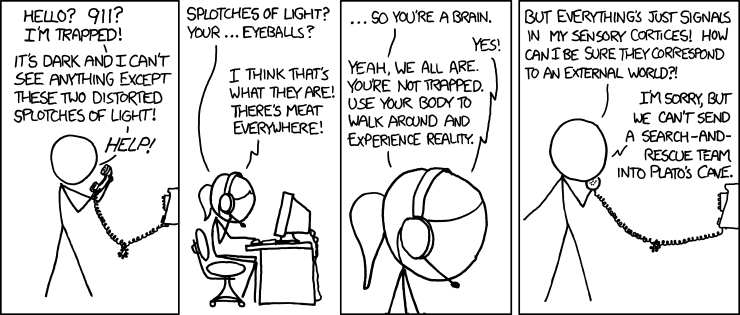
Self and the Other
I happen to be sitting in on faith and science discussions on a bi-weekly basis this year. It's been an interesting journey, as two representatives of UVA's atheist/agnostic society have been joining us pretty faithfully. Last week I became especially intrigued by some of the fundamental philosophical issues that finally came up as a result of our conversation. One of the atheists in our group was led by a conversation about where we find meaning to say the following (I must paraphrase, since my memory is not exact):
There is no resolving the tension; it is inescapable. The only question is, what shall we do with the tension? How do we interpret it? I can name two options; there may be others, but I know of two. One option is nihilism, that is, in the words of my friend, the self is nothing. The self is nothing, because it cannot control its own fate, not really; and yet it must control its own fate, because there is no meaning apart from this. The self is ultimately alone; there really is no Other. "Reality" itself is nothing, with the self eternally separated from it, yet always enslaved by it. With a simple act of will, the self can create meaning for himself, but he never really believes in it. This is nihilism.
The second option is love. Love finds its own identity precisely because it doesn't seek its own identity. Love locates the self in the Other, fully acknowledging its own emptiness. Love's epistemological foundation is grace, the sense that reality is given, not constructed. The self becomes one with the Other, without the two ever being confused. It is only because they are one and the same that they can truly be distinct. In this the self finds true freedom, because love knows that freedom is all of grace, and grace is free. It is this givenness, this freedom, that allows us humans to grow in the knowledge of reality; without grace, we are but nothing studying nothing.
I realize that in my worldview I hold two contradictory beliefs together: one in strict scientific determinism, and the other in the absolute freedom of the individual.And there it is! Anyone who is a true philosopher, in my opinion, has already come to this conclusion: that the freedom of the individual and the reality of the Other exist in tension with one another, not in harmony. For everyone knows that his own actions are his own responsibility, yet simultaneously he knows that he is the product not of himself, but of that which is other than himself. I think, therefore I am; yet my thoughts are not my own, but they are the product of genetics, environment, culture, all the result of the mere passage of time. One may search endlessly to truly locate his own identity, and never find it. Am I my thoughts? My emotions? My body? Yet none of these things seem really to be me, since my thoughts are often conflicting with myself, as are my emotions, and my body perhaps most often of the three of them.
There is no resolving the tension; it is inescapable. The only question is, what shall we do with the tension? How do we interpret it? I can name two options; there may be others, but I know of two. One option is nihilism, that is, in the words of my friend, the self is nothing. The self is nothing, because it cannot control its own fate, not really; and yet it must control its own fate, because there is no meaning apart from this. The self is ultimately alone; there really is no Other. "Reality" itself is nothing, with the self eternally separated from it, yet always enslaved by it. With a simple act of will, the self can create meaning for himself, but he never really believes in it. This is nihilism.
The second option is love. Love finds its own identity precisely because it doesn't seek its own identity. Love locates the self in the Other, fully acknowledging its own emptiness. Love's epistemological foundation is grace, the sense that reality is given, not constructed. The self becomes one with the Other, without the two ever being confused. It is only because they are one and the same that they can truly be distinct. In this the self finds true freedom, because love knows that freedom is all of grace, and grace is free. It is this givenness, this freedom, that allows us humans to grow in the knowledge of reality; without grace, we are but nothing studying nothing.
Tuesday, March 15, 2011
The science of theology
In attempting to explain the Scientia aspect of theology, Vanhoozer says the following about science (The Drama of Doctrine, Ch. 8, p. 247):
It is telling that Vanhoozer has such a gaping hole in his definition of knowledge, here (next page):
While impersonal empirical procedures may be the mark of modern science, they are not that of Aristotle, Aquinas, or Barth. For Aristotle, a science proceeds from the "first principles" that are intrinsic to some aspect or area of reality. These principles are ontological (real) before they are theoretical (propositional). To be scientific is to approach a subject matter in a way that is appropriate with its first principles. ... For both Aquinas and Barth, Christian theology is the science that approaches its subject matter, God, on the basis of first principles that themselves proceed from God: "For sacred doctrine, those first principles are...scripture and Christ."I don't think the classical approach gets off on the right foot. The theoretical does precede the ontological, because all language, including the word ontological itself, is theory-laden. Theory is more than a package of propositions. It is something like a "procedure," as Vanhoozer suspects, but more pertinently it is an interpretive matrix. Critical to the whole discussion of epistemology is that a theory is an evolving interpretive matrix. Ontology, for us feeble creatures, is really a bit of a fantasy. We could learn nothing if we didn't already have a theory about how things work. It is only because our theories are constantly being bombarded with corrections that we are able to learn more.
It is telling that Vanhoozer has such a gaping hole in his definition of knowledge, here (next page):
Theories of knowledge come and go, and theology would frankly be ill advised wholly to invest in any single account. Some minimal account of knowledge is, however, needed; hence the following provisional definition: knowledge is the product of a disciplined approach to a particular subject matter.The irony of this statement is that he gets the first part right: theories come and go, precisely because we are ever-evolving creatures. But his provisional definition of knowledge obviously lacks all accounting for spontaneous increase in knowledge, including those wonderful discoveries which occur mostly by accident. Granted, his main concern in this chapter is discipleship. Yet I don't think it is a trivial matter to completely overlook the way in which knowledge grows more spontaneously than we often believe. Perhaps Vanhoozer ought to remember Barth's words: theology is a free science.
Thursday, March 10, 2011
Concept and thought: Vanhoozer gets it right
Chapter 3, page 90, The Drama of Doctrine:
Many, if not most, of the concepts in the Bible (e.g., father, king, salvation, sin, image of God) are more like "my childhood" or "house" than "spped of light." They have fuzzy edges' they lack exactitude. They are not meaningless--far from it!--yet they are not susceptible to unambiguous and univocal definitions either. While some might worry that such fuzzy concepts communicate less, they actually communicate more. The reason is that concepts are not mental pictures of discrete objects but rather mental habits that connect entities and experiences in significant relationships. A concept is a habitual way of experiencing and interpreting the world. We do not think about but with concepts.Corollary: timeless, unambiguous statements of eternal truth cannot be the goal of theology, unless God really is a creation of man.
Tuesday, March 8, 2011
Essence of human
Fascinating book review on the NYT (HT: Mockingbird blog) talking about the neurological roots of de-humanization, from genocide to slavery. In the book Less Than Human, philosopher David Livingstone Smith argues that we may be in some sense hard-wired to de-humanize people:
Smith clearly explains why many cognitive scientists believe this tendency is innate and then links it to another predisposition that seems “built in” to the human mind: our inclination to see living things in hierarchies, as in the “great chain of being” of medieval European Christians, with God at its perfect top, human beings above “higher” animals, and so on down to worms and plants. Because we feel that living things are defined by their essence, and because we feel that each creature has its rank in the world, Smith argues, dehumanization comes easily to the human mind: we accept that someone can look human but have a subhuman essence, and we accept that what is not human must be inferior. “When we dehumanize people,” he writes, “we think of them as counterfeit human beings.”But reviewer David Berreby thinks this explanation doesn't match reality:
All these troubles arise because Smith’s insistence on immutable essences is only half right: people do categorize themselves and others using essences, but there’s nothing immutable about them. If, like trained philosophers, we could settle for good who is essentially human and who is a zombie vampire squid, we wouldn’t have, or need, this drama of dehumanization, rehumanization, then more dehumanization, and so on. Instead, the who-is-and-isn’t-human question is never truly settled. In fact, it is the dynamic, even mercurial nature of “real human” status that makes this mystery of our psychology so fascinating. What Amenemhet wants us to remember isn’t that he thought Asiatics were dogs, but that he made them act like dogs.It's something worth thinking about: given dynamic conceptual frameworks, how do we become more just? Is it by taking the philosopher's approach, which is essentially to make our concepts more static, or is there a way to account for justice for an evolving human consciousness?
Saturday, March 5, 2011
Language and Reason
Pyman discusses Florensky's attempt at "an answer to the eighteenth-century dispute between Church and Enlightenment as to whether language is God's gift to man or the creation of the peoples who speak it and the individuals who us it. Florensky's take of this dispute is conciliatory:
In other words, no matter how in tune we are with eternal truth, we still have no firm or final way to express this. "Out of the mouths of babes and infants..."
it is precisely in this contradiction, and in its extreme acuity, that language as eternal, steadfast, unchanging Reason, as pre-human Logos, is in fact conceivable as something at the same time infinitely close to the soul of each one of us, affectionately supple to the heart, personal in its every moment, its every movement and expressive of utmost individuality."I see what Florensky's getting at here, but my suspicion here is that the Church and the Enlightenment were both wrong, and that even a conciliatory view of their positions is insufficient. I'm more convinced by a view of language as a cultural artifact, a "product of human action but not human design." I am a skeptic when it comes to language being so closely tied to "eternal, steadfast, unchanging Reason." There is a reason why words are so hard to define, why Socratic dialogs never reach firm conclusions. Language is grown; it does not transcend the created order, but is a product of the physical passage of time.
In other words, no matter how in tune we are with eternal truth, we still have no firm or final way to express this. "Out of the mouths of babes and infants..."
Florensky on Ontology
From Avril Pyman's biography on Florensky, quoting Florensky:
The basic self-awareness of humanity, that 'I live in the world and with the world', presupposes the existence, the real existence as reality, of both myself, humanity as such, and that which is outside myself, which exists apart from me or, more exactly, independently of human awareness ... In the act of cognisance it is impossible to separate subject from object; cognisance is at once the one and the other; more exactly, it is precisely the cognisance of the object by the subject, a unity, that is, in which the one can be distinguished from the other only in the abstract, yet at the same time the object is not obliterated by the subject, neither is the latter dissolved in the object of cognisance exterior to itself. Moreover, once unified, they do not engulf one another even though, while maintaining their mutual independence, they are no longer divided. The theological formula without confusion and without separation is fully applicable to the cognitive interrelationship of subject and object...In other words, subjective and objective are analogous to the two natures of Christ--both bound up together as one, yet fully distinct. It is a paradox on which the pursuit of all knowledge depends.
Monday, February 7, 2011
Materialism and the Mind
Christianity has historically embraced a dualist interpretation of the mind/body problem inherited largely from the Greeks (Plato, Aristotle, etc.). There are two main reasons for this embrace: the first is explanatory, and the second is ontological. The explanatory power of dualism is intuitive to many (if not most) people. Thought does not appear to be physical, and reason appears to ascertain truths far more abstract than any material substance. It seems intuitively plausible that reason itself must be the product of a non-material substance. Along these lines an even more compelling case can be made for the non-physical existence of the will, which, if separated from the mind, constitutes perhaps yet a third "substance" in addition to the mind and the body. The ontology of dualism (or trio-ism?) is probably even more important to the Christian than this explanatory power. It typically helps explain the image of God in man, the ability for human beings to spiritual, and the significance of human life over and against plant and animal life.
Monday, January 31, 2011
Words, meaning, and truth
Words are artifacts of human existence. When we first encounter them, they are not symbols for preconceived abstract ideas. Such ideas develop only in the course of time, as we connect various experiences in a network of associations. Words become associated with people, things, actions, and more generally patterns which can be perceived by the human mind. They then become symbols, but not merely so. To think of words as merely symbols is to falsely assume that language was designed for the purpose of representing a certain a priori cognitive framework.
Wednesday, January 26, 2011
Reuters: mathematics is just opinion
Reuters reported last week on a Japanese man who reached a new world record for computing the digits of Pi:
This makes me think about how I teach mathematics. Just because I've proved something rigorously, does that mean students believe me? That is, do they now accept it as genuine fact? How much of a difference is there, fundamentally, between not understanding a proof and doubting a proof? Things to ponder...
HT: Gary Davis
Shigeru Kondo, a systems engineer in his 50s at a food company in the central Japanese prefecture of Nagano, in August calculated pi -- the ratio of a circle's circumference to its diameter -- to five trillion digits, almost doubling the accuracy of the previous world record.It's "believed" to go on forever? Who knew the media was so skeptical of mathematical proof?
...
Calculating a more accurate pi, which is believed to go on forever, has been a challenge for scholars for thousands of years, ever since the parameter was used in ancient Egypt.
This makes me think about how I teach mathematics. Just because I've proved something rigorously, does that mean students believe me? That is, do they now accept it as genuine fact? How much of a difference is there, fundamentally, between not understanding a proof and doubting a proof? Things to ponder...
HT: Gary Davis
Friday, December 31, 2010
The beauty of abstract simplicity
Gary Davis over at Republic of Mathematics has an interesting hypothesis about how less able mathematics students are making problem solving unnecessarily complicated. He uses some good illustrations to show how an astute mathematics student will take the time to formulate the simplest method of approach. He hypothesizes that a less able student will even choose more complicated examples in studying a particular idea (see his example of multivariable functions).
Excelling in mathematics, or in any theoretical field, requires an ability to make things simpler. It seems to me that what holds people back is that they erroneously equate "abstract" with "complicated," when in fact it's just the other way around. We create abstractions precisely to make simple the things that are complicated.
Excelling in mathematics, or in any theoretical field, requires an ability to make things simpler. It seems to me that what holds people back is that they erroneously equate "abstract" with "complicated," when in fact it's just the other way around. We create abstractions precisely to make simple the things that are complicated.
Saturday, December 11, 2010
Symbol and Meaning
I made an abbreviated effort to express my current epistemology of mathematics, in which symbols take on a primary role, to one of my fellow grad students. His response was, "But they're more just than symbols."
Just symbols? I can see where he's coming from. Anyone who's tried to explain mathematics to someone else knows the frustration of trying to express concepts as more than mere symbolic manipulation. As grad students we're expected to teach mathematics to students who are often pretty uninterested in math, and who have often been taught their whole lives that math is nothing but symbols which have no connection to the real world. Trying to convince these students that there is real meaning behind these symbols can be exceedingly frustrating, especially if they care about their grades but not about the material. Students who try merely to memorize symbolic manipulations without understanding any of the concepts will do poorly in a college calculus class, and the worst part is they might not ever know why.
Just symbols? I can see where he's coming from. Anyone who's tried to explain mathematics to someone else knows the frustration of trying to express concepts as more than mere symbolic manipulation. As grad students we're expected to teach mathematics to students who are often pretty uninterested in math, and who have often been taught their whole lives that math is nothing but symbols which have no connection to the real world. Trying to convince these students that there is real meaning behind these symbols can be exceedingly frustrating, especially if they care about their grades but not about the material. Students who try merely to memorize symbolic manipulations without understanding any of the concepts will do poorly in a college calculus class, and the worst part is they might not ever know why.
Sunday, November 28, 2010
Evolution of mathematical symbols
At first glance (at least for me), mathematics seems to be a purely rationalistic endeavor. One sits and thinks about a problem, and then by the sheer power of the individual mind is able to produce an answer. By nothing more than logical deduction, one is able to prove theorems linking certain basic assumptions to interesting and/or useful conclusions. Unlike most other subjects, mathematics is a quest for abstract principles, without any necessary connection to concrete facts.
Yet doing mathematics requires symbols, which are necessarily concrete in their origin and use. The use of symbols in mathematics arises naturally even at its very beginning: counting. There is nothing more fundamental to mathematics than a collection of symbols representing different quantities. What often goes overlooked by those who don't study mathematics is that embedded in those symbols is a theory of numbers. For instance, many people hardly notice that our counting system is a "base 10" or "decimal" system. The number 10 itself is not so significant. What is significant is that somehow everyone knows that when I put a "1" directly to the left of a "0" I actually mean ten. This principle allows us to express remarkably large numbers with relatively few digits; indeed, the value of a number grows exponentially with the length of the number: 10 is ten times 1, 100 is ten times 10, 1000 is ten times 100, and so on. Thus a deep fundamental principle is embedded into the very symbols we use to count things: that all whole numbers are uniquely expressible as a sum of powers of ten, where the coefficients of each power is something between zero and nine.
Yet doing mathematics requires symbols, which are necessarily concrete in their origin and use. The use of symbols in mathematics arises naturally even at its very beginning: counting. There is nothing more fundamental to mathematics than a collection of symbols representing different quantities. What often goes overlooked by those who don't study mathematics is that embedded in those symbols is a theory of numbers. For instance, many people hardly notice that our counting system is a "base 10" or "decimal" system. The number 10 itself is not so significant. What is significant is that somehow everyone knows that when I put a "1" directly to the left of a "0" I actually mean ten. This principle allows us to express remarkably large numbers with relatively few digits; indeed, the value of a number grows exponentially with the length of the number: 10 is ten times 1, 100 is ten times 10, 1000 is ten times 100, and so on. Thus a deep fundamental principle is embedded into the very symbols we use to count things: that all whole numbers are uniquely expressible as a sum of powers of ten, where the coefficients of each power is something between zero and nine.
Friday, November 26, 2010
The use of the mind in society
Friedrich Hayek is primarily known for his contributions to economics and political philosophy. Yet one of his best contributions to both of these fields is an underlying theory of social learning. As an economist, he was interested in how it is that civilizations make use of information which is distributed among many individual minds (see, for instance, Hayek's essay, "The Use of Knowledge in Society"). As a political philosopher, he was interested in how institutions come to be, and how these institutions benefit individuals and allow society to progress. In both cases, Hayek finds that people engaged in free exchanges with one another unwittingly contribute to a process of social learning of which they themselves are mostly unaware.
Monday, November 22, 2010
Hayek Against Rationalism
All political theories assume, of course, that most individuals are very ignorant. Those who plead for liberty differ from the rest in that they include among the ignorant themselves as well as the wisest. Compared with the totality of knowledge which is continually utilized in the evolution of a dynamic civilization, the difference between the knowledge that the wisest and that which the most ignorant individual can deliberately employ is comparatively insignificant.Perhaps the single most attractive part of Hayek's philosophy is, in my view, his epistemology. This is not something that the majority of people are likely to care about. Yet whether most people care about them or not, questions about what we know and how we know it are intensely important to the intellectuals who are often most influential in shaping society. The argument for a free society must have, as part of its foundation, an argument for the right kind of answers to these questions.

Monday, October 25, 2010
Concerning philosophy and one year olds
rationalism -noun
1. the principle or habit of accepting reason as the supreme authority in matters of opinion, belief, or conduct.
The life of a graduate student, in my experience, is typically spent around peers, around professors, or in solitude. Marriage is common enough in graduate school, but I would venture to guess that the majority of us aren't married. Parents make up a much smaller percentage of graduate students. In this environment it is taken as a truism that having children hinders progress in our studies. (I have heard stunning exceptions to this. One student in religious studies once told me that his advisor recommends having children as a graduate student--then suddenly you will be unable to waste time.)
Well, you'll get no argument from me on the practical implications of having children--they take a lot of work. What I'm interested in is the effect of simply not being around children, of being immersed in a world of professionals. Of course we could go on all day about how this affects our priorities, what it does to our personal development, and so on. But I'm really interested in the intellectual side of it. How does being absent from children all the time affect the way we think, about ourselves and about our beliefs?
Sunday, August 22, 2010
Unity in Truth
For just as the body is one and has many memberrs, and all the members of the body, though many, are one body, so it is with Christ. (1 Cor. 12:12)Can there be unity among Christians? There are always attempts being made to do so. In our day people very much appreciate dialogue, and there is a lot of hunger, especially among young Christians, to see divisions decrease. Yet there are always a significant number of people who say (and reasonably so, at least on the face of it) that "we can have unity as long as we unite around truth." After all, it would be silly to unite solely around the fact that we're willing to call ourselves "Christians." We'd have unity, but we'd have very little to show for it.
And yet, all those passionate seekers of truth, despite the best of intentions, always seem to end up splitting Christianity into smaller and smaller pieces. Why is this? There may be many reasons, but I have come to suspect that it largely boils down to a misunderstanding of what truth is, and how we get it.
Postmodernism has brought with it the now widespread idea that truth is relative to both cultures and individuals. The assumptions we hold are conditioned by our experiences and by the society we live in; therefore there really is no "absolute truth." Christians (at least of a more conservative bent) tend to emphatically reject this assumption, insisting that truth is one, and that it is absolute. This is ironic for a group of people who run around proclaiming so many conflicting "truths." Uniting around the belief that there exists only one capital-T Truth is as vacuous as uniting around a mere label, such as "Christian."
The question is, what do Christians have with which to replace postmodern claims about truth? Can we deal with postmodern critiques without merely dismissing them? It would not be wise to neglect the insight that our assumptions are indeed culturally conditioned, and that a lot of the truths we cling to are largely wrapped up in personal experience. Ignoring these insights does not make them go away. It is not much better to casually admit, "True, our beliefs are largely culturally conditioned, but that doesn't mean there isn't absolute truth out there to be found." We ought to have some positive evidence that there really is Truth to be found, and that we're not wasting our time in search of it because we wish it to be there.
How have we misunderstood truth? In my opinion, postmodern claims about truth are irrefutable, provided we assume truth is something to be grasped individually. This understanding of truth is so fixed in our minds that I suspect it would take ages to pry it out. Yet what I believe to be closer to reality is that truth is grasped corporately. It might even be necessary to say something as radical as truth is not a "thing" to be grasped at all, but it is more like a state in which all the parts of a whole are properly ordered.
What leads me to this idea? Ironically, I would start with how individuals learn. One incredible modern insight is that the mind is, essentially, a corporate entity. The brain is composed of billions of cells, each of which sticks to its own individual tasks. Thus learning, even for a single human being, is a corporate activity. Propositions are not grasped by any one neuron. Human understanding is a product of all the parts of the brain being in proper cooperation with each other.
This proper cooperation is exactly what Paul is describing in 1 Corinthians 12. He describes many different tasks that we are given in the church, yet all of these separate tasks are part of the functioning of the one body of Christ. What if we applied this to our understanding of truth?
We already intuitively sense that our pursuit of knowledge benefits from diversity. We see how beneficial it is to discuss things collectively, so that flaws in our reasoning might be exposed and different voices might give us needed perspective. But all this gives us is a struggle to find the right balance between open-mindedness and strong resolve. This is because we still believe that knowledge is fundamentally something to be grasped individually. Hence the struggle is to find the best strategy for getting truth for oneself: open-mindedness might help bring a person closer to truth, while being resolute in one's opinions might protect it from outside threats.
What if this struggle is fundamentally misguided? Individual neurons in the brain do not individually struggle to understand propositions. That is the task of the brain as a whole. In the same way, I suspect that the Truth we are after is of a higher order than each of us as individuals. None of us can grasp it. I am not saying that none of us are smart enough. I am suggesting that it is necessarily impossible, like individual neurons trying to learn calculus, or individual muscle cells trying to play basketball. The Truth is not within our grasp because we are not supposed to grasp it individually, but collectively. This is why the church is a body, and not merely a set of individuals.
The postmodern complaint that no one can own the truth seems to be correct. But the conclusion that there is no truth relies on the assumption that we are meant to exist solely as individuals, rather than as a connected whole. Yet in the New Testament, the "new humanity" (Eph. 2:15) is a "body," (1 Cor. 12:12) organically connected to one another, as it were. It is not the destiny of human beings to find truth individually, but only as a body.
So if truth is not something that can be grasped individually, what is it? I have to insist that I don't know, because it is beyond my grasp. Instead, I merely insist that I am connected to a body that, in time, will be "guided into all the truth." (John 16:13)
For Catholics (at least of a conservative persuasion), the interpretation of John 16:13 is that the Church has been kept safe from key doctrinal errors, and that the way to have the Truth is to receive the teaching passed down through the Church. This would appear to be close to what I am saying, but it is in fact radically far off. The job of the body is not to receive the truth and break it down into propositions which can be understood by each individual part of the body. How absurd would it be if the brain broke down ideas so that the fingers and toes could understand them! This is not even necessary, nor is it reasonable. Rather, the body as a whole gains wisdom as each member of the body carries out its function properly.
Thus the function of the church as the "pillar and ground of the truth" (1 Tim. 3:15) is not primarily to write down statements of doctrine to which its members ought to assent. Statements of doctrine are wonderfully useful. I by no means intend to disparage words and propositions. That is how, for millennia, human beings have meaningfully communicated with one another on a level that would not be possible otherwise. I am simply saying that words and propositions are not "the truth," and never will be. No, the task of the church, as I have said, is to be well-ordered, to be healthy, and in this way to collectively possess the truth in a way that surpasses all individual understanding.
Here I have to express my skepticism toward the Protestant treatment of the doctrine of Sola Scriptura. In my mind there are two very different understandings of that doctrine, one of which I can accept, and another which doesn't work, in my opinion. The former is simply that the church does not have authority over Scripture, but must be continually transformed by it; in this sense the Scriptures are "authoritative." This much I can accept.
But there is a second sense in which Sola Scriptura commonly taken, and in that sense the Bible is God's Truth perfectly expressed to man in written form. Regardless of whether or not the words of the Bible are 100% factually accurate, I find it difficult to accept this doctrine of Sola Scriptura on philosophical grounds. Words and propositions do not add up to Truth, and I think this applies as much to the Bible as to anything else. Not that the Bible is just some other book; I wouldn't even suggest such a thing. I just think we have to make a distinction between capital-T Truth and the words of Scripture. Wouldn't every Protestant admit that understanding the words of Scripture is not the same as knowing God? Theologically speaking, wouldn't we rather say that knowing God is closer to what "having the Truth" is about, rather than knowing certain doctrines?
So then I reject these two notions of Truth espoused (at least sometimes) by both Catholics and Protestants--dogma on the one hand and "Sola Scriptura" on the other hand--which are really the same notion, namely that Truth is meant to be consumed individually. Instead, I propose that Truth is meant to be understood by us corporately, by which I mean that we are connected to one another and rightly ordered as a body. Ideally this means all humans. But it is natural to ask, how do we as the church pursue truth under this model?
For one thing, we each do our individual tasks. Each of us has a particular calling, and we ought to fulfill that calling in faith that by doing so we are contributing to the proper functioning of the body. The eye has to have faith that because it does its job, the legs will be able to carry the body where it needs to go. The ear has to have faith that because it does its job, the mind will understand what's being said. We all have to have faith in our individual tasks, because those tasks are all essential parts of a much greater body; and none of us has the right or that capability of overseeing the entire body.
For another thing, we connect to one another. The famous "love chapter" is the central part of Paul's argument in 1 Corinthians 12-14, concerning the body and its proper ordering. Love really is the core of the Christian life. We ought to have faith that our collective understanding of the truth comes out of our mutual love for one another. I don't think it really happens in reverse. One does not need to know "the truth" in order to love others. Neither do I think it really helps us love one another when we have pure doctrine. Rather, love is more fundamental. Truth is something that we can have together, but only if we have love keeping us together. If we don't have love, then neither will we have truth. But this requires a different notion of "truth" than what is commonly accepted.
I think I'll end this here. There's a lot more I could say, but I think I will save it for other topics.
Subscribe to:
Posts (Atom)