I realize this is not the kind of everyday pleasure reading that most people would engage in. But it appeals not only to my tendency towards abstraction (hello, I'm a mathematician), but also my deep personal desire to answer those scary questions, like what is truth?
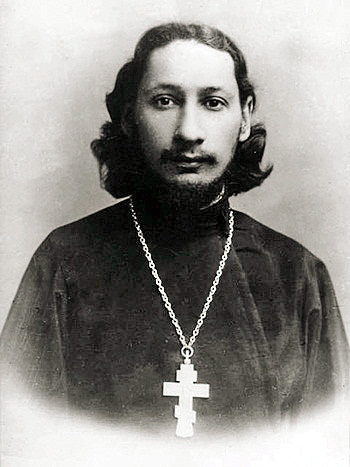
This book has had a profound impact on me. Not that everything it says is thoroughly compelling to me, but its approach is unlike anything I've seen before. I love how Florensky starts from such an intensely personal point of view, and then delves into philosophical abstraction not only with intellect, but with passion.
The (Eastern) Orthodox way of thinking is fiercely Trinitarian. This is the Ground of the Truth. There simply is no Truth without Trinity.
Already in this we see Florensky powerfully seek to dismantle Western rationalism. For him any attempt to search for the Truth based on "givens," the axioms of the human mind, is deeply flawed. Thus he strongly condemns the Law of Self-Identity:
"A = A. That is the final answer. But this tautological formula, this lifeless, thought-less, and therefore meaningless equality A = A, is, in fact, only a generalization of the self-identity that is inherent in every given. But by no means is this formula an answer to our question 'Why?'The Truth, on the other hand, is absolute precisely because it transcends this egotistical self-assertion. It finds its self-identity through the denial of self, receiving itself back through love.
...
"'I = I' turns out to be nothing more than a cry of naked egotism: 'I!'"
"Instead of an empty, dead, formal self-identity A = A, in virtue of which A should selfishly, self-assertively, egotistically exclude every not-A, we get a real self-identity of A, full of content and life, a self-identity that eternally rejects itself and that eternally receives itself in its self-rejection.So in this view, Truth is found not (as dear old Schaeffer would have it) in the Principle of Non-Contradiction, but rather in the Principle of Self-Contradiction, the principle of denying oneself in order to find self-identity through love, rather than rationality.
...
"Truth is the contemplation of Oneself through Another in a Third: Father, Son, and Spirit."
This view of the Truth also leads to a similarly styled view of the truth (with a lower-case "t"). If the nature of Truth is the denial of this self-identity "I = I," then it's not surprising that Florensky comes to a view of "truth" (meaning knowledge about the Truth) that relishes antinomy, or contradiction:
"A rational formula can be above the attacks of life if and only if it gathers all of life into itself, with all of life's diversity and all of its present and possible future contradictions. ... It follows that truth is a judgment that also contains the limit of all its refutations, or (in other words) that truth is a self-contradictory judgment."But if you really hate all this abstraction, you'll thank Florensky for pointing out how concretely this idea appears in scripture. He actually gives a little list of antinomies in scripture (one or two examples omitted):
Divinity: both One and ThreeFlorensky isn't giving skeptics a cheat-sheet for how to argue against Christianity. He's stating powerfully what he feels to be the very strength of Orthodoxy.
Christ: both human and divine
Relation of Man to God: both predistination (Rom 9) and free will (Rom 9:30 - 10:21)
Sin: both through the fall of Adam (Rom 5:12-21) and inherent in the flesh (1 Cor 15:50)
Retribution: both retribution according to works (Rom 2:6-10, 2 Cor 5:10) and free forgiveness (Rom 4:4, 9:11, 11:6)
Final Fate: both universal restoration (Rom 8:19-23, 11:30-36) and the "double end" (Rom 2:5-12)
Works: both the necessity of works (1 Cor 9:24) and the lack thereof (Rom 9:16). See also Phil 2:12 and then 2:13 for a related antinomy
Faith: both free and depending on free will (John 3:16-28) and God's gift not found in human will but in the will of God (John 6:44)
Judgment: "For judgment I come into the world" (John 9:39) "I came not to judge the world" (John 12:47)
"Contradiction! It is always a mystery of the soul, a mystery of prayer and love. The closer one is to God, the more distinct are the contradictions. In Heavenly Jerusalem, there are no contradictions. Here, on earth, there are contradictions in everything; and they can be removed neither by social reorganization nor by philosophical argument."In this way he disparages all rationalistic worldviews. (No doubt the Soviets didn't approve of this, as their own Marxism depended on the strength of "social reorganization" to solve the contradictions of life.)
It is with these things in mind that I read a recent article by Al Mohler disparaging the postmodernism of "emergent church" types. He writes:
"The problem is this -- [the] argument that truth is plural means that the church should both embrace and celebrate different and even contradictory understandings of these doctrinal statements and core truths."I wonder what Florensky would have to say about this classical Protestant attitude?
"A heresy, even a mystical one, is a rational one-sidedness that claims to be everything. ... Orthodoxy has a universal nature, but heresy essentially has a sectarian nature. The spirit of a sect is the egoism that emanates from it, spiritual separateness. A one-sided proposition takes the place of absolute Truth..."Under this view, I suppose that Protestantism is, by its very nature, heretical. At its very core is the desire to get the Bible right, to boldly affirm one interpretation to the exclusion of other contradictory interpretations.
I wonder if Florensky has a point. The empirical evidence from the Bible is almost compelling enough. Can anyone actually resolve these passages together logically? Somehow I think those who do inevitably suck the life out of one passage or another.
But if that's not enough, can't you just take a look around at the sheer number of Protestant denominations and ask, didn't these all come from a desire to be "right"? Is there maybe a hint of egoism in our Protestant tendency to split, not only from the historic Church, but even from each other?
On the other hand, Protestantism is a reaction against idolatry. Thus it always seeks to remind humanity that its conceptions of God are always too small. If only Protestants would continually apply this principle to our own rationalistic interpretations of scripture!
There are many reasons to think about this conception of truth other than to critique Protestantism, for sure. This just happens to be on my mind at the moment, as it often is.
In any case, The Pillar and Ground of the Truth is shaping my thinking in lots of ways, and this won't be the last time I mention it.