Showing posts with label skepticism. Show all posts

Saturday, September 18, 2010

Training skeptics

This semester my teaching experience has been much different than last year. Whereas last year I taught a "throw-away" calculus course designed to fulfill a requirement for certain majors (but not designed to prepare students for any mathematics beyond calculus), this semester I'm teaching an honors course in multivariable calculus specifically designed to train students for higher level mathematics. Hence one of the essential parts of the course is teaching students to write proofs.

There is a certain level at which young mathematicians regard "proofs" almost as a specific area of math. They've learned algebra, trigonometry, calculus, and now they're learning "proofs." If they continue on in mathematics, they can't continue to think this way for long. Proof is not a part of mathematics. Proof is mathematics.

On the list of ways in which we teach mathematics badly in American schools, I would certainly add that we teach students that writing is not a part of mathematics. Writing is part of everything. If you can't write it, you can't communicate it. Perhaps part of the problem is that most people (even those who teach mathematics in high school and below) don't even realize mathematics needs to be communicated. Why would you need to convince someone that something is true in mathematics? Hasn't it all been figured out already? I kid you not--I would not be surprised if half the people I meet don't realize there's still being research done in mathematics. As in there's still math we don't know!

Since we teach students to do math without actually writing sentences, we also implicitly teach them that math is nothing more than a series of arcane symbolic manipulations that magically results in an answer. Many students will simply never grasp the idea that mathematics is really a set of questions that real people have asked out of genuine curiosity, and have answered purely through deductive reasoning. No magic necessary.

My students are a little sharper than that, but many of them still have a rough transition to make. They know how to get the answer, but they're totally new to actually writing mathematics. Thus if they were asked to prove that if x is a number other than 1, then 1 + x + x^2 + ... + x^n = (x^{n+1} - 1)/(x-1), they might give me an argument that looks like this:
1 + x + x^2 + ... + x^n = (x^{n+1} - 1)/(x-1)
(x-1)*(1 + x + x^2 + ... + x^n) = (x-1)*(x^{n+1} - 1)/(x-1)
(x + x^2 + ... + x^{n+1}) - (1 + x + x^2 + ... + x^n) = x^{n+1} - 1
x^{n+1} - 1 = x^{n+1} - 1
writing a check mark beside the last line. It seems like a legitimate way to argue, because the symbolic manipulations are exactly what they've been trained to do all through their previous math education, particularly when they're trying to solve equations. And the symbolic manipulations generate something that's true! So it must be right.

There is a sense in which this argument is correct. If the student were to indicate that each line is logically equivalent to the line before it, then I suppose the argument would work. But it still wouldn't feel like good style. Everyone who is trained in higher mathematics (or in logic) understands this basic fact about a good argument: you don't start with what you're trying to prove. You start with your hypothesis, then argue step by step to the conclusion.

A reasonable argument of the proposition I just mentioned might simply reverse the lines of the poorer argument I gave, but that would be rather clunky. A good argument would actually use words! It would be much easier and clearer to simply write the following:
Observe that (x-1)*(1 + x + x^2 + ... + x^n) = (x + x^2 + ... + x^{n+1}) - (1 + x + x^2 + ... + x^n) = x^{n+1} - 1. Now divide both sides of the equation by (x-1) to obtain the desired conclusion. QED

Here's what I tell my students: try to write as if you're trying to convince the most skeptical person in the world. Every line you write has to be 100% convincing. Starting with what you're trying to prove will never satisfy a skeptic, because a skeptic knows that you can get anything to be true if you just start by assuming it to be true. For instance, let's say I want to prove that -1 = 1. Well, my argument would be rather short and sweet:
-1 = 1
(-1)*(-1) = 1*1
1 = 1 (check mark!)
Since what I got in the end is clearly true, the argument must work, right? Well, of course not, because -1 does not equal 1. But that's basically how students will argue when they're first starting to write proofs in mathematics. They've never had to convince a skeptic before. All they had to do was convince their teachers, who really just wanted to see a bunch of symbolic manipulations that magically resulted in an answer. In other words, all they had to do before was computations. Now they actually have to write arguments.

I have a great deal of uneasiness about the whole process of teaching good mathematical writing. I can tell them all day what's wrong with their proofs, and they might write little notes to themselves to try to figure out what I want to see on their homework. But that's the last thing I want them to learn. I don't want them to be able to convince me. I want them to be able to convince anyone who understands the symbols being used. There's no precise way to say this, but what I'm really going for is that they would be able to convince reason itself. Somehow they have to transcend the personal motives of finding acceptance from their teacher and getting good grades. They have to develop an innate desire to critique their own arguments, and write something about which they can confidently say, This is simply irrefutable.

Of course, mathematics is never really exactly like that in the real world of research. Mistakes are made. In the rush to get results published, sometimes mathematicians have indeed overlooked important details. But members of the mathematical community are constantly attempting to hold each other to that rigorous standard of irrefutable proof. This principle is emulated in all the sciences, yet mathematics has the privilege of working by pure logic. There is no "methods" section of a research paper in mathematics.

What an interesting sort of community this is, though. We're not a community of experimentalists, who argue over the analysis of data. We're not a community of theologians or philosophers, who argue over the meanings of words or doctrines. In fact, arguments between mathematicians are rarely over the actual content of what they study. We can argue over what the best method of proof is (though such arguments can be absurd), or we can argue over what we think the solution to a problem will be (though such arguments are rendered somewhat meaningless once the problem is actually solved). (There are also plenty of arguments between mathematicians mainly concerning their own egos; in that our community is not at all unique.)

If all the theologians or philosophers in the world were asked to reach a conclusive solution to a problem in one of these disciplines, they would only succeed in dividing into several camps. Yet do the same thing for all the mathematicians in the world, and all of them, working entirely independently from one another, can still reach the same solution. There will be no disagreement on the final result. Of all the other academic disciplines, the scientific community is most similar to this; yet the scientific community routinely has to correct past theories.

Does that make the mathematics community somehow ideal, which the whole world ought to emulate? Not at all. Mathematics progresses through skepticism; society in general does not. Part of skepticism is the ability to say, "I don't know." In the case of mathematics, we can say that for quite a long time--many famous problems have taken centuries to solve. It would be absurd to advocate the kind of rigor that mathematics demands as a way to unite all people. There are plenty of decisions in life that need to be made now. There are plenty of questions of profound importance which demand incomplete answers. I believe it was an insight of Friedrich Hayek that if we only accepted what we could justify on purely rational grounds, no human institutions could exist.

In short, mathematics is a luxury sport (like everything academic). That's not to say one must come from a wealthy family to do it. But it is certainly something that society could never have developed if it had never moved beyond the point of just doing enough to survive. More than that, it fundamentally arises out of a certain kind of dissatisfaction with mere acquaintance with the world around us. Mathematics can be characterized by a strange and relentless longing to see the inherent logical connections between ideas.

That is basically what I'm trying to train my students into. It should not be surprising if some of them never get it. If this innate desire is in you, you don't really need your teacher to justify it. On the other hand, if this desire isn't in you, then I wonder if you can ever really understand more than what it is that your teacher wants to see on your homework.

The point is that if a student wants to really do mathematics, he has to be skeptical of himself, first of all. He has to understand that it doesn't really matter whether or not he has the basic gist of a problem. He has to learn to expect a kind of precision of himself that can only be based on a relentless desire to see clearly the logical connections between ideas. If one is genuine about this, it really demands a great deal of humility. It demands the ability to say, I don't know until I have truly seen. And when one has seen clearly, then one has to humbly accept that there is no denying what one has seen. Yet while this is a humbling experience, it is simultaneously empowering, as it grants the ability to prove irrefutable claims.

Even as I teach students this, I am still learning it myself. It is an endless process. Yet I have to believe there is some inherent value in it. On the other hand, whether or not mathematics has value is hardly a mathematical question.

Saturday, July 3, 2010

Ritual, Narrative, and Understanding the World

Inspired in part by a post by Peter Leithart called "Changing the Liturgy," I thought I'd share this piece of human psychology demonstrated here:

What I think this video demonstrates is how we enter into ritual behaviors (which are called "liturgies" in a religious context) and commit to seeing them through to the end, so much that we can be led to miss rather obvious details in our surroundings. The trickster you see in this video, Derren Brown, has a bit of an agenda in mind. He wants to show people how they are so easily fooled. He seems to be trying to train people in the ways of skepticism.

One thing I found just as interesting as the video itself was watching the reactions of my friends to the video. You probably will have them yourself: laughter and incredulity. There's a certain irony to this reaction. The people in the video are so easily fooled because they have accepted a narrative about their surroundings and are committed to acting within that narrative. Our reaction to those people also shows how we have bought into a certain narrative.

The narrative we buy into is that human beings are reasonable people who make choices one at a time; call it the "narrative of rationality." Part of this narrative is that all evidence is equally important. Every detail matters, and if we are alert enough to notice every detail, it shouldn't be difficult to make rational decisions based on those details. Thus our incredulity: how could these people be so stupid? Would I be that stupid if put in that situation? What's happening to the narrative I've accepted about myself as a rational person?

Clearly this video shows the narrative of rationality to be false: normal people often don't operate that way. But whereas Derren Brown might suggest that the average person just needs to learn a bit more skepticism, I would suggest a different idea. Ironically, the firm belief in absolute skepticism (which, to be fair, I can't say for sure Brown holds) requires a commitment to merely a different narrative about the world than the ones ordinary people buy into. Call it the "narrative of unreliability": everything and everyone is potentially a threat, and only by forcing your surroundings to undergo the most rigorous scrutiny can you achieve the best result.

Consider this other video:

Notice that Brown is able to swindle two businessmen--even a high end jeweler!--but he isn't able to swindle the hot dog vendor. My hypothesis: the hot dog vendor more easily accepts the narrative of unreliability. Perhaps in the world as he experiences it, people really are out to get him, and he really isn't safe. The narrative we accept about the world informs how we respond to things.

I don't think the answer is pure skepticism, i.e. just testing everything until you make sure everything works. This simply buys into the narrative of unreliability, and ironically, this narrative cannot be questioned. Skepticism is never able to turn in on itself, or if it does, the result is pure nihilism. I think we can do better than that.

What I'd like to do is offer something more constructive. What we need is a narrative of "constructive ritual-making." This means two things. One is that we can't do without rituals; they are the mechanisms by which we gain access to the order of the universe, the means by which we ultimately understand the world we live in. The second thing is that rituals can and do bind us, and at times they bind us to false things; thus we must continue to build and adapt rituals as we measure the successes and failures of our old ones.

Normal people (and really all people, to greater and lesser extents) must rely on ritual to interact with the world. Skepticism is a leisure activity. Brown's tricks would not be possible if he did not have time to commit to planning them out and executing them. I have no resentment toward Brown whatsoever. On the contrary, we need people who can look at our rituals and penetrate their weaknesses. But such people are specialists; it doesn't make sense for an entire society to be devoted to this kind of analysis. Indeed, the only reason Brown is able to make an influence on anyone is because of the ritual of making and watching broadcasts. Were it not for the rituals built into society, no one would have any reason to give Brown a chance to be heard.

Skepticism also relies on the assumption that all details are equally important. But rituals carry a certain weight and demand a certain commitment that often trumps certain details. Why did people in the first video not recognize the switch from one person to the other? It wasn't because they couldn't see the difference. Indeed, the difference was right in front of them. Almost assuredly, their brains actually took some note of this change. One person even commented on it. He stops, looks at the new person holding a map, and says something like, "I'm sorry, I thought you were someone else for a second," and then goes back to explaining directions. Why did he go back to explaining directions instead of insisting that something was wrong? The social ritual of explaining directions took precedence over any details that seemed amiss.

Hilarious and shocking as this may be, I don't think it shows something fundamentally wrong with us. I think that not only is it natural, but it is also good that we learn to give that kind of commitment to certain rituals. How can people in a large society ever hope to work together without certain cultural artifacts being preserved? Total skepticism would require zero commitment to rituals of social interaction. Language itself would have to be questioned. If we lose that, what do we have left?

Of course, we do need to question the value of certain rituals. There is no doubt that rituals can control us to such an extent that we miss out on opportunities to change for the better. However, it must be acknowledged that no one can question every ritual all the time, nor can all people be equally involved in questioning every ritual. The task of examining the rituals through which we understand the world around us is a specialized task. Thus, the existence of skeptics depends on the existence of trust. Society depends on skeptics, but skeptics in turn depend on the fact that society is not fundamentally skeptical. Every skeptic should also realize the limits of his own skepticism. At the end of the day, even someone whose entire occupation consists in skeptically analyzing the world has to have some basic narrative by which to make sense of the world. And in fact, everyone does have some narrative, whether he acknowledges it or not.

One last point. I've been saying that it is through ritual that we not only interact with the world, but actually "understand" it. Is that right? It might not sound right to most of us, because we're used to thinking of knowledge as something quite different from interaction. Knowledge, in the common view, is something that's out there that needs to be gathered and put into the mind to be processed. I say this view of knowledge isn't quite right. Knowledge is precisely our ability to interact with the world in a way that coheres with its inherent structure. When you write answers on a test, we like to say that you regurgitate information onto the page, but this metaphor is highly misleading. What you are doing, in reality, is interacting with the world around you according to the rituals you have learned. And that is precisely knowledge. Knowledge doesn't "come out" of you while you are taking your test; rather, knowledge is demonstrated while you are taking your test, precisely in that it is demonstrated that you have the ability to respond to the test in a coherent way.

Take another, clearer example. When you are driving, you do not regurgitate information. Rather, you react to things as they come, and the reaction is instantaneous. Later you can explain in words what you have done, but the connection between knowledge and action is far more immediate than words convey. Knowledge is not simply a store of information that allows you to drive; knowledge is the ability to drive. Thus the ritual of learning how to drive, and the rituals that define driving itself (changing lanes, obeying traffic lights, etc.) actually allow you to understand the world around you. You understand driving by following its rituals. It is exactly the same with anything else.

Monday, July 20, 2009

Cynicism and Skepticism

I realized at a conversation about politics the other night that one dominant characteristic of my generation is cynicism.

This cynicism is born out of skepticism: whatever we read or hear from anyone, it's probably biased, and we'll never know the full truth. Everyone has an agenda, and no one is out for your best interest.

Wisdom demands a certain amount of skepticism, right? Even well-intentioned people get things wrong, and it's both your right and your duty to question the information they feed you.

But cynicism is not healthy skepticism. While a person who is skeptical by nature might be inclined to seek out answers, a cynical person is not so inclined, because the answers just don't ever seem to be there.

I think this has everything to do with the form of media we consume, namely mass media. Mass media is only there to be consumed. It cannot be reasoned with. You cannot strike up a conversation with it. Even talk radio is hardly conversational.

Listening to both sides does not help. It only adds confusion to cynicism, resulting in despair. Is anyone telling the truth? I hear two people from opposite sides of an issue who both seem equally trustworthy (or equally dishonest). Some of the disagreement isn't even over grand theories of how the world works--it's over basic facts.

I suppose there are many who can watch the news and consume mass media without having these feelings of despair, but if you listen to the voice of the broader culture, it most certainly has an air of cynicism. And with cynicism often comes apathy.

This is all modernism's fault. The old idea of what it means to be "informed" is simply unfeasible, and perhaps on a very fundamental level, it's sheer nonsense.

The modernist view of what it means to be informed is this: you learn all the "facts," get both sides of an issue, and formulate opinions that somehow make sense of this data.

Never mind all the philosophical issues I have with drawing a hard and fast line between "facts" and other ideas. Suffice it to say I think "facts" are in part human constructions, and this is part of why everyone seems to have a bias in the media.

The real issue here is approach. The modernist basically says you have to back up in order to see the world through objective eyes. What I think is that we have to engage fully in order to gain knowledge.

In the old view, objectivity is basically observation that is untainted by outside influences. Our generation says, cynically, that a person is always tainted by outside influences. What I think we need is to happily be influenced by what's outside of us.

That's not to say don't be careful. The problems come when we isolate ourselves from certain influences that may give balance to our opinions. When we engage more fully with information presented to us, we diminish these problems.

When two people converse, they each bring their own personal biases to the conversation. The assumption of our culture is sometimes that this means we're hopelessly lost in the search for truth. On the contrary, I would say two people can learn a lot from each other, precisely because they have preconceived notions about life. If I ever tried talking to someone with no presuppositions, there would be nothing to learn from that person.

Somehow, we have to learn to be happy in our genuine make-up as human beings. We are not meant to have a view of the world that is detached from the world, making our view as close to "God's eye" as possible. I am beginning to think that "God's eye" doesn't see the world this way at all, and in fact our use of this metaphor may be yet another example of human misunderstanding of the divine.

So what forms of media would help us engage more, rather than simply consuming information and wallowing in our cynicism? I've noticed every web site now has comment pages. People know that there is a cultural need to be engaged in conversation.

But somehow anywhere you find mass media, there is definitely some level of detachment. A comment page with 200 comments has essentially lost its use as a place for conversation. A talk radio show where callers get a couple of minutes to ask a question does not constitute a conversation. A CNN poll is hardly engaging. One needs more than merely expressing opinions.

My church is currently having a Sunday school class on "Thinking Critically about Faith and Culture." Each week a relevant topic is brought up and discussed among small groups. It occurs to me that something like this could actually be a means by which current events and other forms of information are made known and processed by people in the culture.

There is a place for mass media, but given the way mass media sells information as a thing to be consumed, I think it's necessary to push back against it and limit its sphere of influence. We are all relational beings, and ultimately to process knowledge requires relationship of some kind. No one can simply "give" you knowledge.

Anyway, it's late, I'm rambling, and the ultimate irony is that I might just be spewing out information--unless someone wants to leave a comment, and we can start a conversation. :)

Sunday, February 15, 2009

Judgment

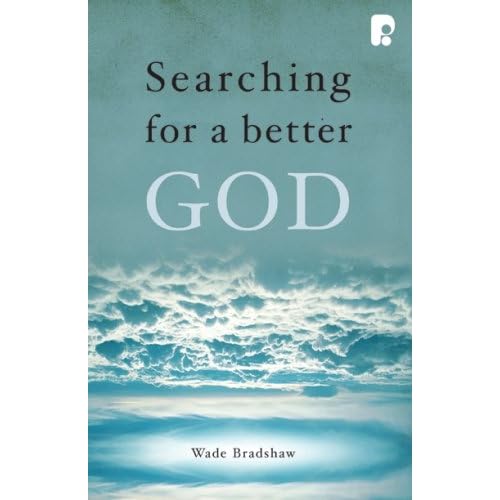
So I'm currently taking a Sunday school class at Trinity Presbyterian called "Searching for a Better God," which is taken from the title of a new book that one of our very own pastors, Wade Bradshaw, has written.

The basic idea of the book is that there are really two critical questions when it comes to God, one of which is sometimes assumed to be the only real question--namely, does He exist?

The other question has also been asked throughout history, but it has a huge impact on today's culture: is God good? This is the question Wade means to focus on.

I have a friend who was raised conservative Baptist, went to college, and became an atheist. Of course there were numerous reasons, but the first one (both logically and chronologically) was that he found he could no longer justify the malevolent behavior of God in the Bible.

Indeed, every thinking Christian has probably wondered about these things at some point. That's why I thought I'd check out this class.

I like the book so far, and I've made it almost all the way through. Wade has a sensitivity very akin to Francis Schaeffer (no surprise there--he spent 12 years at L'Abri in England).

My one complaint (and this would not be a complaint for some) is that his answers are too classic evangelical. I've heard them before, and they're not always so satisfying as they sound.

For instance, in addressing the question "Is God Angry?" he goes through another version, albeit a much more sensitive version, of the standard argument: yes, God is angry, but not in the way in which sinful people are angry (He does not let His emotions get the best of Him, He does not take out His wrath on people arbitrarily, etc.); and He is angry because something is wrong with the world, because He created it good and people went bad. His anger is impartial, directed entirely at what is evil. And we wouldn't want a God who just didn't care about evil.

Wade makes these points much more sensitively and eloquently than I have just summarized, and I think he does a good job. I just don't know if these answers are enough.

What is this judgment stuff all about? In searching for an answer, I've begun to contemplate a different conception of God than I'm used to. I think part of the reason judgment sounds so unbelievably horrible to us is because of the model we have of God.

Christianity has come to dominate Western culture, and people have used it to justify use and abuse of power for centuries. How might that affect our image of God? The prevailing metaphor for God in our culture is the omnipotent King, who could do anything if He wanted.

So then, why doesn't He? In particular, why doesn't He just teach us all to be good, and we can skip all that stuff about judgment? (And why does He allow suffering? These questions are all interconnected.)

But where did this judgment talk in the Bible come from? Somehow we are apt to forget that the ancient Israelites were never a very important people by the world's standards. In fact, my guess is that the lack of archeological evidence for the Exodus is probably not so much a sign that the Bible is false, as it is a testament to how relatively insignificant the people of Israel really were.

I'm definitely not badmouthing the Jews or anything. What I'm saying is that the prevailing metaphor must have been totally different: they were always the underdog. If God the omnipotent King is fighting on the side of the oppressed, then there might be justice in the world, after all.

When Jesus spoke of judgment, was he not speaking as an underdog? Indeed, an underdog beneath an underdog--a rebel against the Jewish establishment, who were themselves a small minority within the Roman Empire. How might this change your view of his words?

It does seem to me that judgment in the Bible is all about rescuing the underling from the oppressors. It struck me today that we as human beings are more powerful than we think, and if only we realize how much power we have to oppress, we would be more open to the concept that we are guilty before God.

Here's where I might just have to depart from the classical theology I've been taught all my life. I think that in a very real way, God is not in charge of the world. Scripture says He created humans to take care of the land, and it does seem He refuses to take that back from us. God has placed us in charge, and that's how it has been ever since.

Why is there suffering? Because God isn't in charge. Why do people sin? Because God isn't in charge. We are in charge, and we have made a mess of things. We are the oppressors of God's creation.

So what's all this talk about judgment? Doesn't that sound like tyranny? The Bible means for it to sound like a Cinderella story. A come-from-behind victory. God, the courageous rebel against the oppressors of His people, is going to liberate us from Egypt, and take us to the promised land. It's the story that inspired the civil rights movement--it's the story we all secretly (or not so secretly) want to be part of. And the Bible says, yeah, that's what life is all about.

God has to be in charge of the universe in some ultimate way, if He's God. But I think knowing God is often about choosing the best model for understanding Him. His omnipotence is certainly not so cut-and-dry as saying, "He can do anything." That kind of shallow reasoning leaves you open to the childish retort, "Can He make a rock so heavy He can't lift it?"

So what I'm saying is that the best model for understanding God's judgment is not the old model, where God looks down on His unholy creations from a distance and says, "Ew! How pathetic." Rather, the best model is one in which God comes to His people to dwell among them, so that He can free them from bondage. Judgment means overthrowing the oppressor.

Just some thoughts, I guess. Like my blog title says, whenever I have a thought, I just write it down for the whole world to see.

I just thought you'd like to know what I'm reading.